Hssayeni Murtadha D, Jimenez-Shahed Joohi, Ghoraani Behnaz
Department of Computer and Electrical Engineering and Computer Science, Florida Atlantic University, Boca Raton, FL 33431, USA.
Department of Neurology, Baylor College of Medicine, Houston, TX 77030, USA.
Entropy (Basel). 2019 Feb 1;21(2):137. doi: 10.3390/e21020137.
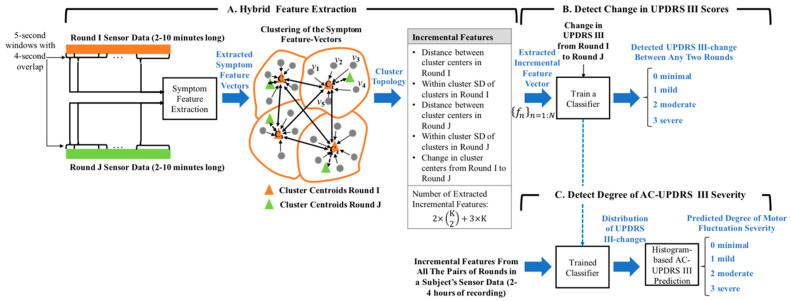
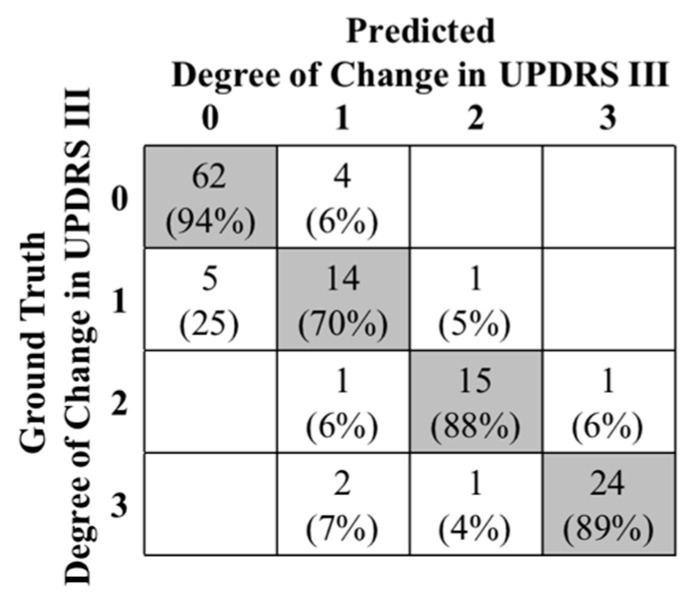
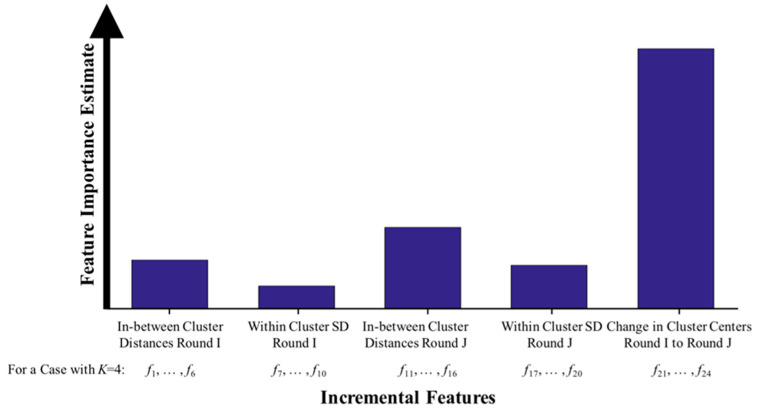
The success of medication adjustment in Parkinson's disease (PD) patients with motor fluctuation relies on the knowledge about their fluctuation severity. However, because of the temporal and spatial variability in motor fluctuations, a single clinical examination often fails to capture the spectrum of motor impairment experienced in routine daily life. In this study, we developed an algorithm to estimate the degree of motor fluctuation severity from two wearable sensors' data during subjects' free body movements. Specifically, we developed a new hybrid feature extraction method to represent the longitudinal changes of motor function from the sensor data. Next, we developed a classification model based on random forest to learn the changes in the patterns of the sensor data as the severity of the motor function changes. We evaluated our algorithm using data from 24 subjects with idiopathic PD as they performed a variety of daily routine activities. A leave-one-subject-out assessment of the algorithm resulted in 83.33% accuracy, indicating that our approach holds a great promise to passively detect degree of motor fluctuation severity from continuous monitoring of an individual's free body movements. Such a sensor-based assessment system and algorithm combination could provide the objective and comprehensive information about the fluctuation severity that can be used by the treating physician to effectively adjust therapy for PD patients with troublesome motor fluctuation.
对于存在运动波动的帕金森病(PD)患者,药物调整的成功依赖于对其波动严重程度的了解。然而,由于运动波动在时间和空间上的变异性,单次临床检查往往无法全面反映患者在日常生活中所经历的运动功能损害情况。在本研究中,我们开发了一种算法,可根据两个可穿戴传感器在受试者自由身体运动期间收集的数据来估计运动波动的严重程度。具体而言,我们开发了一种新的混合特征提取方法,以从传感器数据中表征运动功能的纵向变化。接下来,我们基于随机森林开发了一种分类模型,用于学习随着运动功能严重程度变化,传感器数据模式的改变。我们使用24名特发性PD患者在进行各种日常活动时的数据对我们的算法进行了评估。该算法采用留一法评估,准确率达83.33%,这表明我们的方法有望通过持续监测个体自由身体运动来被动检测运动波动的严重程度。这样一种基于传感器的评估系统与算法相结合的方式,能够提供关于波动严重程度的客观且全面的信息,供治疗医生有效调整对存在棘手运动波动的PD患者的治疗方案。