IEEE Trans Biomed Eng. 2018 Jan;65(1):159-164. doi: 10.1109/TBME.2017.2697764. Epub 2017 Apr 25.
Fluctuations in response to levodopa in Parkinson's disease (PD) are difficult to treat as tools to monitor temporal patterns of symptoms are hampered by several challenges. The objective was to use wearable sensors to quantify the dose response of tremor, bradykinesia, and dyskinesia in individuals with PD.
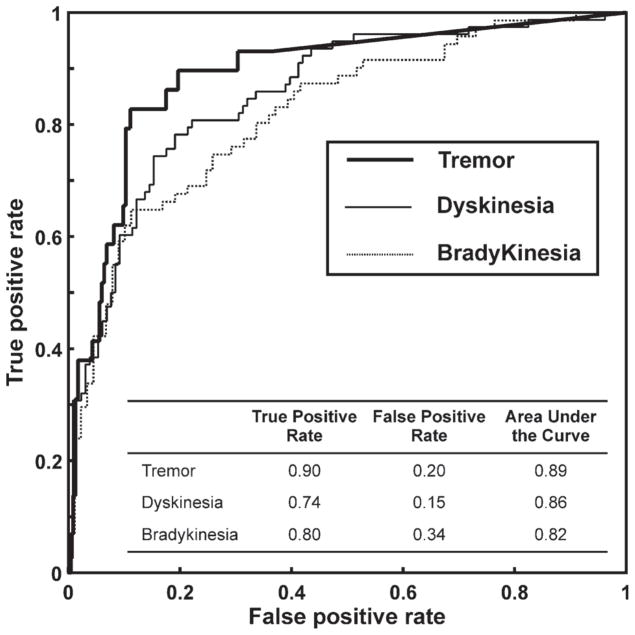
Thirteen individuals with PD and fluctuating motor benefit were instrumented with wrist and ankle motion sensors and recorded by video. Kinematic data were recorded as subjects completed a series of activities in a simulated home environment through transition from off to on medication. Subjects were evaluated using the unified Parkinson disease rating scale motor exam (UPDRS-III) at the start and end of data collection. Algorithms were applied to the kinematic data to score tremor, bradykinesia, and dyskinesia. A blinded clinician rated severity observed on video. Accuracy of algorithms was evaluated by comparing scores with clinician ratings using a receiver operating characteristic (ROC) analysis.
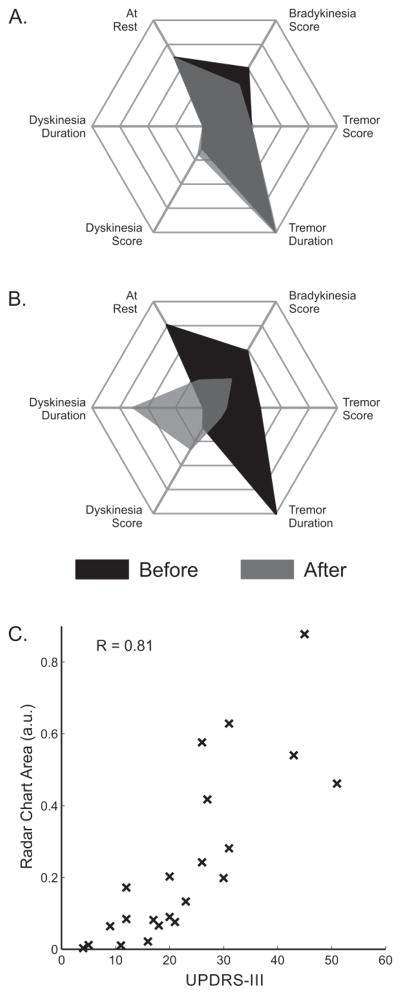
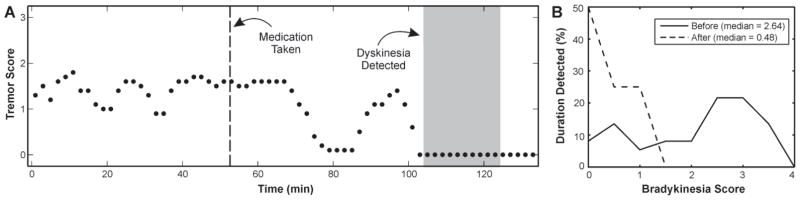
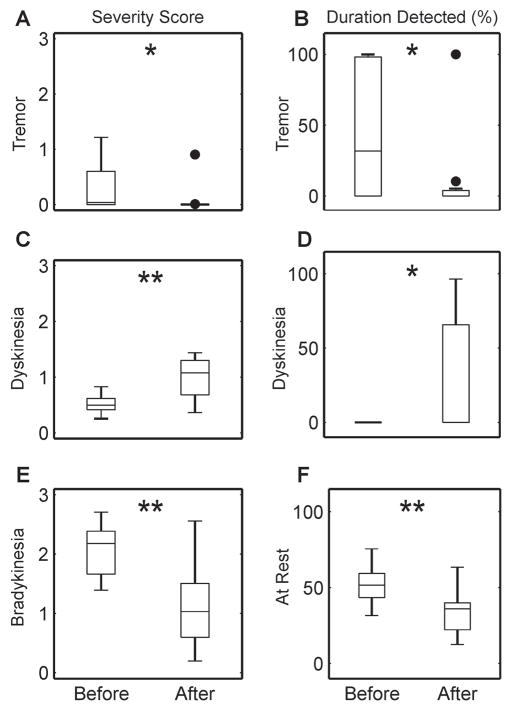
Algorithm scores for tremor, bradykinesia, and dyskinesia agreed with clinician ratings of video recordings (ROC area > 0.8). Summary metrics extracted from time intervals before and after taking medication provided quantitative measures of therapeutic response (p < 0.01). Radar charts provided intuitive visualization, with graphical features correlated with UPDRS-III scores (R = 0.81).
A system with wrist and ankle motion sensors can provide accurate measures of tremor, bradykinesia, and dyskinesia as patients complete routine activities.
This technology could provide insight on motor fluctuations in the context of daily life to guide clinical management and aid in development of new therapies.
帕金森病(PD)患者对左旋多巴的反应波动难以治疗,因为监测症状时间模式的工具受到多种挑战的阻碍。本研究旨在使用可穿戴传感器来量化个体 PD 震颤、运动迟缓及运动障碍的剂量反应。
13 名伴有运动波动获益的 PD 患者佩戴腕部和踝部运动传感器,并通过视频进行记录。在模拟家庭环境中,通过从关药状态向服药状态过渡,让受试者完成一系列活动,同时记录运动学数据。在数据采集开始和结束时,受试者使用统一帕金森病评定量表运动部分(UPDRS-III)进行评估。应用算法对运动学数据进行评分,以评估震颤、运动迟缓及运动障碍。一位盲法临床医生对视频记录中的严重程度进行评分。通过受试者工作特征(ROC)分析,将算法评分与临床医生的评分进行比较,以评估算法的准确性。
震颤、运动迟缓及运动障碍的算法评分与视频记录的临床医生评分一致(ROC 曲线下面积>0.8)。服药前后时间间隔提取的综合指标提供了治疗反应的定量测量(p<0.01)。雷达图提供了直观的可视化效果,图形特征与 UPDRS-III 评分相关(R=0.81)。
腕部和踝部运动传感器系统可以在患者完成日常活动时提供准确的震颤、运动迟缓及运动障碍评估。
该技术可在日常生活背景下提供对运动波动的深入了解,以指导临床管理并有助于新疗法的开发。