College of Nursing, Ewha Womans University, Seoul, Republic of Korea.
Department of Public Health, Graduate School, Yonsei University, Seoul, Republic of Korea.
Nutr J. 2020 Dec 2;19(1):131. doi: 10.1186/s12937-020-00650-9.
This study investigated whether commensality (eating a meal with others) is associated with mental health (depression, suicidal ideation) in Korean adults over 19 years old.
Our study employed data from the sixth and seventh Korea National Health and Nutritional Examination Surveys (KNHANES) for 2013, 2015, and 2017. The study population consisted of 14,125 Korean adults (5854 men and 8271 women). In this cross-sectional study, data were analyzed with the Rao-Scott chi-square test and multiple logistic regression to evaluate the association between commensality(0[includes skipping meals] to 3 times eating meals together) and both depression and suicidal ideation using select questions from the Mental Health Survey. By setting socioeconomic factors, health conditions, and behavioral factors as confounders, we conducted a subgroup analysis to reveal the effect on depression and suicidal ideation commensality.
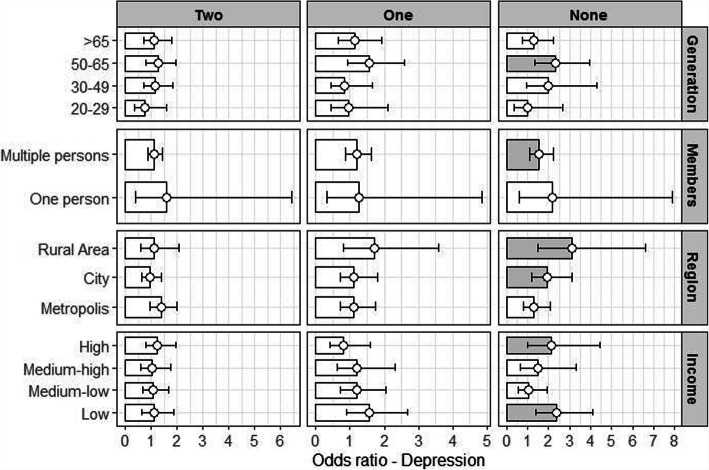
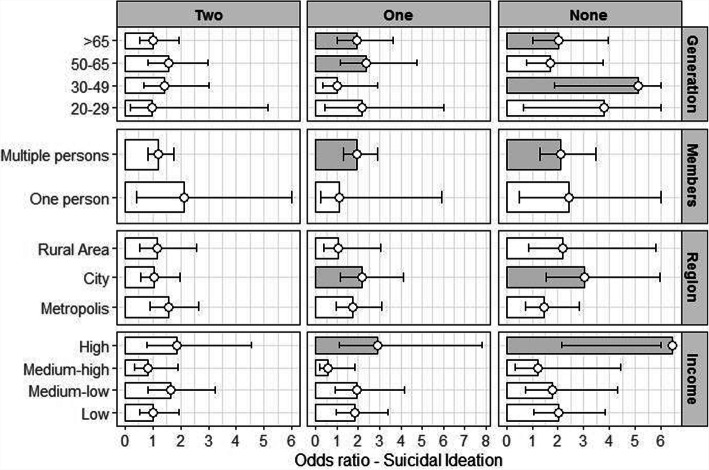
Commensality was significantly associated with depression and suicidal ideation (p < 0.05). In both sexes, people who ate fewer meals together had poorer mental health. In a subgroup analysis, we revealed greater odds of developing depression in men when living in rural areas and belonging to low-income groups. In contrast, greater odds of suicidal ideation in men who ate alone when living in the city and belonging to high-income groups. On the other hand, Women in every region had greater odds of being depressed if they ate alone. And greater odds of suicidal ideation in women who ate alone when living in the city and belonging to medium-high income groups.
Our analysis confirmed that Korean adults with lower chance of commensality had greater risk of developing depression and suicidal ideation. And it could be affected by individuals' various backgrounds including socioeconomic status. As a result, to help people with depression and prevent a suicidal attempt, this study will be baseline research for social workers, educators and also policy developers to be aware of the importance of eating together.
本研究旨在探讨韩国成年人(19 岁以上)共同进餐(合餐)是否与心理健康(抑郁、自杀意念)相关。
本研究使用了 2013 年、2015 年和 2017 年第六次和第七次韩国国家健康和营养检查调查(KNHANES)的数据。研究人群包括 14125 名韩国成年人(5854 名男性和 8271 名女性)。在这项横断面研究中,采用 Rao-Scott 卡方检验和多因素逻辑回归分析,利用心理健康调查中的特定问题评估共同进餐(0[包括不吃饭]至 3 次一起吃饭)与抑郁和自杀意念之间的关联。通过设定社会经济因素、健康状况和行为因素作为混杂因素,我们进行了亚组分析,以揭示共同进餐对抑郁和自杀意念的影响。
共同进餐与抑郁和自杀意念显著相关(p<0.05)。在男性和女性中,共同进餐次数较少的人心理健康状况较差。在亚组分析中,我们发现农村地区和低收入群体的男性更容易出现抑郁,而独自进餐的男性更容易出现自杀意念。相比之下,城市地区和高收入群体的男性独自进餐时出现自杀意念的几率更高。另一方面,每个地区的女性如果独自进餐,出现抑郁的几率更高。而城市地区和中高收入群体的女性独自进餐时出现自杀意念的几率更高。
本分析证实,共同进餐机会较少的韩国成年人患抑郁和自杀意念的风险更高。这可能受到个体各种背景的影响,包括社会经济地位。因此,为了帮助有抑郁的人并预防自杀企图,本研究将为社会工作者、教育工作者和政策制定者提供基线研究,使他们认识到一起吃饭的重要性。