Milana Edoardo, Zhang Rongjing, Vetrano Maria Rosaria, Peerlinck Sam, De Volder Michael, Onck Patrick R, Reynaerts Dominiek, Gorissen Benjamin
Department of Mechanical Engineering, KU Leuven and Flanders Make, Leuven, Belgium.
Zernike Institute for Advanced Materials, University of Groningen, Groningen, Netherlands.
Sci Adv. 2020 Dec 2;6(49). doi: 10.1126/sciadv.abd2508. Print 2020 Dec.
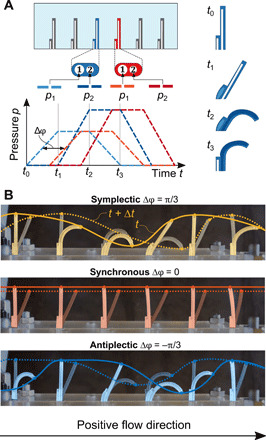
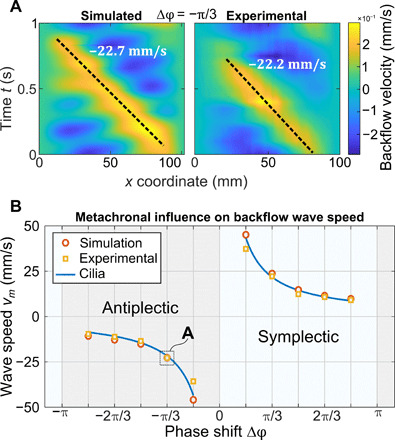
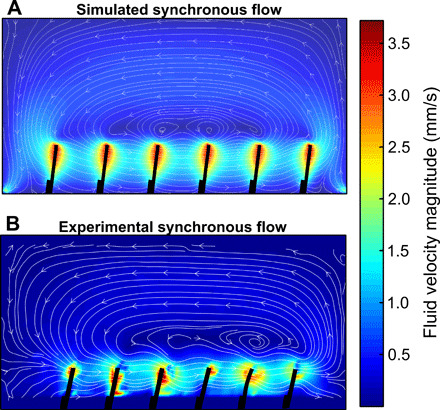
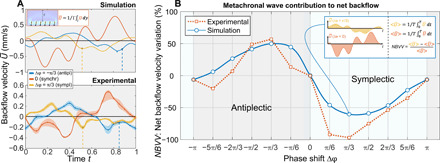
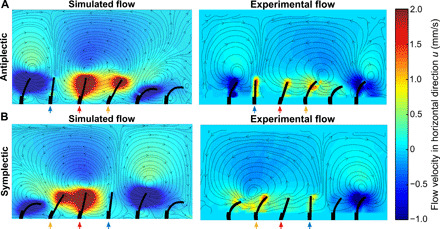
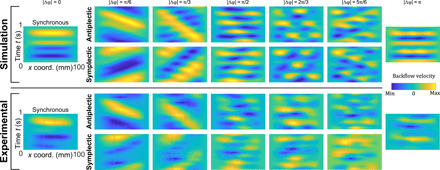
Cilia are hair-like organelles, present in arrays that collectively beat to generate flow. Given their small size and consequent low Reynolds numbers, asymmetric motions are necessary to create a net flow. Here, we developed an array of six soft robotic cilia, which are individually addressable, to both mimic nature's symmetry-breaking mechanisms and control asymmetries to study their influence on fluid propulsion. Our experimental tests are corroborated with fluid dynamics simulations, where we find a good agreement between both and show how the kymographs of the flow are related to the phase shift of the metachronal waves. Compared to synchronous beating, we report a 50% increase of net flow speed when cilia move in an antiplectic wave with phase shift of -π/3 and a decrease for symplectic waves. Furthermore, we observe the formation of traveling vortices in the direction of the wave when metachrony is applied.
纤毛是毛发状细胞器,呈阵列状排列,共同摆动以产生流体流动。鉴于其尺寸小以及由此导致的低雷诺数,非对称运动对于产生净流是必要的。在这里,我们开发了一组六个可单独寻址的软机器人纤毛,以模仿自然界的对称破缺机制并控制不对称性,从而研究它们对流体推进的影响。我们的实验测试得到了流体动力学模拟的证实,我们发现两者之间有很好的一致性,并展示了流动的波形图与异时波的相移之间的关系。与同步摆动相比,我们报告当纤毛以-π/3的相移以反拍波形式移动时,净流速度增加50%,而对于拍波则降低。此外,当应用异时性时,我们观察到在波的方向上形成了行进涡旋。