Department of Biology, Massachusetts Institute of Technology, Cambridge, MA, USA.
Boston Children's Hospital and Harvard Medical School, Boston, MA, USA.
Nat Commun. 2020 Dec 2;11(1):6179. doi: 10.1038/s41467-020-19884-6.
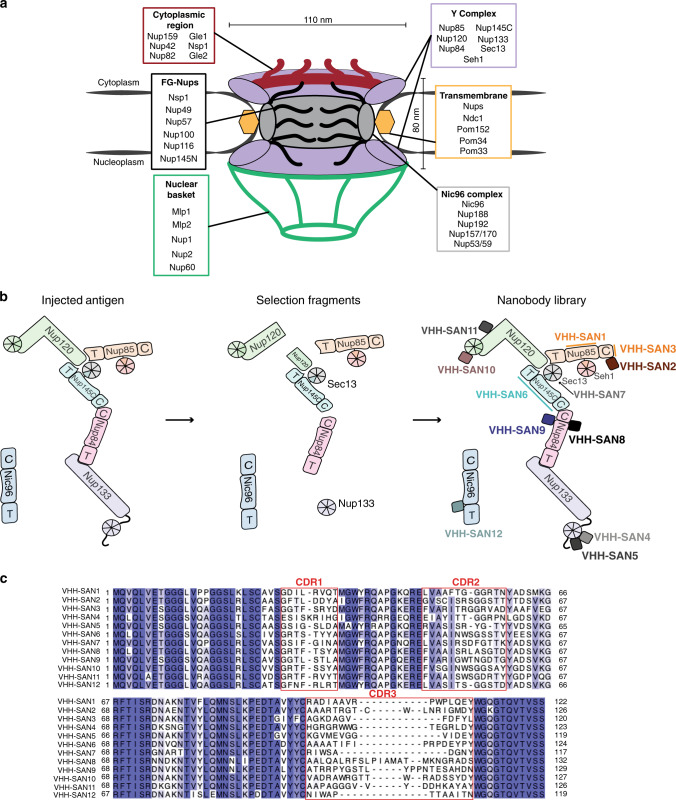
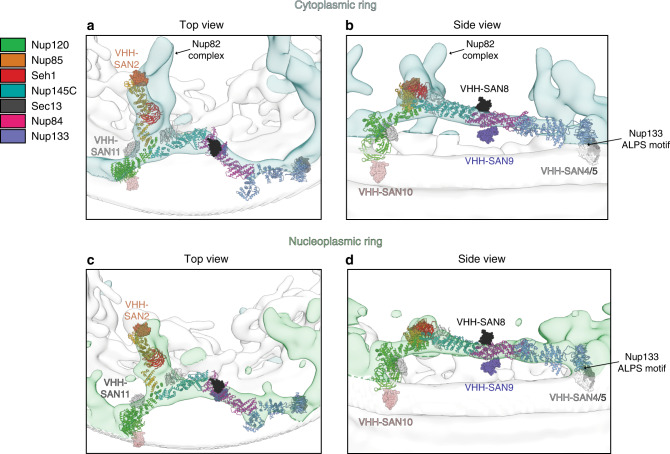
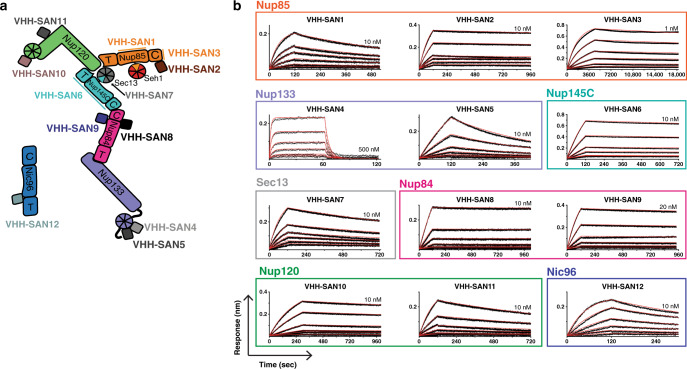
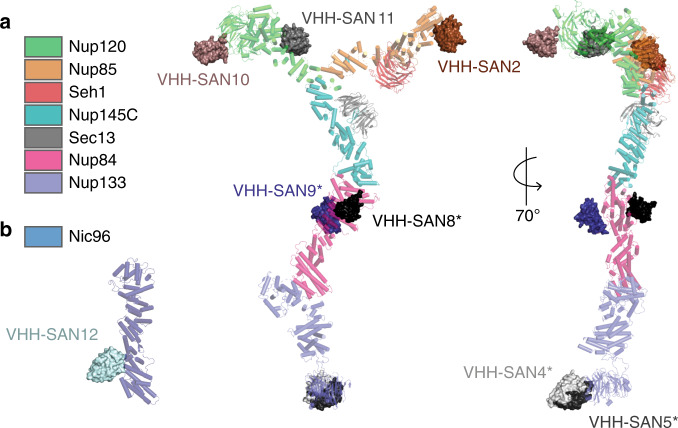
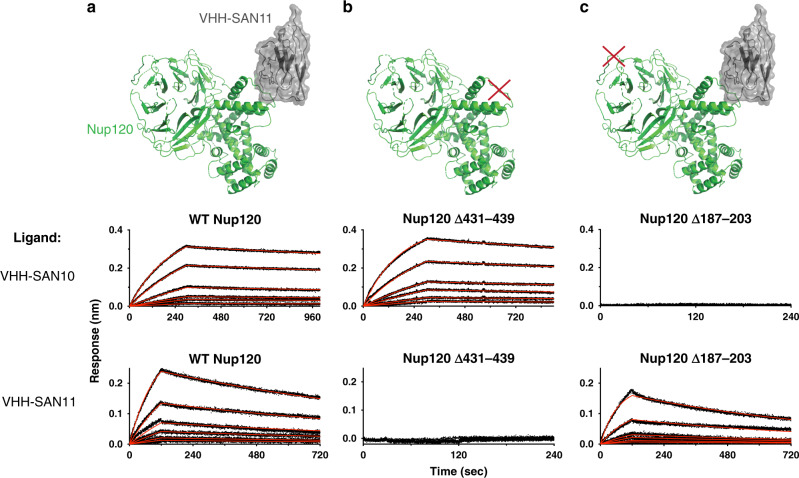
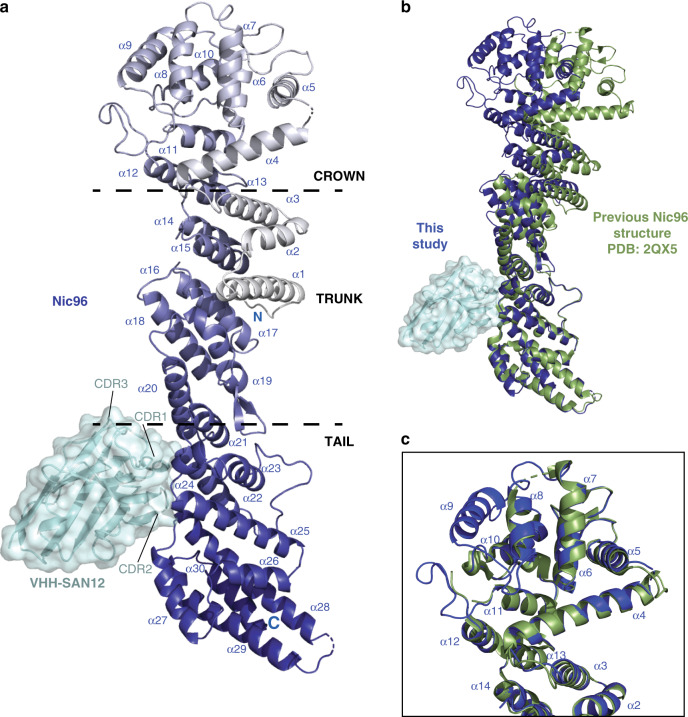
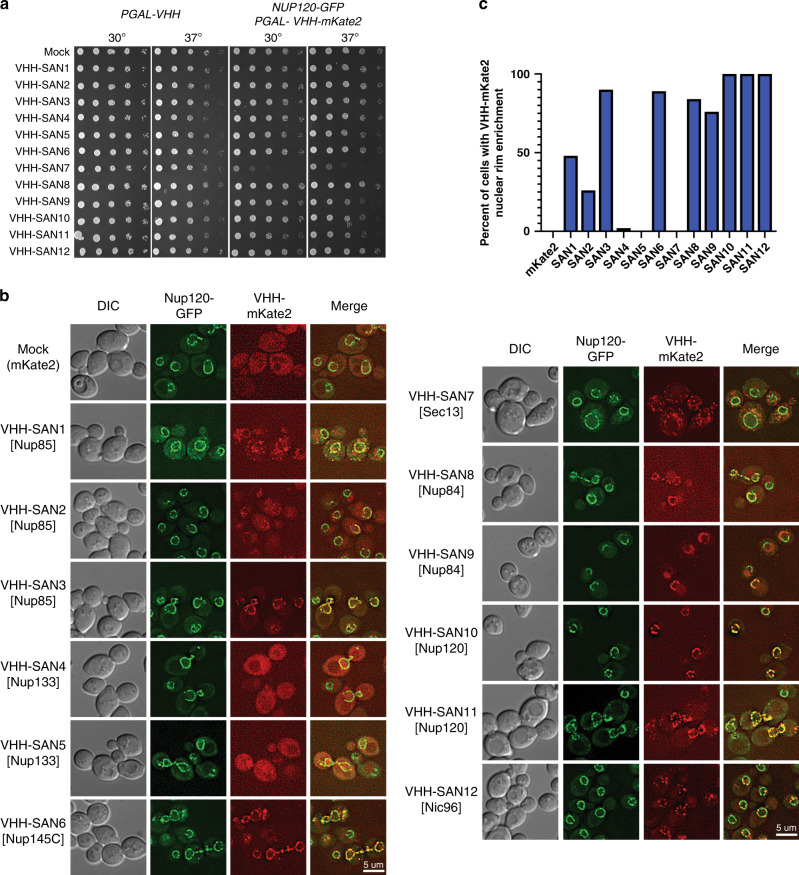
Nuclear pore complexes (NPCs) are the main conduits for molecular exchange across the nuclear envelope. The NPC is a modular assembly of ~500 individual proteins, called nucleoporins or nups. Most scaffolding nups are organized in two multimeric subcomplexes, the Nup84 or Y complex and the Nic96 or inner ring complex. Working in S. cerevisiae, and to study the assembly of these two essential subcomplexes, we here develop a set of twelve nanobodies that recognize seven constituent nucleoporins of the Y and Nic96 complexes. These nanobodies all bind specifically and with high affinity. We present structures of several nup-nanobody complexes, revealing their binding sites. Additionally, constitutive expression of the nanobody suite in S. cerevisiae detect accessible and obstructed surfaces of the Y complex and Nic96 within the NPC. Overall, this suite of nanobodies provides a unique and versatile toolkit for the study of the NPC.
核孔复合体(NPC)是核膜分子交换的主要通道。NPC 是由约 500 个单独的蛋白质组成的模块化组装体,称为核孔蛋白或 nups。大多数支架 nups 组织在两个多聚体亚复合物中,即 Nup84 或 Y 复合物和 Nic96 或内环复合物中。在 S. cerevisiae 中工作,并研究这两个必需亚复合物的组装,我们在此开发了一组 12 种纳米体,可识别 Y 和 Nic96 复合物的七个组成核孔蛋白。这些纳米体均特异性结合,亲和力高。我们展示了几个 nup-纳米体复合物的结构,揭示了它们的结合位点。此外,在 S. cerevisiae 中组成型表达纳米体套件可检测 NPC 中 Y 复合物和 Nic96 的可及和受阻表面。总的来说,这套纳米体为 NPC 的研究提供了独特而通用的工具包。