Hanke Leo, Sheward Daniel J, Pankow Alec, Vidakovics Laura Perez, Karl Vivien, Kim Changil, Urgard Egon, Smith Natalie L, Astorga-Wells Juan, Ekström Simon, Coquet Jonathan M, McInerney Gerald M, Murrell Ben
Department of Microbiology, Tumor and Cell Biology, Karolinska Institutet, Stockholm, Sweden.
Division of Medical Virology, Institute of Infectious Diseases and Molecular Medicine, University of Cape Town, Cape Town, South Africa.
Sci Adv. 2022 Mar 25;8(12):eabm0220. doi: 10.1126/sciadv.abm0220.
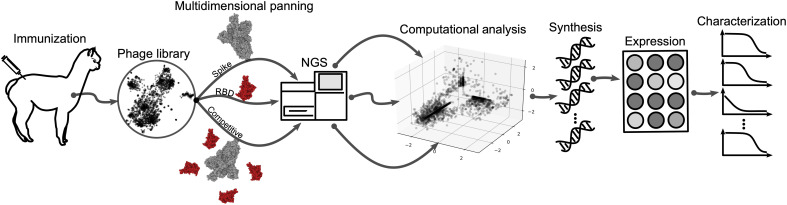
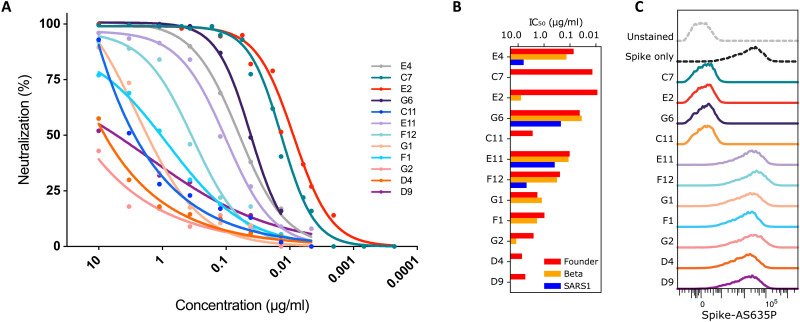
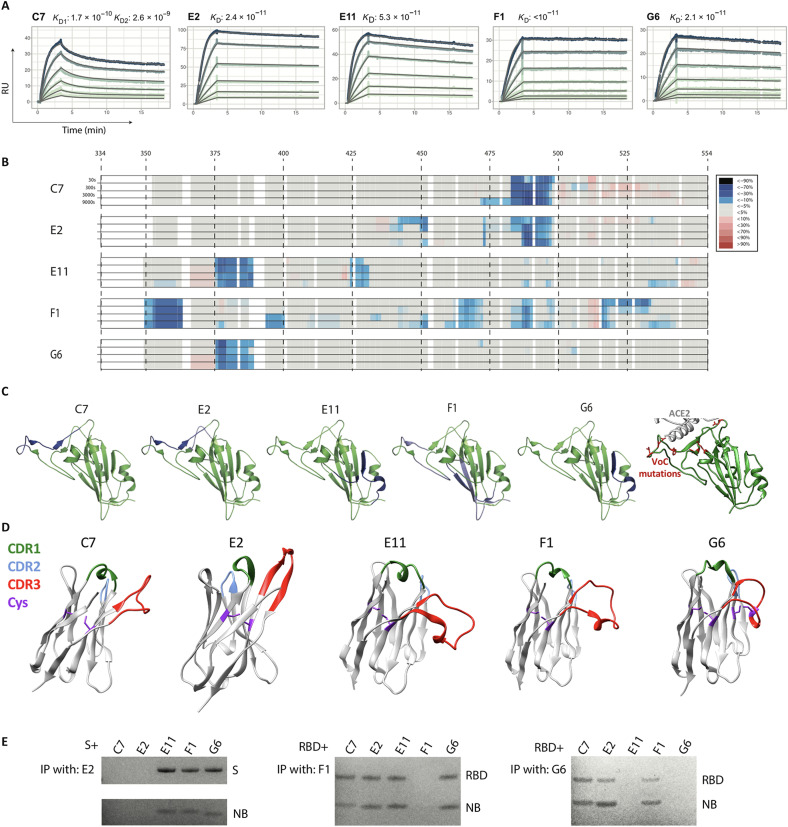
Conventional approaches to isolate and characterize nanobodies are laborious. We combine phage display, multivariate enrichment, next-generation sequencing, and a streamlined screening strategy to identify numerous anti-severe acute respiratory syndrome coronavirus 2 (SARS-CoV-2) nanobodies. We characterize their potency and specificity using neutralization assays and hydrogen/deuterium exchange mass spectrometry (HDX-MS). The most potent nanobodies bind to the receptor binding motif of the receptor binding domain (RBD), and we identify two exceptionally potent members of this category (with monomeric half-maximal inhibitory concentrations around 13 and 16 ng/ml). Other nanobodies bind to a more conserved epitope on the side of the RBD and are able to potently neutralize the SARS-CoV-2 founder virus (42 ng/ml), the Beta variant (B.1.351/501Y.V2) (35 ng/ml), and also cross-neutralize the more distantly related SARS-CoV-1 (0.46 μg/ml). The approach presented here is well suited for the screening of phage libraries to identify functional nanobodies for various biomedical and biochemical applications.
传统的分离和鉴定纳米抗体的方法很繁琐。我们结合噬菌体展示、多变量富集、下一代测序和简化的筛选策略,以鉴定出众多抗严重急性呼吸综合征冠状病毒2(SARS-CoV-2)纳米抗体。我们使用中和试验和氢/氘交换质谱(HDX-MS)来表征它们的效力和特异性。最有效的纳米抗体与受体结合域(RBD)的受体结合基序结合,我们鉴定出该类别中两个特别有效的成员(单体半数最大抑制浓度约为13和16 ng/ml)。其他纳米抗体与RBD侧面一个更保守的表位结合,并且能够有效中和SARS-CoV-2原始病毒(42 ng/ml)、β变体(B.1.351/501Y.V2)(35 ng/ml),还能交叉中和亲缘关系更远的SARS-CoV-1(0.46 μg/ml)。本文介绍的方法非常适合筛选噬菌体文库,以鉴定用于各种生物医学和生化应用的功能性纳米抗体。