Podewils Laura Jean, Burket Tori L, Mettenbrink Christie, Steiner Abigail, Seidel Allison, Scott Kenneth, Cervantes Lilia, Hasnain-Wynia Romana
MMWR Morb Mortal Wkly Rep. 2020 Dec 4;69(48):1812-1816. doi: 10.15585/mmwr.mm6948a3.
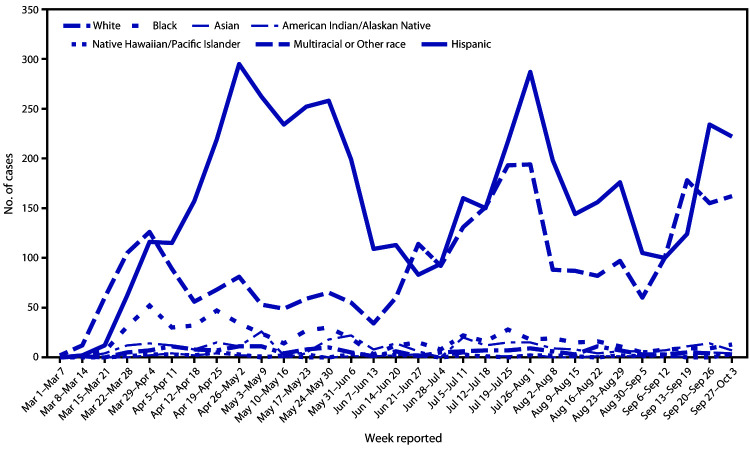
Persons identifying as Hispanic or Latino (Hispanic) represent the second largest racial/ethnic group in the United States (1), yet understanding of the impact of coronavirus disease 2019 (COVID-19) in this population is limited. To evaluate COVID-19 health disparities in the community and inform public health, health system, and community-based interventions, local public health authorities analyzed the sociodemographic characteristics of persons who were diagnosed, hospitalized, and who died with COVID-19 in Denver, Colorado. During the first 7 months of the COVID-19 epidemic in Denver (March 6-October 6, 2020) the majority of adult COVID-19 cases (54.8%), hospitalizations (62.1%), and deaths (51.2%) were among persons identifying as Hispanic, more than double the proportion of Hispanic adults in the Denver community (24.9%) (1). Systemic drivers that influence how Hispanic persons live and work increase their exposure risks: compared with non-Hispanic persons, Hispanic persons with COVID-19 in Denver reported larger household sizes and were more likely to report known exposures to household and close contacts with COVID-19, working in an essential industry, and working while ill. Reducing the disproportionate incidence of COVID-19 morbidity and mortality among Hispanic persons will require implementation of strategies that address upstream social and environmental factors that contribute to an increased risk for both infection and transmission and that facilitate improved access to culturally congruent care.
自认为是西班牙裔或拉丁裔(西班牙裔)的人群是美国第二大种族/族裔群体(1),然而,对于2019冠状病毒病(COVID-19)对该人群影响的了解却很有限。为了评估社区中COVID-19的健康差异,并为公共卫生、卫生系统和基于社区的干预措施提供信息,当地公共卫生当局分析了科罗拉多州丹佛市被诊断、住院和死于COVID-19的患者的社会人口学特征。在丹佛市COVID-19疫情的前7个月(2020年3月6日至10月6日),大多数成年COVID-19病例(54.8%)、住院病例(62.1%)和死亡病例(51.2%)发生在自认为是西班牙裔的人群中,这一比例是丹佛社区西班牙裔成年人比例(24.9%)的两倍多(1)。影响西班牙裔人群生活和工作方式的系统性因素增加了他们的暴露风险:与非西班牙裔人群相比,丹佛市感染COVID-19的西班牙裔人群报告的家庭规模更大,更有可能报告已知接触过感染COVID-19的家庭成员和密切接触者、在关键行业工作以及患病时仍在工作。要降低西班牙裔人群中COVID-19发病率和死亡率的不成比例情况,需要实施一些策略,解决那些导致感染和传播风险增加的上游社会和环境因素,并促进获得符合文化背景的医疗服务。