Department of Microbiology, Tumor and Cell Biology, Karolinska Institutet, 171 77, Stockholm, Sweden.
Eurocine Vaccines AB, Karolinska Institutet Science Park, 171 65, Solna, Sweden.
Sci Rep. 2020 Dec 3;10(1):21076. doi: 10.1038/s41598-020-78009-7.
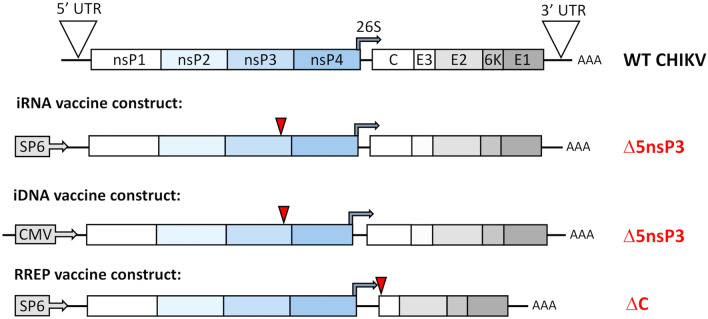
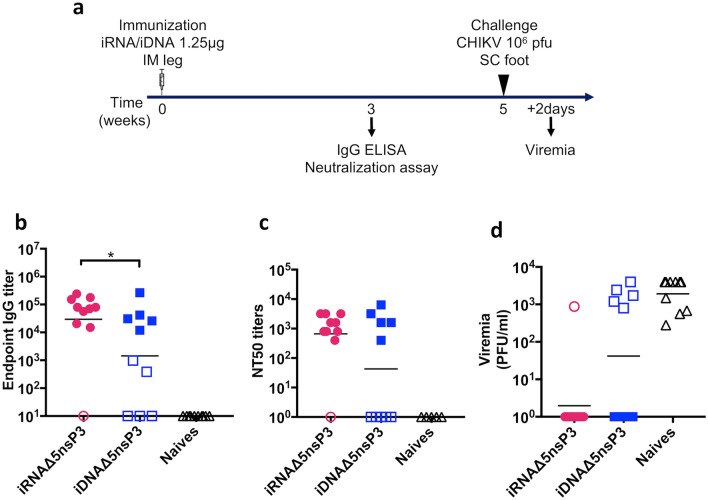
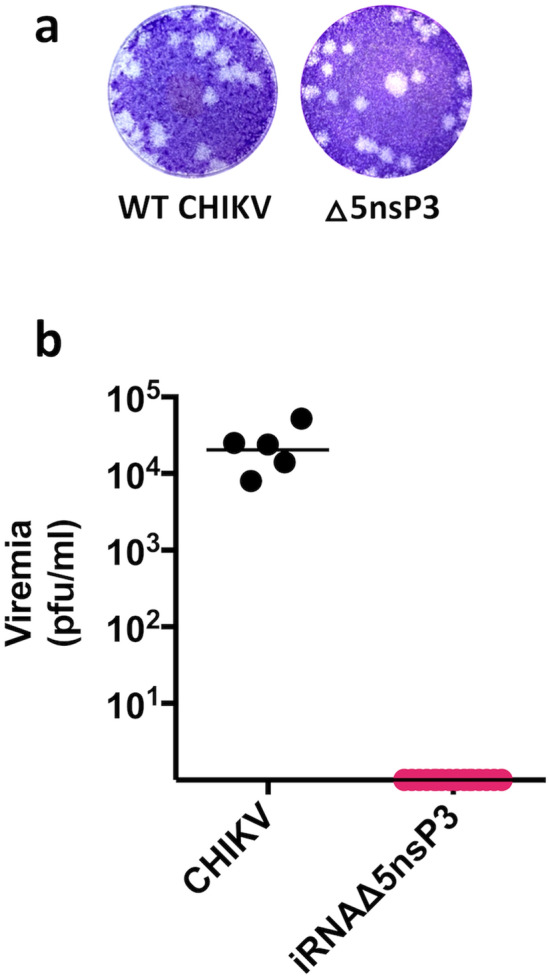
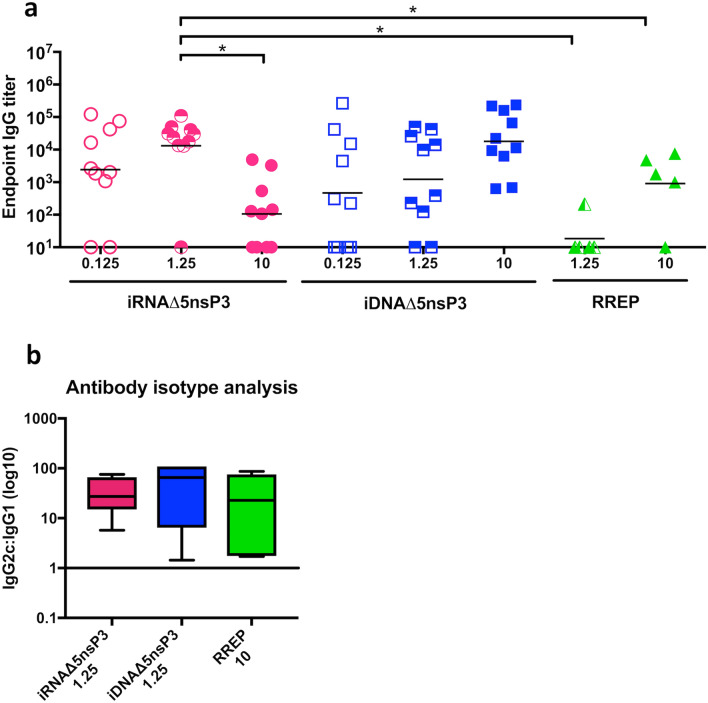
We describe a novel vaccine platform that can generate protective immunity to chikungunya virus (CHIKV) in C57BL/6J mice after a single immunization by employing an infectious RNA (iRNA), which upon introduction into a host cell launches an infectious attenuated virus. We and others have previously reported that an engineered deletion of 183 nucleotides in the nsP3 gene attenuates chikungunya virus (CHIKV) and reduces in vivo viral replication and viremia after challenge in mice, macaques and man. Here, we demonstrated that in vitro transfection of iRNA carrying the nsP3 deletion generated infectious viruses, and after intramuscular injection, the iRNA induced robust antibody responses in mice. The iRNA was superior at eliciting binding and neutralizing antibody responses as compared to a DNA vaccine encoding the same RNA (iDNA) or a non-propagating RNA replicon (RREP) lacking the capsid encoding gene. Subsequent challenge with a high dose of CHIKV demonstrated that the antibody responses induced by this vaccine candidate protected animals from viremia. The iRNA approach constitutes a novel vaccine platform with the potential to impact the spread of CHIKV. Moreover, we believe that this approach is likely applicable also to other positive-strand viruses.
我们描述了一种新型疫苗平台,该平台可通过单次免疫使用传染性 RNA(iRNA)在 C57BL/6J 小鼠中产生对基孔肯雅病毒(CHIKV)的保护性免疫。引入宿主细胞后,该 iRNA 会启动传染性减毒病毒。我们和其他人之前曾报道过,nsP3 基因中的 183 个核苷酸缺失可减弱基孔肯雅病毒(CHIKV),并降低小鼠、猕猴和人类感染后的体内病毒复制和病毒血症。在这里,我们证明了携带 nsP3 缺失的 iRNA 的体外转染可产生传染性病毒,并且肌肉内注射后,iRNA 可在小鼠中诱导强烈的抗体反应。与编码相同 RNA 的 DNA 疫苗(iDNA)或缺乏衣壳编码基因的非增殖性 RNA 复制子(RREP)相比,iRNA 更能引起结合和中和抗体反应。随后用高剂量的 CHIKV 进行攻毒表明,该候选疫苗诱导的抗体反应可保护动物免受病毒血症的侵害。iRNA 方法构成了一种新型疫苗平台,具有影响 CHIKV 传播的潜力。此外,我们相信这种方法也可能适用于其他正链病毒。