Abdel Raouf Haiam, Kholoussi Naglaa Mohamed, Eissa Eman, El Nady Hala Gouda, Fayed Dalia Bayoumi, Abdelkawy Rania Fawzy Mahmoud
Immunogenetics Department, Human Genetics and Genome Research Division, National Research Centre, Egypt.
Child Health Department, Medical Research Division, National Research Centre, Egypt.
Int J Mol Cell Med. 2020 Summer;9(3):188-197. doi: 10.22088/IJMCM.BUMS.9.3.188. Epub 2020 Nov 10.
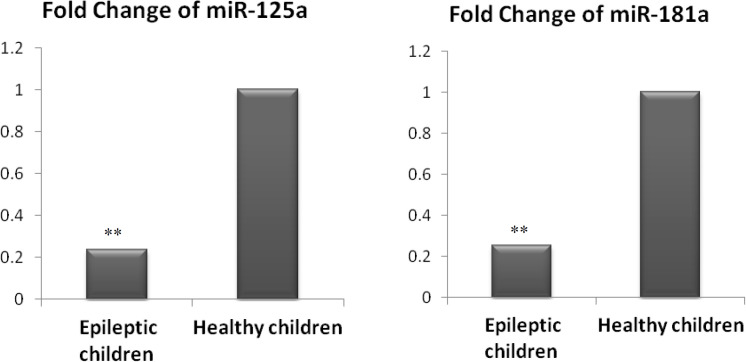
Epilepsy is a chronic clinical syndrome of brain function which is caused by abnormal discharge of neurons. MicroRNAs (miRNAs) are small non-coding RNAs which act post-transcriptionally to regulate negatively protein levels. They affect neuroinflammatory signaling, glial and neuronal structure and function, neurogenesis, cell death, and other processes linked to epileptogenesis. The aim of this study was to explore the possible role of miR-125a and miR-181a as regulators of inflammation in epilepsy through investigating their involvement in the pathogenesis of epilepsy, and their correlation with the levels of inflammatory cytokines. Thirthy pediatric patients with epilepsy and 20 healthy controls matched for age and sex were involved in the study. MiR-181a and miR-125a expression were evaluated in plasma of all subjects using qRT-PCR. In addition, plasma levels of inflammatory cytokines (IFN-γ and TNF-) were determined using ELISA. Our findings indicated significantly lower expression levels of miR-125a (P=0.001) and miR-181a (P=0.001) in epileptic patients in comparison with controls. In addition, the production of IFN-γ and TNF- was non-significantly higher in patients with epilepsy in comparison with the control group. Furthermore, there were no correlations between miR-125a and miR-181a with the inflammatory cytokines (IFN-γ and TNF-) in epileptic patients. MiR-125a and miR-181a could be involved in the pathogenesis of epilepsy and could serve as diagnostic biomarkers for pediatric patients with epilepsy.
癫痫是一种由神经元异常放电引起的慢性脑功能临床综合征。微小RNA(miRNA)是一类小的非编码RNA,它们在转录后发挥作用,负向调节蛋白质水平。它们影响神经炎症信号传导、神经胶质细胞和神经元的结构与功能、神经发生、细胞死亡以及其他与癫痫发生相关的过程。本研究的目的是通过研究miR-125a和miR-181a参与癫痫发病机制及其与炎症细胞因子水平的相关性,探讨它们作为癫痫炎症调节因子的可能作用。30例癫痫患儿和20例年龄、性别匹配的健康对照者参与了本研究。使用qRT-PCR评估所有受试者血浆中miR-181a和miR-125a的表达。此外,使用ELISA测定血浆中炎症细胞因子(IFN-γ和TNF-)的水平。我们的研究结果表明,与对照组相比,癫痫患者中miR-125a(P=0.001)和miR-181a(P=0.001)的表达水平显著降低。此外,与对照组相比,癫痫患者中IFN-γ和TNF-的产生无显著升高。此外,癫痫患者中miR-125a和miR-181a与炎症细胞因子(IFN-γ和TNF-)之间无相关性。miR-125a和miR-181a可能参与癫痫的发病机制,并可作为小儿癫痫患者的诊断生物标志物。