Helse Nord TB Initiative, College of Medicine, University of Malawi, Blantyre, Malawi.
Malawi Liverpool Wellcome Trust Clinical Research Programme, Blantyre, Malawi.
Glob Public Health. 2021 Feb;16(2):227-240. doi: 10.1080/17441692.2020.1851386. Epub 2020 Dec 4.
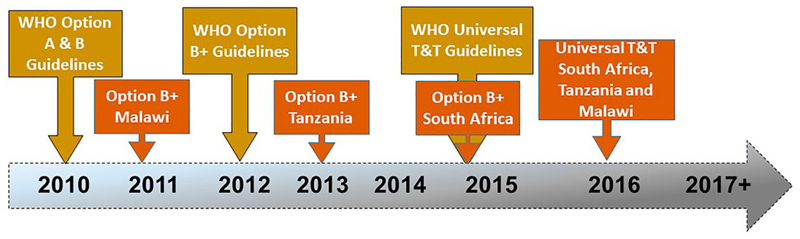
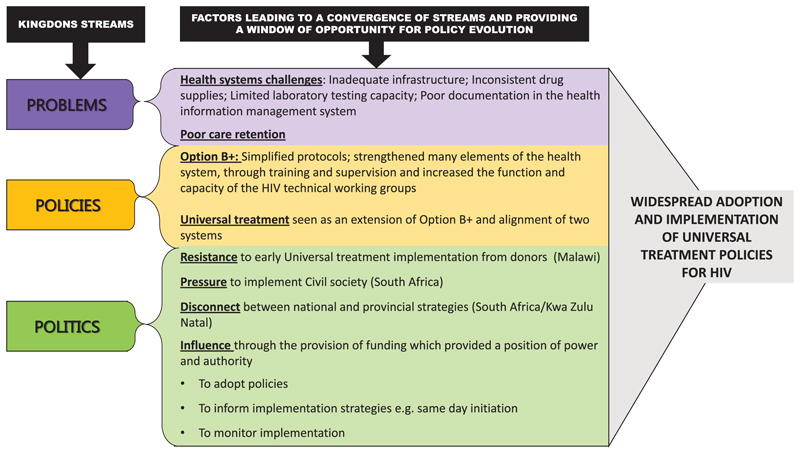
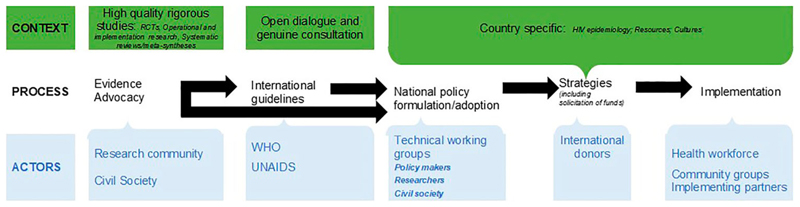
Universal antiretroviral therapy (ART) strategies have dramatically changed HIV programming across sub-Saharan Africa. We explored factors that influenced the development, adoption and implementation of universal ART policies in Tanzania, South Africa and Malawi. We conducted 26 key informant interviews and applied Kingdon's 'streams' model to explore how problems, policies and politics converged to provide a window of opportunity for universal ART roll-out. Weak health systems and sub-optimal care retention were raised as during Option B+ implementation, which preceded universal ART , and persisted after its implementation. The adoption and implementation of Option B+ facilitated the uptake of universal ART. played out through pressures from different stakeholders to accelerate or slow down implementation, from governments, civil society groups, researchers and donors. Policy processes leading to universal ART were open to pressures and influence. The extraordinary financial support which enabled the widespread and rapid implementation of universal ART skewed the power balance and sometimes left little space for locally-derived solutions to respond to specific health system abilities and epidemiological contexts. Donors may be more effective if they ensure a greater focus on strengthening the whole health system as well as accounting for local contextual factors and recent policy development histories when funding policy implementation.
普遍的抗逆转录病毒疗法(ART)策略极大地改变了撒哈拉以南非洲的艾滋病毒规划。我们探讨了影响坦桑尼亚、南非和马拉维普遍采用 ART 政策的制定、采用和实施的因素。我们进行了 26 次关键知情人访谈,并应用金登的“流”模型来探讨问题、政策和政治是如何汇聚在一起,为普遍采用 ART 提供机会窗口的。在普遍采用 ART 之前的 B+方案实施期间以及之后,卫生系统薄弱和护理保留情况不佳被提了出来。B+方案的采用和实施促进了普遍采用 ART。政治因素通过来自不同利益攸关方的压力发挥作用,这些压力旨在加速或减缓实施速度,这些利益攸关方包括政府、民间社会团体、研究人员和捐助者。导致普遍采用 ART 的政策进程容易受到压力和影响。广泛而迅速实施普遍采用 ART 的巨额财政支持改变了权力平衡,有时几乎没有空间让当地制定的解决方案来应对特定的卫生系统能力和流行病学背景。如果捐助者在为政策实施供资时更加注重加强整个卫生系统,并考虑到当地的背景因素和最近的政策发展历史,那么他们可能会更加有效。