• 文献检索
  • 文档翻译
  • 深度研究
  • 学术资讯
  • Suppr Zotero 插件Zotero 插件
  • 邀请有礼
  • 套餐&价格
  • 历史记录
应用&插件
Suppr Zotero 插件Zotero 插件浏览器插件Mac 客户端Windows 客户端微信小程序
定价
高级版会员购买积分包购买API积分包
服务
文献检索文档翻译深度研究API 文档MCP 服务
关于我们
关于 Suppr公司介绍联系我们用户协议隐私条款
关注我们

Suppr 超能文献

核心技术专利:CN118964589B侵权必究
粤ICP备2023148730 号-1Suppr @ 2026

文献检索

告别复杂PubMed语法,用中文像聊天一样搜索,搜遍4000万医学文献。AI智能推荐,让科研检索更轻松。

立即免费搜索

文件翻译

保留排版,准确专业,支持PDF/Word/PPT等文件格式,支持 12+语言互译。

免费翻译文档

深度研究

AI帮你快速写综述,25分钟生成高质量综述,智能提取关键信息,辅助科研写作。

立即免费体验

一开始就出师不利?津巴布韦的社区团体如何在应对艾滋病病毒问题时与外部机构建立合作关系。

Getting off on the wrong foot? How community groups in Zimbabwe position themselves for partnerships with external agencies in the HIV response.

作者信息

Skovdal Morten, Magutshwa-Zitha Sitholubuhle, Campbell Catherine, Nyamukapa Constance, Gregson Simon

机构信息

Department of Public Health, University of Copenhagen, Øster Farimagsgade 5, 1014, Copenhagen, Denmark.

Biomedical Research and Training Institute, Harare, Zimbabwe.

出版信息

Global Health. 2017 Jun 1;13(1):29. doi: 10.1186/s12992-017-0253-5.

DOI:10.1186/s12992-017-0253-5
PMID:28569165
原文链接:https://pmc.ncbi.nlm.nih.gov/articles/PMC5452287/
Abstract

BACKGROUND

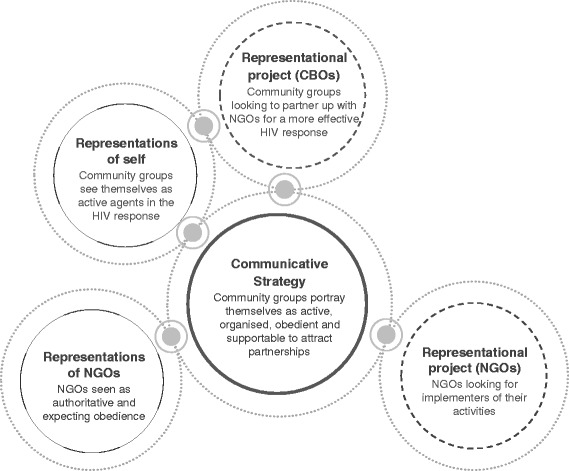
Partnerships are core to global public health responses. The HIV field embraces partnership working, with growing attention given to the benefits of involving community groups in the HIV response. However, little has been done to unpack the social psychological foundation of partnership working between well-resourced organisations and community groups, and how community representations of partnerships and power asymmetries shape the formation of partnerships for global health. We draw on a psychosocial theory of partnerships to examine community group members' understanding of self and other as they position themselves for partnerships with non-governmental organisations.

METHODS

This mixed qualitative methods study was conducted in the Matobo district of Matabeleland South province in Zimbabwe. The study draws on the perspectives of 90 community group members (29 men and 61 women) who participated in a total of 19 individual in-depth interviews and 9 focus group discussions (n = 71). The participants represented an array of different community groups and different levels of experience of working with NGOs. Verbatim transcripts were imported into Atlas.Ti for thematic indexing and analysis.

RESULTS

Group members felt they played a central role in the HIV response. Accepting there is a limit to what they can do in isolation, they actively sought to position themselves as potential partners for NGOs. Partnerships with NGOs were said to enable community groups to respond more effectively as well as boost their motivation and morale. However, group members were also acutely aware of how they should act and perform if they were to qualify for a partnership. They spoke about how they had to adopt various strategies to become attractive partners and 'supportable' - including being active and obedient.

CONCLUSIONS

Many community groups in Zimbabwe recognise their role in the HIV response and actively navigate representational systems of self and other to showcase themselves as capable actors. While this commitment is admirable, the dynamics that govern this process reflect knowledge encounters and power asymmetries that are conditioned by the aid architecture, undermining aspiring efforts for more equitable partnerships from the get-go.

摘要

背景

伙伴关系是全球公共卫生应对措施的核心。艾滋病领域采用伙伴关系工作模式,越来越重视社区团体参与艾滋病应对工作的益处。然而,对于资源充足的组织与社区团体之间伙伴关系工作的社会心理基础,以及伙伴关系的社区表征和权力不对称如何塑造全球卫生伙伴关系的形成,人们所做的工作甚少。我们借鉴伙伴关系的社会心理理论,来审视社区团体成员在与非政府组织建立伙伴关系时对自我和他人的理解。

方法

这项混合定性研究在津巴布韦南马塔贝莱兰省的马托博区进行。该研究借鉴了90名社区团体成员(29名男性和61名女性)的观点,他们总共参与了19次个人深度访谈和9次焦点小组讨论(n = 71)。参与者代表了一系列不同的社区团体以及与非政府组织合作的不同经验水平。逐字记录稿被导入到Atlas.Ti中进行主题索引和分析。

结果

团体成员认为他们在艾滋病应对中发挥着核心作用。他们认识到孤立行事所能做的事情有限,因此积极寻求将自己定位为非政府组织的潜在伙伴。与非政府组织的伙伴关系据说能使社区团体更有效地做出应对,同时提升他们的动力和士气。然而,团体成员也敏锐地意识到,如果要获得伙伴关系资格,他们应该如何行动和表现。他们谈到必须采取各种策略来成为有吸引力的伙伴和“值得支持的”伙伴,包括积极主动和顺从听话。

结论

津巴布韦的许多社区团体认识到他们在艾滋病应对中的作用,并积极应对自我和他人的表征系统,以展示自己是有能力的行动者。虽然这种承诺令人钦佩,但支配这一过程的动态反映了由援助架构所决定的知识碰撞和权力不对称,从一开始就破坏了建立更公平伙伴关系的抱负努力。
https://cdn.ncbi.nlm.nih.gov/pmc/blobs/9896/5452287/fc10aa9a8e70/12992_2017_253_Fig1_HTML.jpg

相似文献

1
Getting off on the wrong foot? How community groups in Zimbabwe position themselves for partnerships with external agencies in the HIV response.一开始就出师不利?津巴布韦的社区团体如何在应对艾滋病病毒问题时与外部机构建立合作关系。
Global Health. 2017 Jun 1;13(1):29. doi: 10.1186/s12992-017-0253-5.
2
Community groups as 'critical enablers' of the HIV response in Zimbabwe.社区团体是津巴布韦艾滋病毒应对措施的“关键推动者”。
BMC Health Serv Res. 2013 May 26;13:195. doi: 10.1186/1472-6963-13-195.
3
Obstacles to local-level AIDS competence in rural Zimbabwe: putting HIV prevention in context.津巴布韦农村地区地方层面艾滋病防治能力的障碍:将艾滋病毒预防置于具体情境中
AIDS Care. 2010;22 Suppl 2(2):1662-9. doi: 10.1080/09540121.2010.521544.
4
Children's role in the community response to HIV in Zimbabwe.儿童在津巴布韦艾滋病毒社区应对中的作用。
J Int AIDS Soc. 2013 Feb 4;16(1):18468. doi: 10.7448/IAS.16.1.18468.
5
Building community partnerships: case studies of Community Advisory Boards at research sites in Peru, Zimbabwe, and Thailand.建立社区伙伴关系:秘鲁、津巴布韦和泰国研究站点社区咨询委员会的案例研究
Clin Trials. 2008;5(2):147-56. doi: 10.1177/1740774508090211.
6
Securitizing HIV/AIDS: a game changer in state-societal relations in China?将 HIV/AIDS 证券化:中国国家-社会关系的游戏规则改变者?
Global Health. 2018 May 16;14(1):50. doi: 10.1186/s12992-018-0364-7.
7
Social capital and HIV competent communities: the role of community groups in managing HIV/AIDS in rural Zimbabwe.社会资本与具备艾滋病防治能力的社区:津巴布韦农村地区社区团体在管理艾滋病毒/艾滋病方面的作用。
AIDS Care. 2013;25 Suppl 1(Suppl 1):S114-22. doi: 10.1080/09540121.2012.748170.
8
Attitudes to sex and sexual behaviour in rural Matabeleland, Zimbabwe.津巴布韦马塔贝莱兰农村地区对性及性行为的态度。
AIDS Care. 1994;6(2):193-203. doi: 10.1080/09540129408258630.
9
Partnership selection and formation: a case study of developing adolescent health community-researcher partnerships in fifteen U.S. communities.伙伴关系的选择与形成:以美国15个社区中发展青少年健康社区 - 研究者伙伴关系为例的研究
J Adolesc Health. 2007 Jun;40(6):489-98. doi: 10.1016/j.jadohealth.2006.11.136. Epub 2007 Feb 20.
10
Understanding the complex relationships among actors involved in the implementation of public-private mix (PPM) for TB control in India, using social theory.运用社会理论理解印度实施结核公私混合(PPM)控制中涉及的各行为体之间复杂的关系。
Int J Equity Health. 2018 Jun 7;17(1):73. doi: 10.1186/s12939-018-0785-1.

引用本文的文献

1
Health priority-setting for official development assistance in low-income and middle-income countries: a Best Fit Framework Synthesis study with primary data from Ethiopia, Nigeria and Tanzania.卫生重点制定用于低收入和中等收入国家的官方发展援助:埃塞俄比亚、尼日利亚和坦桑尼亚的初步数据的最佳拟合框架综合研究。
BMC Public Health. 2021 Nov 21;21(1):2138. doi: 10.1186/s12889-021-12205-6.
2
Exploring the evolution of policies for universal antiretroviral therapy and their implementation across three sub-Saharan African countries: Findings from the SHAPE study.探索三个撒哈拉以南非洲国家普遍抗逆转录病毒治疗政策的演变及其实施情况:来自 SHAPE 研究的结果。
Glob Public Health. 2021 Feb;16(2):227-240. doi: 10.1080/17441692.2020.1851386. Epub 2020 Dec 4.
3

本文引用的文献

1
Time for full inclusion of community actions in the response to AIDS.是时候让社区行动全面融入艾滋病应对工作了。
J Int AIDS Soc. 2016 Apr 13;19(1):20712. doi: 10.7448/IAS.19.1.20712. eCollection 2016.
2
Building partnerships to support community-led HIV/AIDS management: a case study from rural South Africa.建立伙伴关系以支持社区主导的艾滋病毒/艾滋病管理:南非农村地区的一个案例研究
Afr J AIDS Res. 2008 May;7(1):45-53. doi: 10.2989/AJAR.2008.7.1.6.434.
3
Findings from the SASA! Study: a cluster randomized controlled trial to assess the impact of a community mobilization intervention to prevent violence against women and reduce HIV risk in Kampala, Uganda.
Social and Psychological Readiness to Take Collective Action Against Violence Against Women: A Mixed Methods Study of Informal Settlements in Mumbai, India.社会和心理准备采取集体行动反对暴力侵害妇女行为:印度孟买非正规住区的混合方法研究。
Violence Against Women. 2021 Dec;27(15-16):3176-3196. doi: 10.1177/1077801220971360. Epub 2020 Nov 23.
4
Promoting women's and children's health through community groups in low-income and middle-income countries: a mixed-methods systematic review of mechanisms, enablers and barriers.通过低收入和中等收入国家的社区团体促进妇女和儿童健康:对机制、促进因素和障碍的混合方法系统评价
BMJ Glob Health. 2019 Dec 5;4(6):e001972. doi: 10.1136/bmjgh-2019-001972. eCollection 2019.
“萨萨!”研究的结果:一项整群随机对照试验,旨在评估在乌干达坎帕拉开展的一项社区动员干预措施对预防针对妇女的暴力行为及降低感染艾滋病毒风险的影响。
BMC Med. 2014 Jul 31;12:122. doi: 10.1186/s12916-014-0122-5.
4
Effect of community-based voluntary counselling and testing on HIV incidence and social and behavioural outcomes (NIMH Project Accept; HPTN 043): a cluster-randomised trial.基于社区的自愿咨询和检测对艾滋病毒发病率及社会和行为结果的影响(NIMH 项目接受;HPTN 043):一项集群随机试验。
Lancet Glob Health. 2014 May;2(5):e267-77. doi: 10.1016/S2214-109X(14)70032-4. Epub 2014 Apr 8.
5
Partnerships as knowledge encounters: a psychosocial theory of partnerships for health and community development.伙伴关系作为知识的相遇:健康和社区发展伙伴关系的一种社会心理理论。
J Health Psychol. 2014 Jan;19(1):34-45. doi: 10.1177/1359105313509733. Epub 2013 Nov 5.
6
Grassroots community organizations' contribution to the scale-up of HIV testing and counselling services in Zimbabwe.基层社区组织对津巴布韦扩大艾滋病毒检测和咨询服务的贡献。
AIDS. 2013 Jun 19;27(10):1657-66. doi: 10.1097/QAD.0b013e3283601b90.
7
Evidence for a contribution of the community response to HIV decline in eastern Zimbabwe?津巴布韦东部社区应对措施对艾滋病毒感染率下降有贡献的证据?
AIDS Care. 2013;25 Suppl 1(Suppl 1):S88-96. doi: 10.1080/09540121.2012.748171.
8
Social capital and HIV competent communities: the role of community groups in managing HIV/AIDS in rural Zimbabwe.社会资本与具备艾滋病防治能力的社区:津巴布韦农村地区社区团体在管理艾滋病毒/艾滋病方面的作用。
AIDS Care. 2013;25 Suppl 1(Suppl 1):S114-22. doi: 10.1080/09540121.2012.748170.
9
Community groups as 'critical enablers' of the HIV response in Zimbabwe.社区团体是津巴布韦艾滋病毒应对措施的“关键推动者”。
BMC Health Serv Res. 2013 May 26;13:195. doi: 10.1186/1472-6963-13-195.
10
Children's role in the community response to HIV in Zimbabwe.儿童在津巴布韦艾滋病毒社区应对中的作用。
J Int AIDS Soc. 2013 Feb 4;16(1):18468. doi: 10.7448/IAS.16.1.18468.