Faculty of Medicine and Health Technology, Department of Ophthalmology, University of Tampere, Tampere, Finland.
Finnish Register of Visual Impairment, Finnish Federation of the Visually Impaired, Helsinki, Finland.
Qual Life Res. 2019 Dec;28(12):3225-3236. doi: 10.1007/s11136-019-02260-3. Epub 2019 Aug 10.
The impact of visual acuity (VA) on Health-Related Quality of Life (HRQoL) and the cross-sectional and longitudinal differences in HRQoL during the 11-year follow-up were investigated. The aim was to examine the impact declining vision has on HRQoL and to provide comparable data to facilitate the allocation of health-care resources.
We utilized nationwide health examination surveys carried out by the National Institute for Health and Welfare in 2000 and 2011, providing a representative sampling of the Finnish adult population aged 30 and older. VA was assessed through Snellen E test, and HRQoL scores were evaluated using EQ-5D and 15D questionnaires. Multiple imputations with Markov chain Monte Carlo method was used to utilize the data more effectively. Regression analyses were conducted to assess the impact of declining VA on HRQoL, adjusted for incident comorbidities.
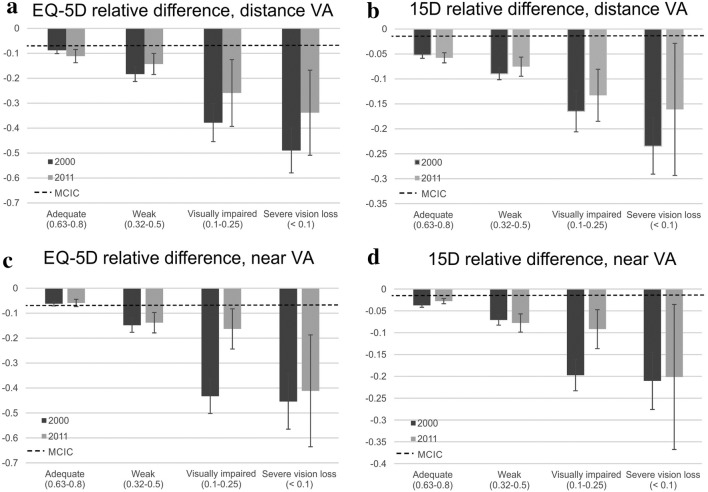
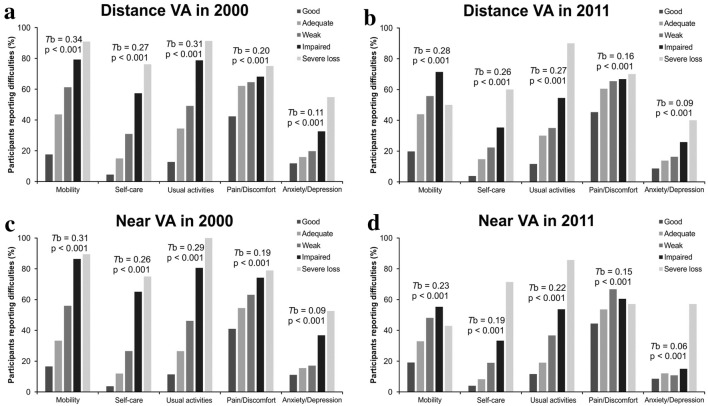
Lower VA status was associated with significantly lower HRQoL at both time points, most clearly observable below the VA level of 0.5. Declining VA resulted in statistically significant decline in HRQoL during the follow-up, greater with distance than near VA. 15D impairment associated with decline in the distance VA was also clinically meaningful and greater than that associated with any of the examined comorbidities.
HRQoL was significantly and meaningfully impaired even before the threshold of severe vision loss or blindness was reached. The results encourage the improvement of available treatment options aiming to postpone the onset of visual impairment or declining VA, to maintain better quality of life among the population.
本研究旨在调查视力(VA)对健康相关生活质量(HRQoL)的影响,以及在 11 年随访期间 HRQoL 的横断面和纵向差异。目的是探讨视力下降对 HRQoL 的影响,并提供可比数据,以方便医疗资源的分配。
我们利用国家健康与福利研究所于 2000 年和 2011 年进行的全国健康检查调查,对 30 岁及以上的芬兰成年人口进行了代表性抽样。通过 Snellen E 测试评估 VA,使用 EQ-5D 和 15D 问卷评估 HRQoL 评分。采用马尔可夫链蒙特卡罗法进行多重插补,以更有效地利用数据。回归分析用于评估 VA 下降对 HRQoL 的影响,调整了新发合并症的影响。
VA 状态较低与两个时间点的 HRQoL 显著降低相关,在 VA 水平低于 0.5 时最为明显。在随访期间,VA 下降导致 HRQoL 出现统计学上显著下降,远视力比近视力下降更为明显。与距离 VA 下降相关的 15D 损害也具有临床意义,且大于任何检查到的合并症相关的损害。
即使在严重视力丧失或失明的阈值之前,HRQoL 也会受到显著和有意义的损害。研究结果鼓励改善现有的治疗方案,旨在推迟视觉障碍或 VA 下降的发生,以维持人群更好的生活质量。