Department of Nutrition, Gillings School of Global Public Health and School of Medicine, The University of North Carolina at Chapel Hill, 170 Rosenau Hall, CB# 7400, 135 Dauer Drive, Chapel Hill, NC 27516, USA.
Department of Nutritional Sciences, Medical Sciences Building, 5th Floor, Room 5358, University of Toronto, 1 King's College Circle, Toronto, ON M5S 1A8, Canada.
Nutrients. 2020 Dec 2;12(12):3718. doi: 10.3390/nu12123718.
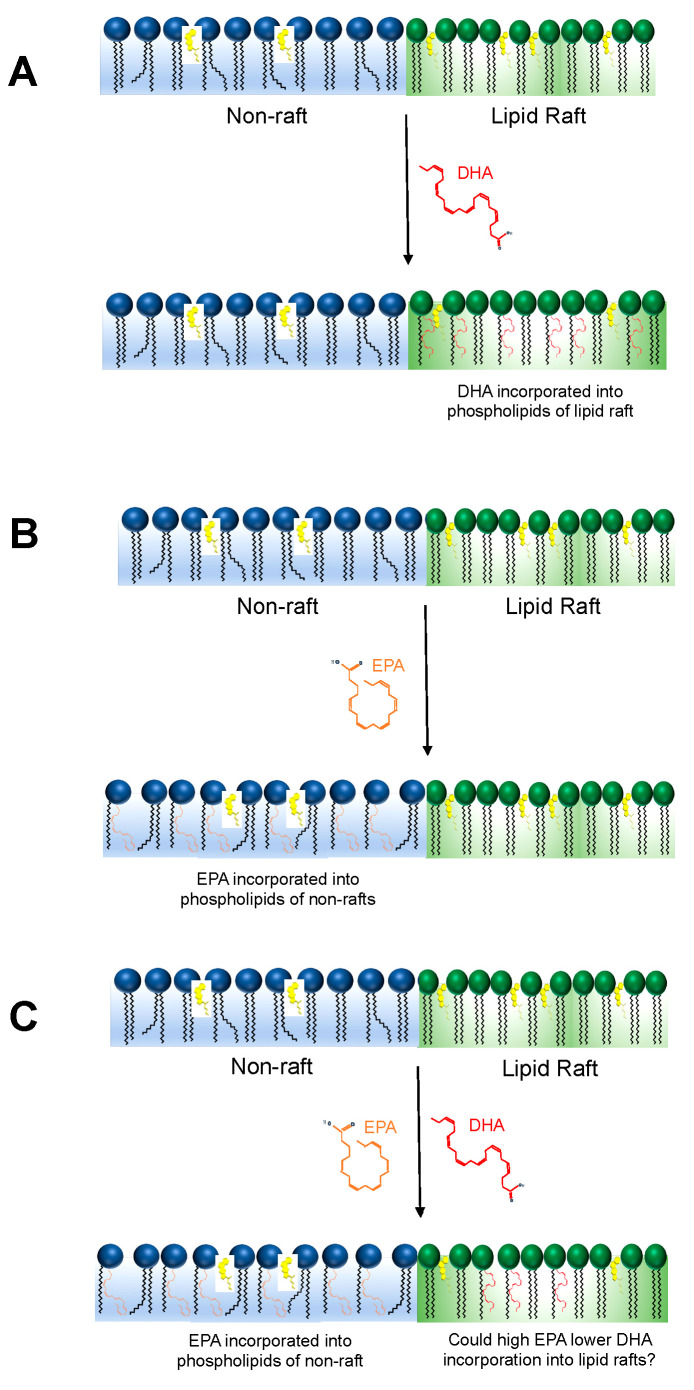
Eicosapentaenoic acid (EPA) and docosahexaenoic acid (DHA) are n-3 polyunsaturated fatty acids (PUFAs) consumed in low abundance in the Western diet. Increased consumption of n-3 PUFAs may have beneficial effects for a wide range of physiological outcomes including chronic inflammation. However, considerable mechanistic gaps in knowledge exist about EPA versus DHA, which are often studied as a mixture. We suggest the novel hypothesis that EPA and DHA may compete against each other through overlapping mechanisms. First, EPA and DHA may compete for residency in membrane phospholipids and thereby differentially displace n-6 PUFAs, which are highly prevalent in the Western diet. This would influence biosynthesis of downstream metabolites of inflammation initiation and resolution. Second, EPA and DHA exert different effects on plasma membrane biophysical structure, creating an additional layer of competition between the fatty acids in controlling signaling. Third, DHA regulates membrane EPA levels by lowering its rate of conversion to EPA's elongation product n-3 docosapentaenoic acid. Collectively, we propose the critical need to investigate molecular competition between EPA and DHA in health and disease, which would ultimately impact dietary recommendations and precision nutrition trials.
二十碳五烯酸 (EPA) 和二十二碳六烯酸 (DHA) 是 n-3 多不饱和脂肪酸 (PUFA),在西方饮食中摄入量较低。增加 n-3 PUFAs 的摄入量可能对包括慢性炎症在内的广泛生理结果产生有益影响。然而,关于 EPA 与 DHA 之间存在着大量的知识机制差距,这两者通常作为混合物进行研究。我们提出了一个新颖的假说,即 EPA 和 DHA 可能通过重叠的机制相互竞争。首先,EPA 和 DHA 可能会争夺膜磷脂的位置,从而取代在西方饮食中高度流行的 n-6 PUFAs。这将影响炎症起始和解决的下游代谢物的生物合成。其次,EPA 和 DHA 对质膜生物物理结构产生不同的影响,在控制信号方面,脂肪酸之间存在着额外的竞争层。第三,DHA 通过降低 EPA 转化为其延伸产物 n-3 二十二碳五烯酸的速度来调节膜 EPA 水平。总之,我们提出了在健康和疾病中研究 EPA 和 DHA 之间分子竞争的迫切需要,这将最终影响饮食建议和精准营养试验。