Lim Carolin, Blaszczyk Edyta, Riazy Leili, Wiesemann Stephanie, Schüler Johannes, von Knobelsdorff-Brenkenhoff Florian, Schulz-Menger Jeanette
Working Group on Cardiovascular Magnetic Resonance, Experimental and Clinical Research Center, a Joint Cooperation Between the Charité - Universitätsmedizin Berlin, Department of Internal Medicine and Cardiology and the Max-Delbrueck Center for Molecular Medicine, and HELIOS Klinikum Berlin Buch, Department of Cardiology and Nephrology, Berlin, Germany.
DZHK (German Center for Cardiovascular Research), Partner Site, Berlin, Germany.
Eur Radiol. 2021 Jun;31(6):3962-3972. doi: 10.1007/s00330-020-07539-5. Epub 2020 Dec 4.
Quantification of myocardial deformation by feature tracking is of growing interest in cardiovascular magnetic resonance. It allows the assessment of regional myocardial function based on cine images. However, image acquisition, post-processing, and interpretation are not standardized. We aimed to assess the influence of segmentation procedure such as slice selection and different types of analysis software on values and quantification of myocardial strain in healthy adults.
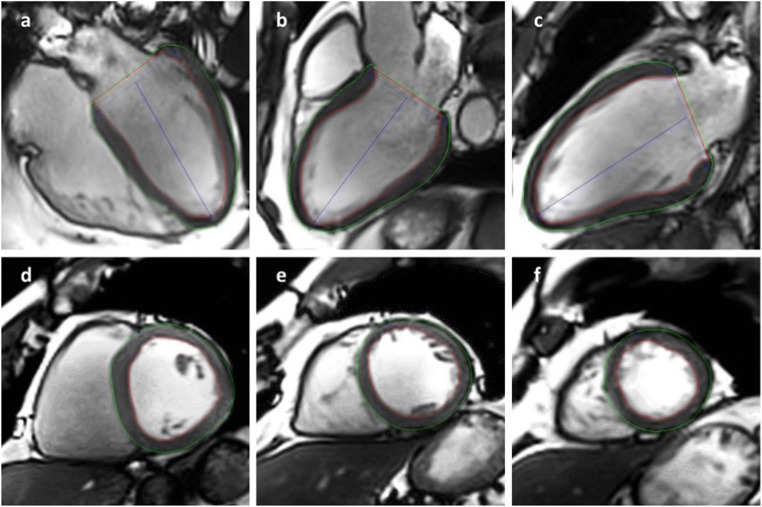
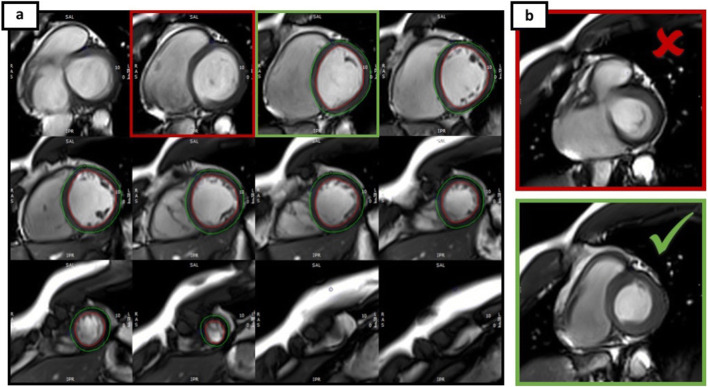
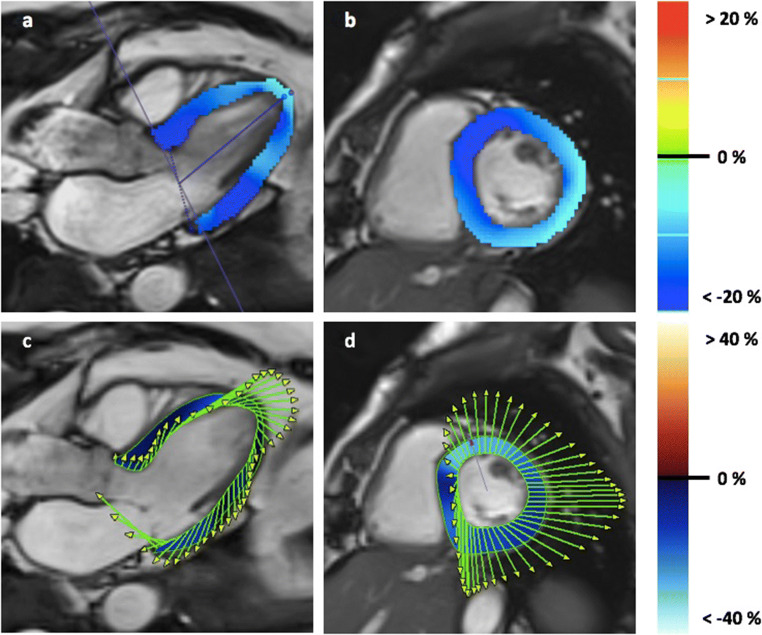
Healthy volunteers were retrospectively analyzed. Post-processing was performed using CVI and TomTec. Longitudinal and radial strain were quantified using 4-chamber-view, 3-chamber-view, and 2-chamber-view. Circumferential and radial strain were assessed in basal, midventricular, and apical short-axis views and using full coverage. Global and segmental strain values were compared to each other regarding their post-processing approach and analysis software package.
We screened healthy volunteers studied at 1.5 or 3.0 T and included 67 (age 44.3 ± 16.3 years, 31 females). Circumferential and radial strain values were different between a full coverage approach vs. three short slices (- 17.6 ± 1.8% vs. - 19.2 ± 2.3% and 29.1 ± 4.8% vs. 34.6 ± 7.1%). Different analysis software calculated significantly different strain values. Within the same vendor, different field strengths (- 17.0 ± 2.1% at 1.5 T vs. - 17.0 ± 1.7% at 3 T, p = 0.845) did not influence the calculated global longitudinal strain (GLS), and were similar in gender (- 17.4 ± 2.0% in females vs. - 16.6 ± 1.8% in males, p = 0.098). Circumferential and radial strain were different in females and males (circumferential strain - 18.2 ± 1.7% vs. - 17.1 ± 1.8%, p = 0.029 and radial strain 30.7 ± 4.7% vs. 27.8 ± 4.6%, p = 0.047).
Myocardial deformation assessed by feature tracking depends on segmentation procedure and type of analysis software. Circumferential and radial depend on the number of slices used for feature tracking analysis. As known from other imaging modalities, GLS seems to be the most stable parameter. During follow-up studies, standardized conditions should be warranted. Trial registration Retrospectively registered KEY POINTS: • Myocardial deformation assessed by feature tracking depends on the segmentation procedure. • Global myocardial strain values differ significantly among vendors. • Standardization in post-processing using CMR feature tracking is essential.
通过特征追踪对心肌形变进行定量分析在心血管磁共振成像中越来越受到关注。它能够基于电影图像评估局部心肌功能。然而,图像采集、后处理及解读尚未标准化。我们旨在评估诸如切片选择等分割程序以及不同类型的分析软件对健康成年人心肌应变值及定量分析的影响。
对健康志愿者进行回顾性分析。使用CVI和TomTec进行后处理。通过四腔心切面、三腔心切面和两腔心切面定量分析纵向和径向应变。在心底、心室中部和心尖短轴切面并采用全层覆盖评估周向和径向应变。就后处理方法和分析软件包比较整体和节段性应变值。
我们筛选了在1.5或3.0T磁场下研究的健康志愿者,纳入67例(年龄44.3±16.3岁,女性31例)。全层覆盖方法与三个短切片之间的周向和径向应变值不同(-17.6±1.8%对-19.2±2.3%以及29.1±4.8%对34.6±7.1%)。不同分析软件计算出的应变值有显著差异。在同一供应商内,不同场强(1.5T时为-17.0±2.1%,3.0T时为-17.0±1.7%,p=0.845)不影响计算出的整体纵向应变(GLS),且在性别上相似(女性为-17.4±2.0%,男性为-16.6±1.8%,p=0.098)。女性和男性的周向和径向应变不同(周向应变-18.2±1.7%对-17.1±1.8%,p=0.029;径向应变30.7±4.7%对27.8±4.6%,p=0.047)。
通过特征追踪评估的心肌形变取决于分割程序和分析软件类型。周向和径向应变取决于用于特征追踪分析的切片数量。正如其他成像模态所知,GLS似乎是最稳定的参数。在后续研究中,应保证标准化条件。试验注册 回顾性注册 关键点:• 通过特征追踪评估的心肌形变取决于分割程序。• 不同供应商之间的整体心肌应变值存在显著差异。• 使用CMR特征追踪进行后处理的标准化至关重要。