Faculty of Chemical Sciences, Universidad La Salle-México, Cuauhtémoc, Mexico City 06140, Mexico; Department of Allergy and Clinical Immunology Internal Medicine, General Hospital of Zone 27 Mexican Institute of Social Security, Lerdo 311, Nonoalco Tlatelolco, Cuauhtémoc, Mexico City 6390, Mexico.
Department of Allergy and Clinical Immunology Internal Medicine, General Hospital of Zone 27 Mexican Institute of Social Security, Lerdo 311, Nonoalco Tlatelolco, Cuauhtémoc, Mexico City 6390, Mexico.
Int Immunopharmacol. 2021 Jan;90:107209. doi: 10.1016/j.intimp.2020.107209. Epub 2020 Nov 26.
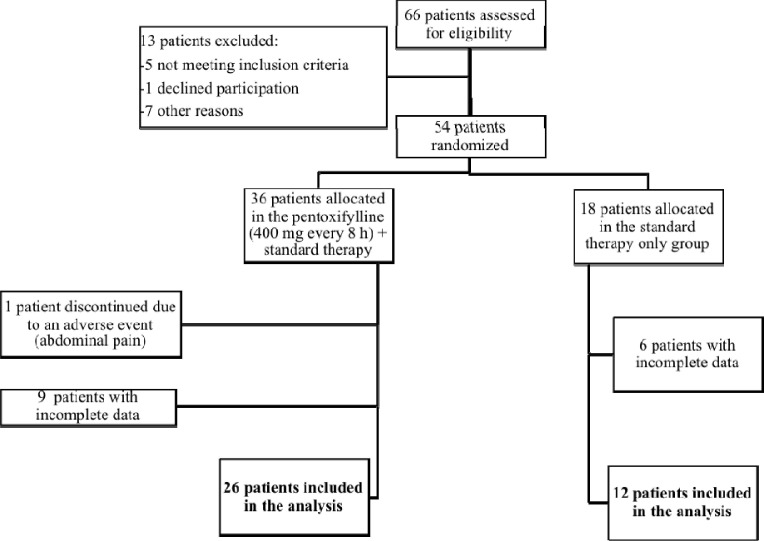
We have previously hypothesized that pentoxifylline could be beneficial for the treatment of COVID-19 given its potential to restore the immune response equilibrium, reduce the impact of the disease on the endothelium and alveolar epithelial cells, and improve the circulatory function.Serum lactate dehydrogenase (LDH) and lymphocyte count are accessible biomarkers that correlate with the severity of COVID-19, the need for hospitalization, and mortality, reflecting the host immune response's contribution to the seriousness of SARS-CoV-2 infection. We carried out this external pilot study on 38 patients with moderate and severe COVID-19 to test the effect pentoxifylline on parameters such as LDH, lymphocyte count, days of hospitalization, mortality, and proportion of patients requiring intubation. Twenty-six patients were randomized to receive 400 mg of pentoxifylline t.i.d. plus standard therapy (pentoxifylline group), while the rest received the standard treatment (control group). Linear regression models were built for statistically significant parameters. Pentoxifylline treatment was associated with a 64.25% increase (CI95% 11.83, 116.68) in lymphocyte count and a 29.61% decrease (CI95% 15.11, 44.10) in serum LDH. Although a trend towards reduced days of hospitalization, mortality, and proportion of patients requiring intubation was observed, no statistically significant difference was found for these parameters. Our findings open the possibility of pentoxifylline being repositioned as a drug for COVID-19 treatment with the advantages of a proven safety profile, availability, and no risk of immunosuppression; however, this evidence needs to be confirmed in a pragmatic randomized controlled trial.
我们之前假设,己酮可可碱可能对 COVID-19 的治疗有益,因为它有可能恢复免疫反应平衡,减轻疾病对内皮细胞和肺泡上皮细胞的影响,并改善循环功能。血清乳酸脱氢酶(LDH)和淋巴细胞计数是与 COVID-19 严重程度、住院需求和死亡率相关的可获得生物标志物,反映了宿主免疫反应对 SARS-CoV-2 感染严重程度的贡献。我们对 38 例中度和重度 COVID-19 患者进行了这项外部试点研究,以测试己酮可可碱对 LDH、淋巴细胞计数、住院天数、死亡率和需要插管的患者比例等参数的影响。26 例患者随机分为接受 400mg 己酮可可碱 tid 加标准治疗(己酮可可碱组),其余患者接受标准治疗(对照组)。对有统计学意义的参数建立了线性回归模型。己酮可可碱治疗与淋巴细胞计数增加 64.25%(95%CI95% 11.83, 116.68)和血清 LDH 降低 29.61%(95%CI95% 15.11, 44.10)相关。尽管观察到住院天数、死亡率和需要插管的患者比例有降低的趋势,但这些参数没有统计学意义上的差异。我们的研究结果为己酮可可碱重新定位为 COVID-19 治疗药物提供了可能性,具有已证实的安全性、可用性和无免疫抑制风险的优势;然而,这一证据需要在一项实用的随机对照试验中得到证实。