Soroya Saira Hanif, Farooq Ali, Mahmood Khalid, Isoaho Jouni, Zara Shan-E
Department of Information Management, University of the Punjab, Lahore, Pakistan.
Department of Future Technologies, Faculty of Science & Engineering, University of Turku. Finland.
Inf Process Manag. 2021 Mar;58(2):102440. doi: 10.1016/j.ipm.2020.102440. Epub 2020 Nov 29.
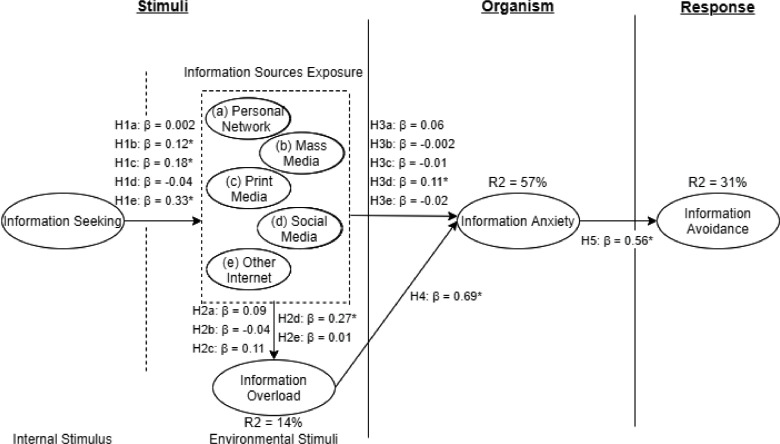
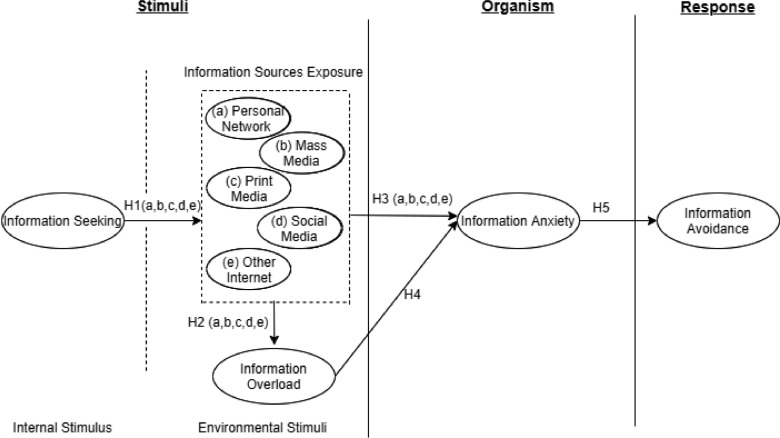
Individuals seek information for informed decision-making, and they consult a variety of information sources nowadays. However, studies show that information from multiple sources can lead to information overload, which then creates negative psychological and behavioral responses. Drawing on the Stimulus-Organism-Response (S-O-R) framework, we propose a model to understand the effect of information seeking, information sources, and information overload (Stimuli) on information anxiety (psychological organism), and consequent behavioral response, information avoidance during the global health crisis (COVID-19). The proposed model was tested using partial least square structural equation modeling (PLS-SEM) for which data were collected from 321 Finnish adults using an online survey. People found to seek information from traditional sources such as mass media, print media, and online sources such as official websites and websites of newspapers and forums. Social media and personal networks were not the preferred sources. On the other hand, among different information sources, social media exposure has a significant relationship with information overload as well as information anxiety. Besides, information overload also predicted information anxiety, which further resulted in information avoidance.
个人为了做出明智的决策而寻求信息,如今他们会咨询各种各样的信息来源。然而,研究表明,来自多个来源的信息可能会导致信息过载,进而产生负面的心理和行为反应。基于刺激-机体-反应(S-O-R)框架,我们提出了一个模型,以理解在全球健康危机(新冠疫情)期间,信息寻求、信息来源和信息过载(刺激因素)对信息焦虑(心理机体)以及随之而来的行为反应——信息回避的影响。我们使用偏最小二乘结构方程模型(PLS-SEM)对所提出的模型进行了测试,通过在线调查从321名芬兰成年人那里收集了数据。人们发现会从传统来源如大众媒体、印刷媒体以及在线来源如官方网站、报纸网站和论坛获取信息。社交媒体和个人网络并非首选来源。另一方面,在不同的信息来源中,接触社交媒体与信息过载以及信息焦虑有着显著的关系。此外,信息过载也预示着信息焦虑,而这进一步导致了信息回避。