Habyarimana Ephrem, De Franceschi Paolo, Ercisli Sezai, Baloch Faheem Shehzad, Dall'Agata Michela
CREA Research Center for Cereal and Industrial Crops, Bologna, Italy.
Department of Horticulture, Faculty of Agriculture, Ataturk University, Erzurum, Turkey.
Front Plant Sci. 2020 Nov 12;11:551305. doi: 10.3389/fpls.2020.551305. eCollection 2020.
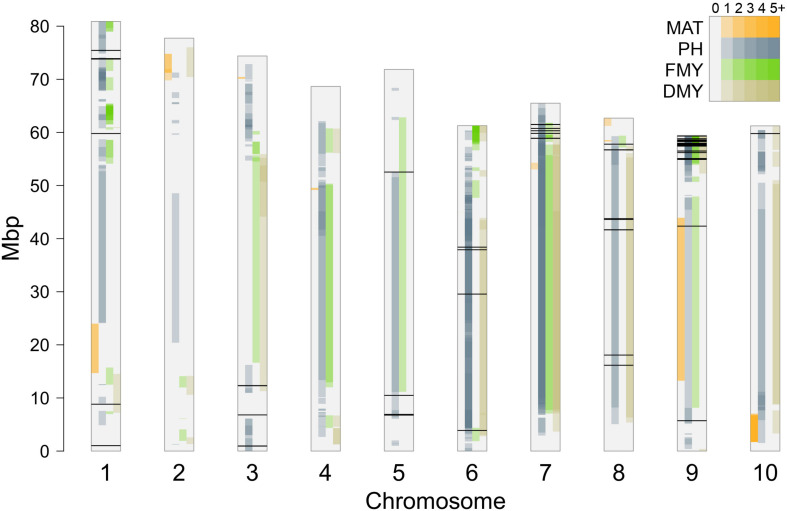
The efficient use of sorghum as a renewable energy source requires high biomass yields and reduced agricultural inputs. Hybridization of with wild can help meet both requirements, generating high-yielding and environment friendly perennial sorghum cultivars. Selection efficiency, however, needs to be improved to exploit the genetic potential of the derived recombinant lines and remove weedy and other wild traits. In this work, we present the results from a Genome-Wide Association Study conducted on a diversity panel made up of and an advanced population derived from × multi-parent crosses. The objective was to identify genetic loci controlling biomass yield and biomass-relevant traits for breeding purposes. Plants were phenotyped during four consecutive years for dry biomass yield, dry mass fraction of fresh material, plant height and plant maturity. A genotyping-by-sequencing approach was implemented to obtain 92,383 high quality SNP markers used in this work. Significant marker-trait associations were uncovered across eight of the ten sorghum chromosomes, with two main hotspots near the end of chromosomes 7 and 9, in proximity of dwarfing genes and . No significant marker was found on chromosomes 2 and 4. A large number of significant marker loci associated with biomass yield and biomass-relevant traits showed minor effects on respective plant characteristics, with the exception of seven loci on chromosomes 3, 8, and 9 that explained 5.2-7.8% of phenotypic variability in dry mass yield, dry mass fraction of fresh material, and maturity, and a major effect ( = 16.2%) locus on chromosome 1 for dry mass fraction of fresh material which co-localized with a zinc-finger homeodomain protein possibly involved in the expression of the (Dry stalk) locus. These markers and marker haplotypes identified in this work are expected to boost marker-assisted selection in sorghum breeding.
高效利用高粱作为可再生能源需要高生物量产量并减少农业投入。将高粱与野生高粱杂交有助于满足这两个要求,培育出高产且环境友好的多年生高粱品种。然而,为了挖掘所得重组系的遗传潜力并去除杂草和其他野生性状,需要提高选择效率。在这项研究中,我们展示了对一个由高粱品种和一个从高粱×高粱多亲本杂交衍生而来的高级群体组成的多样性面板进行全基因组关联研究的结果。目的是鉴定控制生物量产量和与生物量相关性状的基因座,用于育种。连续四年对植株进行表型分析,测定干生物量产量、新鲜材料的干质量分数、株高和植株成熟度。采用测序基因分型方法获得了92383个高质量单核苷酸多态性(SNP)标记,用于本研究。在十个高粱染色体中的八个上发现了显著的标记 - 性状关联,在染色体7和9末端附近有两个主要热点,靠近矮化基因和。在染色体2和4上未发现显著标记。大量与生物量产量和与生物量相关性状相关的显著标记基因座对各自的植株特征影响较小,除了染色体3、8和9上的七个基因座,它们解释了干质量产量、新鲜材料的干质量分数和成熟度中5.2 - 7.8%的表型变异,以及染色体1上一个对新鲜材料干质量分数有主要影响(= 16.2%)的基因座,该基因座与一个可能参与(干茎)基因座表达的锌指同源结构域蛋白共定位。本研究中鉴定出的这些标记和标记单倍型有望促进高粱育种中的标记辅助选择。