Kim Mi Jeong
Department of Food and Nutrition, Prevention and Rehabilitation Center for Aging and Dementia, Silla University, Busan 46958, Korea.
Nutr Res Pract. 2020 Dec;14(6):637-653. doi: 10.4162/nrp.2020.14.6.637. Epub 2020 Oct 12.
BACKGROUND/OBJECTIVES: This study examined the associations between food consumption frequency of Korean adults and self-perceived chewing difficulty, using the food frequency questionnaire (FFQ, 112 items) from 2013-2016 of the Korea National Health and Nutrition Examination Survey (KNHANES).
SUBJECTS/METHODS: Subjects were divided into not difficult in chewing (NDC) and difficult in chewing (DC) groups, with 24.17% being classified into DC. Males and females consumed 35 and 37 items less frequently than the other sex, respectively. Due to the remarkable sex difference in food consumption, sex-stratified one-sided survey regression analysis was performed after adjusted for the effect of age, household income, and self-rated health status.
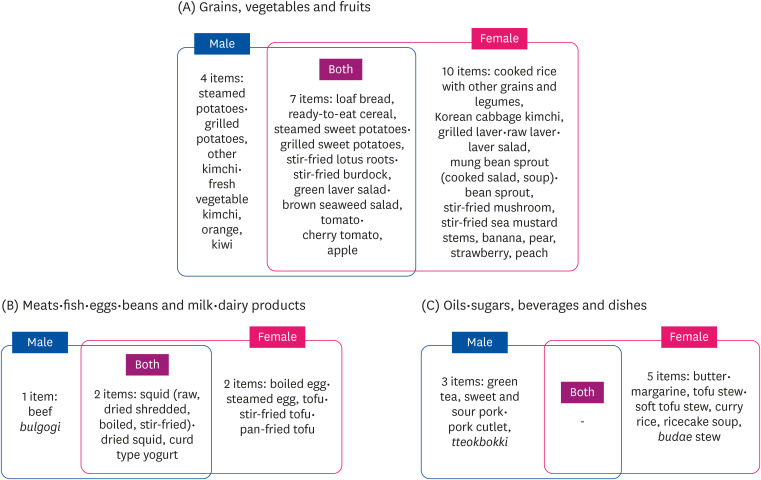
Thirty-four items of FFQ were significantly less consumed by the DC group. Females exclusively consumed less beverages and alcohol while males showed the same for fruits and milk·dairy products. Consumption frequency of 8 items such as steamed potatoes·grilled potatoes, stir fried beef, other kimchi·fresh vegetable kimchi, orange, sour pork·pork cutlet, tteokbokki and green tea were significant only in males. In contrast, 17 items including cooked rice with other grains and legumes, boiled egg·steamed egg, Korean cabbage kimchi, banana, and tofu stew·soft tofu stew were significant only for females. Finally, items that showed significance for both were 9 items including loaf bread, ready-to-eat cereal, steamed sweet potatoes·grilled sweet potatoes, stir-fried lotus roots·stir-fried burdock, green laver salad·brown seaweed salads, apples, tomato·cherry tomatoes, squid (raw, dried shredded, boiled, stir-fried), and curd type yogurt.
Findings in this study suggest chewing difficulty may be an important nutritional issue that has to be dealt with for healthful food consumption, with distinct interest of sex.
背景/目的:本研究使用韩国国家健康与营养检查调查(KNHANES)2013 - 2016年的食物频率问卷(FFQ,112项),调查韩国成年人的食物消费频率与自我感知咀嚼困难之间的关联。
对象/方法:将研究对象分为咀嚼不难(NDC)组和咀嚼困难(DC)组,24.17%的人被归类为DC组。男性和女性分别比另一性别少食用35项和37项食物。由于食物消费存在显著的性别差异,在调整年龄、家庭收入和自我健康状况的影响后,进行了按性别分层的单侧调查回归分析。
DC组FFQ中有34项食物的消费量显著较少。女性仅饮用较少的饮料和酒精,而男性在水果和奶类 - 奶制品方面的消费量较少。蒸土豆·烤土豆、炒牛肉、其他泡菜·新鲜蔬菜泡菜、橙子、糖醋猪肉·猪排、tteokbokki(韩式辣炒年糕)和绿茶等8项食物的消费频率仅在男性中显著。相比之下,包括其他谷物和豆类煮米饭、煮鸡蛋·蒸蛋、韩国白菜泡菜、香蕉以及豆腐炖菜·软豆腐炖菜等17项食物仅在女性中显著。最后,对两性均有显著意义的食物有9项,包括面包、即食谷物、蒸红薯·烤红薯、炒莲藕·炒牛蒡、绿紫菜沙拉·褐藻沙拉、苹果、番茄·樱桃番茄、鱿鱼(生的、干切丝的、煮的、炒的)和凝乳型酸奶。
本研究结果表明,咀嚼困难可能是一个重要的营养问题,在健康饮食消费中必须加以应对,且存在明显的性别差异。