Rink James, Lipinska Gosia
Applied Cognitive Science and Experimental Neuropsychology Team (ACSENT), Department of Psychology, University of Cape Town, Cape Town, South Africa.
Eur J Psychotraumatol. 2020 Nov 9;11(1):1818965. doi: 10.1080/20008198.2020.1818965.
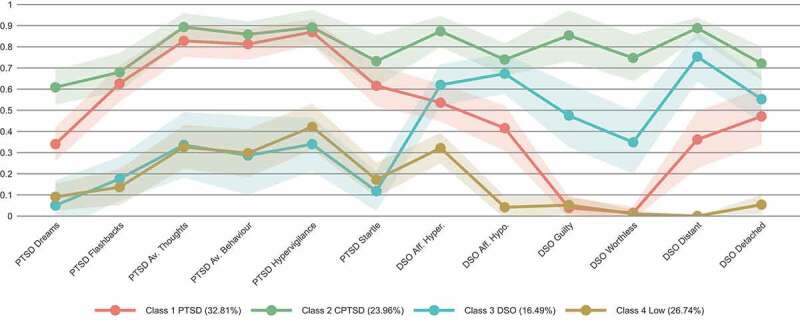
Both post-traumatic stress disorder (PTSD) and complex post-traumatic stress disorder (CPTSD) have been included in the 11th edition of the International Classification of Diseases (ICD-11). Although the validity of CPTSD has been controversial, a growing number of studies support the distinction between PTSD and CPTSD. However, the majority of this research has originated in high-income countries (HICs), whereas the prevalence of trauma experience associated with PTSD/CPTSD diagnosis is significantly higher in low- and middle-income countries (LMICs). This study assessed whether a sample from an LMIC setting produced distinct classes that reflect ICD-11 criteria for PTSD and CPTSD. Furthermore, this study investigated whether childhood trauma distinguished between PTSD and CPTSD. International Trauma Questionnaire responses from a sample of South African university undergraduates were used as indicator variables in a latent class analysis (LCA). Chi-squared tests of independence and Kruskal-Wallis tests were used to assess between-class differences. The LCA identified four distinct classes: a PTSD class with elevated symptoms of PTSD, but low endorsement of disturbances in self-organization (DSO; symptoms that are specific to CPTSD); a CPTSD class with elevated symptoms of PTSD and DSO; a DSO class with low symptoms of PTSD, but elevated symptoms of DSO; and a Low class with low endorsements on all symptoms. Regarding childhood trauma, participants in the CPTSD class had more severe childhood abuse and neglect, specifically emotional abuse and neglect, than participants in the PTSD class. Findings were consistent with the distinction between PTSD and CPTSD symptom profiles in the ICD-11. Our findings support a similar qualitative distinction between PTSD and CPTSD in our LMIC context, as previously reported in HICs. This distinction is especially relevant in LMICs because of the significant number of individuals vulnerable to these disorders.
创伤后应激障碍(PTSD)和复杂性创伤后应激障碍(CPTSD)均已被纳入《国际疾病分类》第11版(ICD - 11)。尽管CPTSD的有效性一直存在争议,但越来越多的研究支持PTSD和CPTSD之间的区别。然而,这项研究大多起源于高收入国家(HICs),而与PTSD/CPTSD诊断相关的创伤经历在低收入和中等收入国家(LMICs)的患病率要高得多。本研究评估了来自LMIC环境的样本是否产生了反映ICD - 11中PTSD和CPTSD标准的不同类别。此外,本研究还调查了童年创伤是否能区分PTSD和CPTSD。南非大学本科生样本的国际创伤问卷回复被用作潜在类别分析(LCA)中的指标变量。使用卡方独立性检验和克鲁斯卡尔 - 沃利斯检验来评估类别之间的差异。LCA确定了四个不同的类别:一个PTSD类别,其PTSD症状升高,但自我组织障碍(DSO;CPTSD特有的症状)的认可程度较低;一个CPTSD类别,其PTSD和DSO症状均升高;一个DSO类别,其PTSD症状较低,但DSO症状升高;以及一个低症状类别,所有症状的认可程度都较低。关于童年创伤,CPTSD类别中的参与者比PTSD类别中的参与者有更严重的童年虐待和忽视,特别是情感虐待和忽视。研究结果与ICD - 11中PTSD和CPTSD症状特征的区别一致。我们的研究结果支持在我们的LMIC环境中PTSD和CPTSD之间存在类似的质性区别,正如之前在HICs中所报道的那样。由于有大量个体易患这些疾病,这种区别在LMICs中尤为重要。