Menzies Centre for Health Governance, School of Regulation and Global Governance (RegNet), ANU College of Asia & the Pacific, The Australian National University, Canberra, ACT, Australia.
Front Public Health. 2020 Nov 17;8:563525. doi: 10.3389/fpubh.2020.563525. eCollection 2020.
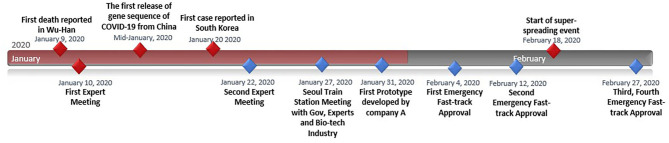
Responsive private sector engagement in developing test kits for coronavirus disease (COVID-19) in South Korea offers a valuable case study in public-private partnership and infectious disease governance. Korean biotech firms promptly developed diagnostic test kits, and the nation achieved capacity to test more than 20,000 people daily. This was a direct result of the continuous application of lessons learned from the Middle Eastern respiratory syndrome outbreak in 2015. South Korea had been strengthening the private sectors' infectious disease governance and response capacity, creating various new constructive pathways toward public-private partnership. Regulatory amendments were made to better liaise with the private sector. Government-led investment had increased in the research and development of testing technologies over the past 5 years. Furthermore, the Korean government had introduced fast-tracking approval, allowing open competition for more than 20 domestic biotech companies to develop test kits. An overview of test kit governance informs us of the importance of public-private partnership for pandemic threats.
韩国私营部门积极参与研发冠状病毒病(COVID-19)检测试剂盒,为公私伙伴关系和传染病治理提供了一个有价值的案例研究。韩国生物技术公司迅速开发出诊断试剂盒,韩国的日检测能力超过 2 万人。这直接得益于韩国从 2015 年中东呼吸综合征疫情中不断吸取经验教训。韩国一直在加强私营部门的传染病治理和应对能力,为公私伙伴关系创造了各种新的建设性途径。韩国对监管法规进行了修订,以更好地与私营部门进行协调。在过去 5 年中,政府主导的投资增加了对检测技术的研发。此外,韩国政府还引入了快速审批程序,允许 20 多家国内生物技术公司公开竞争开发试剂盒。检测试剂盒治理的概述告诉我们,公私伙伴关系对于应对大流行病威胁至关重要。