Andronic Luminita, Enesca Alexandru
Department of Product Design, Mechatronics and Environment, Transilvania University of Brasov, Brasov, Romania.
Front Chem. 2020 Nov 17;8:565489. doi: 10.3389/fchem.2020.565489. eCollection 2020.
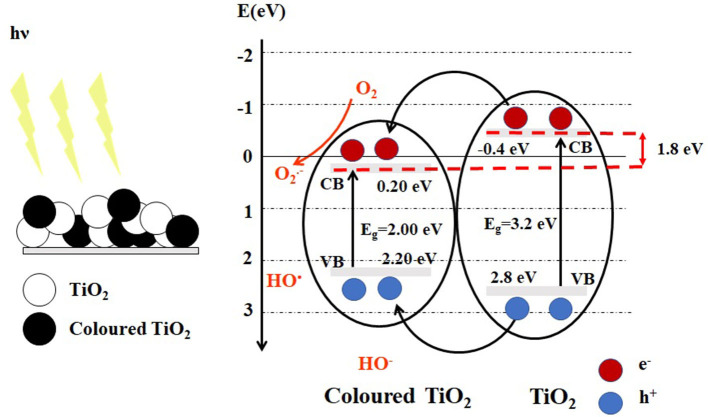
Applications of TiO nanomaterials in photocatalysis, batteries, supercapacitors and solar cells, have seen widespread development in recent decades. Nowadays, black TiO have won attention due to enhancing the solar light absorption by the formation of oxygen vacancies and Ti defects, to promote the separation of photo-generated charge carriers leading to the improvement of the photocatalytic performance in H production and pollutants degradation. The enhanced photocatalytic activity of black TiO is also due to a lattice disorder on the surface and the presence of oxygen vacancies, Ti ions, Ti-OH and Ti-H groups. Enhancing the optical absorption characteristics of TiO and change of energy level and band-gap of materials have been successfully demonstrated to improve their photocatalytic activities, especially for black TiO nanoparticles, which promote visible light absorption. The current review focuses on the investigation of the chemical reduction synthetic route for black TiO nanomaterials, and their proposed association with green applications such as photodegradation of organic pollutants and photocatalytic water splitting. The synthesis methods of black TiO involves the changes from Ti to Ti state, into different strategies: (1) The use of highly active hydrogen species such as H, H/Ar or H/N gases, and metal hydrides (NaBH, CaH), (2) the reduction by active metals such as aluminum, magnesium and zinc, and (3) organic molecules such as imidazole and ascorbic acid.
近几十年来,TiO纳米材料在光催化、电池、超级电容器和太阳能电池中的应用得到了广泛发展。如今,黑色TiO由于通过形成氧空位和Ti缺陷增强了太阳光吸收而受到关注,这促进了光生电荷载流子的分离,从而提高了在制氢和污染物降解方面的光催化性能。黑色TiO增强的光催化活性还归因于其表面的晶格无序以及氧空位、Ti离子、Ti-OH和Ti-H基团的存在。增强TiO的光吸收特性以及材料能级和带隙的变化已被成功证明可提高其光催化活性,特别是对于促进可见光吸收的黑色TiO纳米颗粒。当前的综述重点在于对黑色TiO纳米材料化学还原合成路线的研究,以及它们与诸如有机污染物光降解和光催化水分解等绿色应用的潜在关联。黑色TiO的合成方法涉及从Ti到Ti状态的变化,分为不同策略:(1)使用高活性氢物种,如H、H/Ar或H/N气体以及金属氢化物(NaBH、CaH),(2)通过活性金属如铝、镁和锌进行还原,以及(3)使用有机分子如咪唑和抗坏血酸。