Division of Nephrology, Department of Medicine, Indiana University School of Medicine, Indianapolis, Indiana.
Department of Chemistry and Biochemistry, Texas Tech University, Lubbock, Texas.
Am J Physiol Renal Physiol. 2021 Jan 1;320(1):F114-F129. doi: 10.1152/ajprenal.00428.2020. Epub 2020 Dec 7.
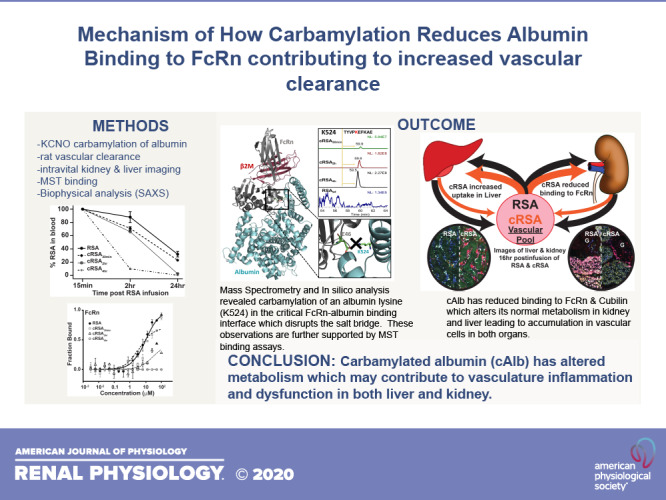
Chronic kidney disease results in high serum urea concentrations leading to excessive protein carbamylation, primarily albumin. This is associated with increased cardiovascular disease and mortality. Multiple methods were used to address whether carbamylation alters albumin metabolism. Intravital two-photon imaging of the Munich Wistar Frömter (MWF) rat kidney and liver allowed us to characterize filtration and proximal tubule uptake and liver uptake. Microscale thermophoresis enabled quantification of cubilin (CUB7,8 domain) and FcRn binding. Finally, multiple biophysical methods including dynamic light scattering, small-angle X-ray scattering, LC-MS/MS and in silico analyses were used to identify the critical structural alterations and amino acid modifications of rat albumin. Carbamylation of albumin reduced binding to CUB7,8 and FcRn in a dose-dependent fashion. Carbamylation markedly increased vascular clearance of carbamylated rat serum albumin (cRSA) and altered distribution of cRSA in both the kidney and liver at 16 h post intravenous injection. By evaluating the time course of carbamylation and associated charge, size, shape, and binding parameters in combination with in silico analysis and mass spectrometry, the critical binding interaction impacting carbamylated albumin's reduced FcRn binding was identified as K524. Carbamylation of RSA had no effect on glomerular filtration or proximal tubule uptake. These data indicate urea-mediated time-dependent carbamylation of albumin lysine K524 resulted in reduced binding to CUB7,8 and FcRn that contribute to altered albumin transport, leading to increased vascular clearance and increased liver and endothelial tissue accumulation.
慢性肾病会导致血清尿素浓度升高,从而导致蛋白质过度碳化,主要是白蛋白。这与心血管疾病和死亡率的增加有关。我们采用了多种方法来研究碳化是否会改变白蛋白的代谢。通过对慕尼黑威斯特法伦弗里蒙特大鼠(MWF)的肾脏和肝脏进行活体双光子成像,我们能够对过滤和近端肾小管摄取以及肝脏摄取进行特征描述。微量热泳动使我们能够对触珠蛋白(CUB7,8 结构域)和 FcRn 的结合进行定量。最后,我们采用了多种生物物理方法,包括动态光散射、小角度 X 射线散射、LC-MS/MS 和计算分析,来鉴定大鼠白蛋白的关键结构变化和氨基酸修饰。白蛋白的碳化以剂量依赖的方式降低了与 CUB7,8 和 FcRn 的结合。碳化显著增加了碳化大鼠血清白蛋白(cRSA)的血管清除率,并在静脉注射后 16 小时改变了 cRSA 在肾脏和肝脏中的分布。通过评估碳化和相关电荷、大小、形状以及结合参数的时间过程,并结合计算分析和质谱分析,我们确定了影响碳化白蛋白与 FcRn 结合减少的关键结合相互作用是 K524。RSA 的碳化对肾小球滤过或近端肾小管摄取没有影响。这些数据表明,尿素介导的白蛋白赖氨酸 K524 的时间依赖性碳化导致与 CUB7,8 和 FcRn 的结合减少,这导致了白蛋白转运的改变,从而导致血管清除率增加,并增加了肝脏和内皮组织的蓄积。