Department of Public Health, University of Naples Federico II, Via S. Pansini 5, 80131, Naples, Italy.
Endocrine. 2021 Jan;71(1):20-25. doi: 10.1007/s12020-020-02559-z. Epub 2020 Dec 7.
Nowadays, the clinical management of thyroid nodules needs to be multi-disciplinary. In particular, the crosstalk between endocrinologists and cytopathologists is key. When FNAs are properly requested by endocrinologists for nodules characterised by relevant clinical and ultrasound features, cytopathologists play a pivotal role in the diagnostic work-up. Conversely, improper FNA requests can lead to questionable diagnostic efficiency. Recently, recommendations to delay all non-urgent diagnostic procedures, such as thyroid FNAs, to contain the spread of COVID-19 infection, have made the interplay between endocrinologists and cytopathologists even more essential. The objective of this study was to assess the impact of COVID-19 pandemic on our practice by evaluating the total number of FNAs performed and the distribution of the Bethesda Categories before, during, and after the lockdown.
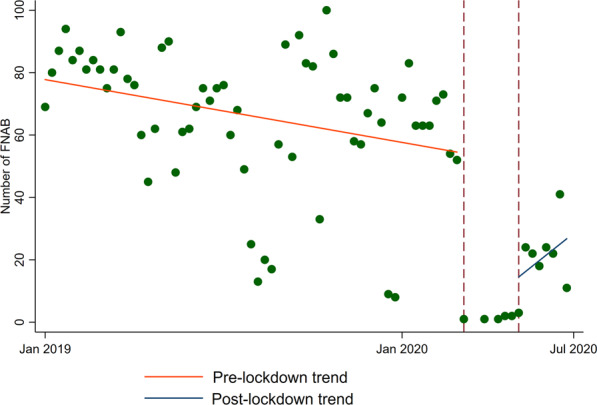
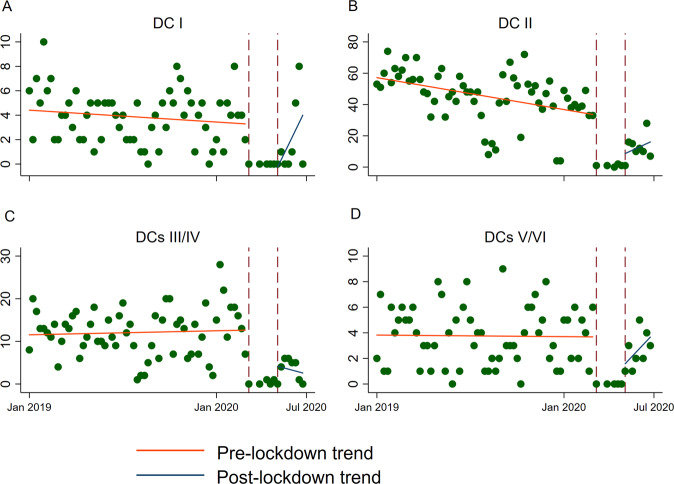
We analysed the FNA trends before (1st January 2019 to March 13th 2020), during (March 14th to May 15th), and after (May 16th to July 7th) the lockdown.
Although the total number of weekly FNAs dropped from 62.1 to 23.1, our referring endocrinologists managed to prioritise patients with high-risk nodules. In fact, in the post-lockdown, the weekly proportion of benign diagnoses dropped on average by 12% and that of high-risk diagnoses increased by 6%.
The lesson we have learned so far from this pandemic is that by applying safety protocols to avoid contagion and by increasing the threshold for FNA requests for thyroid nodules, we can continue to guarantee our services to high-risk patients even in times of a health crisis.
如今,甲状腺结节的临床管理需要多学科参与。特别是内分泌学家和细胞病理学家之间的交流至关重要。当内分泌学家根据具有相关临床和超声特征的结节恰当地请求进行细针穿刺抽吸活检(FNAs)时,细胞病理学家在诊断工作中起着关键作用。相反,不适当的 FNA 请求可能导致诊断效率受到质疑。最近,为了控制 COVID-19 感染的传播,建议延迟所有非紧急的诊断程序,如甲状腺 FNAs,这使得内分泌学家和细胞病理学家之间的相互作用更加重要。本研究的目的是通过评估封锁前后进行的 FNAs 总数和 Bethesda 分类分布,评估 COVID-19 大流行对我们实践的影响。
我们分析了封锁前(2019 年 1 月 1 日至 2020 年 3 月 13 日)、封锁期间(2020 年 3 月 14 日至 5 月 15 日)和封锁后(2020 年 5 月 16 日至 7 月 7 日)的 FNA 趋势。
尽管每周 FNAs 的总数从 62.1 例降至 23.1 例,但我们的转诊内分泌学家成功地为高风险结节患者提供了优先治疗。事实上,在封锁后,每周良性诊断的比例平均下降了 12%,高风险诊断的比例增加了 6%。
我们从这场大流行中学到的教训是,通过应用安全协议来避免传染,并提高对甲状腺结节进行 FNA 请求的门槛,我们即使在卫生危机时期也可以继续为高危患者提供服务。