Optometry and Visual Sciences, School of Health Sciences, University of London, London, United Kingdom.
PLoS One. 2020 Dec 7;15(12):e0243578. doi: 10.1371/journal.pone.0243578. eCollection 2020.
To test the hypothesis that the performance in novel computer-based tasks of everyday visual function worsens with disease severity in people with non-neovascular age-related macular degeneration.
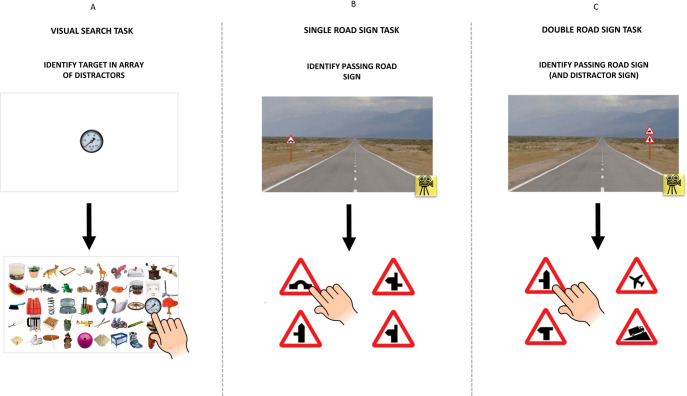
Participants with and without non-neovascular age-related macular degeneration (≥60 years, minimum logMAR binocular visual acuity 0.7) performed a series of standard visual function tests and two novel computer-based tasks. In a visual search task, participants had to locate an image of a single real-world object within an array of 49 distractor images. Next, in a series of simulated dynamic driving scenes, participants were asked to identify one or two approaching real-world road signs and then select these road signs from four options. Outcome measures were median response times and total correct responses.
Forty-nine participants had no macular disease (n = 11), early/intermediate age-related macular degeneration (n = 16) or geographic atrophy (n = 22). Groups were age-similar with median (interquartile range) logMAR visual acuity of 0.00 (-0.08,0.12), 0.13 (-0.08,0.70) and 0.32 (0.12,0.70) respectively. Median (interquartile range) visual search response times were 1.9 (1.0,2.4), 1.8 (1.1,3.7) and 2.4 (1.2,6.0) seconds respectively. Median (interquartile range) road sign response times (single road signs) were 1.2 (0.4,1.7), 1.5 (0.9,2.8) and 1.8 (1.0,5.5) seconds respectively. Median (interquartile range) road sign response times (double road signs) were 1.7 (0.7,2.4), 2.3 (1.2,3.1) and 2.5 (1.7,6) seconds respectively. Participants with geographic atrophy recorded slower response times in all tasks and over 50% performed outside the normative limit for task performance. There were no significant differences between groups in total correct responses across all tasks.
In a novel computer-based assessment, people with increasing severity of age-related macular degeneration take longer to perform visual search of everyday objects and take longer to identify road signs than those with no age-related macular degeneration. These novel assessments could be useful as patient-relevant, secondary outcomes for clinical trials.
检验这样一个假设,即患有非新生血管性年龄相关性黄斑变性的人群,其在新颖的基于计算机的日常视觉功能任务中的表现会随着疾病严重程度的增加而恶化。
纳入患有和不患有非新生血管性年龄相关性黄斑变性(≥60 岁,最小对数视力表双眼视力 0.7)的参与者,让他们进行一系列标准视觉功能测试和两项新颖的基于计算机的任务。在视觉搜索任务中,参与者需要在 49 个干扰图像的数组中找到一个真实世界物体的图像。接下来,在一系列模拟动态驾驶场景中,参与者被要求识别一个或两个接近的真实道路标志,然后从四个选项中选择这些道路标志。结果测量指标为中位数反应时间和总正确反应数。
49 名参与者中,无黄斑疾病者(n=11)、早期/中期年龄相关性黄斑变性者(n=16)和地图样萎缩者(n=22)。各组年龄相似,平均(四分位距)对数视力表视力分别为 0.00(-0.08,0.12)、0.13(-0.08,0.70)和 0.32(0.12,0.70)。平均(四分位距)视觉搜索反应时间分别为 1.9(1.0,2.4)、1.8(1.1,3.7)和 2.4(1.2,6.0)秒。平均(四分位距)道路标志反应时间(单个道路标志)分别为 1.2(0.4,1.7)、1.5(0.9,2.8)和 1.8(1.0,5.5)秒。平均(四分位距)道路标志反应时间(两个道路标志)分别为 1.7(0.7,2.4)、2.3(1.2,3.1)和 2.5(1.7,6)秒。地图样萎缩组在所有任务中的反应时间均较慢,超过 50%的参与者表现超出了任务表现的正常范围。在所有任务的总正确反应数方面,各组之间没有显著差异。
在新颖的基于计算机的评估中,与无年龄相关性黄斑变性的参与者相比,年龄相关性黄斑变性严重程度增加的参与者在进行日常物体的视觉搜索和识别道路标志时,需要花费更长的时间。这些新颖的评估方法可能作为临床试验中与患者相关的次要结果指标有用。