Kuliga Jan, de Campos Ferreirra Rodrigo Cezar, Adhikari Rajan, Massicot Stephen, Lepper Michael, Hölzel Helen, Jux Norbert, Marbach Hubertus, de Siervo Abner, Steinrück Hans-Peter
Lehrstuhl für Physikalische Chemie II, Friedrich-Alexander-Universität Erlangen-Nürnberg, Egerlandstr. 3, 91058, Erlangen, Germany.
Instituto de Física "Gleb Wataghin", Universidade Estadual de Campinas, Campinas, 13083-859, SP, Brazil.
Chemphyschem. 2021 Feb 16;22(4):396-403. doi: 10.1002/cphc.202000883. Epub 2021 Jan 15.
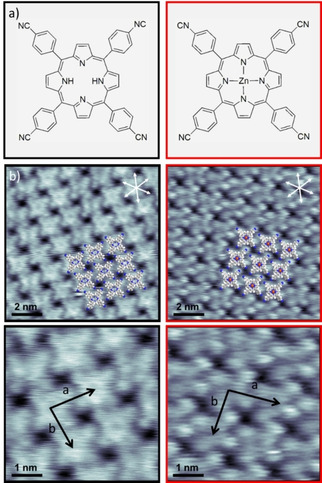
We study the interaction and metalation reaction of a free base 5,10,15,20-terakis(4-cyanophenyl)porphyrin (2HTCNPP) with post-deposited Zn atoms and the targeted reaction product Zn-5,10,15,20-terakis(4-cyanophenyl)porphyrin (ZnTCNPP) on a Ag(111) surface. The investigations are performed with scanning tunneling microscopy at room temperature after Zn deposition and subsequent heating. The goal is to obtain further insights in the metalation reaction and the influence of the cyanogroups on this reaction. The interaction of 2HTCNPP with post-deposited Zn leads to the formation of three different 2D ordered island types that coexist on the surface. All contain a new species with a bright appearance, which increases with the amount of post-deposited Zn. We attribute this to metastable SAT ("sitting atop") complexes formed by Zn and the macrocycle, that is, an intermediate in the metalation reaction to ZnTCNPP, which occurs upon heating to 500 K. Interestingly, the activation barrier for the successive reaction of the SAT complex to the metalated ZnTCNPP species can also be overcome by a voltage pulse applied to the STM tip.
我们研究了自由碱5,10,15,20-四(4-氰基苯基)卟啉(2HTCNPP)与后沉积的锌原子之间的相互作用和金属化反应,以及在Ag(111)表面上目标反应产物锌-5,10,15,20-四(4-氰基苯基)卟啉(ZnTCNPP)。在锌沉积及随后加热后,于室温下用扫描隧道显微镜进行了研究。目的是进一步深入了解金属化反应以及氰基对该反应的影响。2HTCNPP与后沉积的锌之间的相互作用导致在表面上共存的三种不同二维有序岛状结构的形成。所有这些结构都包含一种外观明亮的新物种,其随着后沉积锌的量增加而增多。我们将此归因于由锌和大环形成的亚稳态SAT(“坐落于顶部”)配合物,即金属化反应生成ZnTCNPP时的一种中间体,该反应在加热至500 K时发生。有趣的是,施加到扫描隧道显微镜针尖的电压脉冲也可以克服SAT配合物连续反应生成金属化的ZnTCNPP物种的活化能垒。