Harvard T.H. Chan School of Public Health, Department of Health Policy & Management, Boston, MA, USA; Brigham and Women's Hospital, Department of Medicine, Division of General Internal Medicine, Boston, MA, USA.
Richard A. and Susan F. Smith Center for Outcomes Research in Cardiology, Beth Israel Deaconess Medical Center, Harvard Medical School, Boston, MA, USA.
Healthc (Amst). 2021 Mar;9(1):100495. doi: 10.1016/j.hjdsi.2020.100495. Epub 2020 Nov 21.
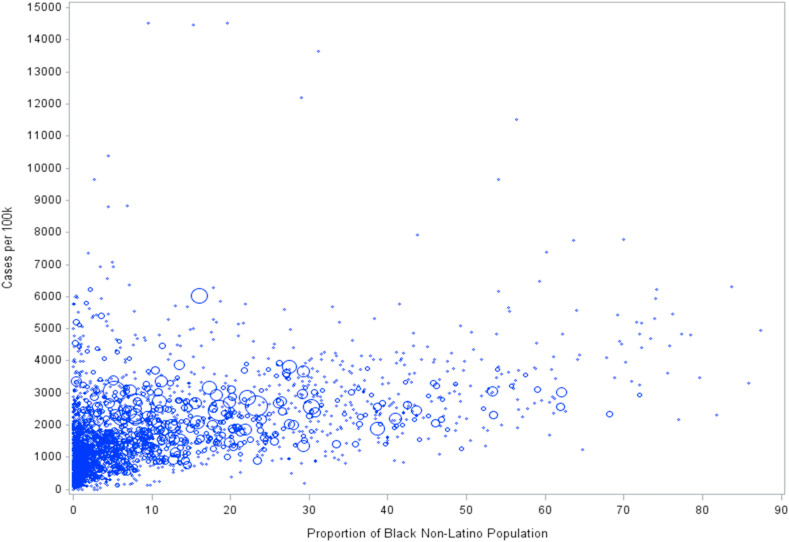
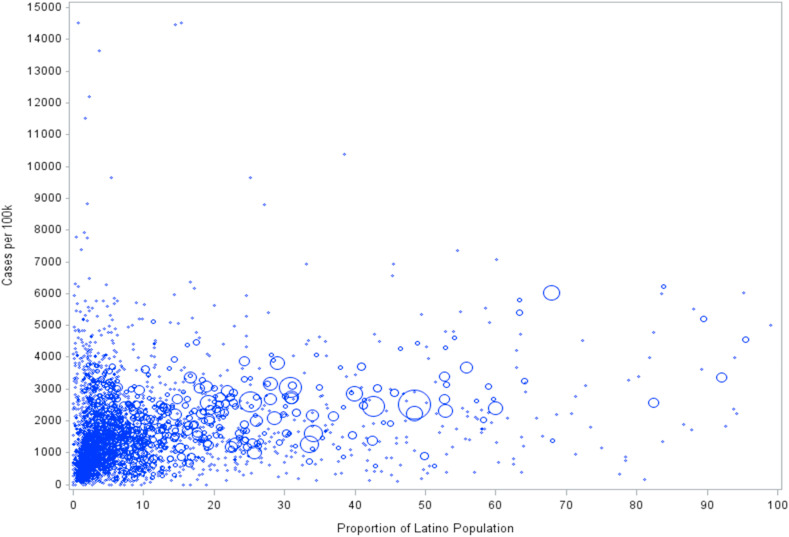
The United States currently has one of the highest numbers of cumulative COVID-19 cases globally, and Latino and Black communities have been disproportionately affected. Understanding the community-level factors that contribute to disparities in COVID-19 case and death rates is critical to developing public health and policy strategies. We performed a cross-sectional analysis of U.S. counties and found that a 10% point increase in the Black population was associated with 324.7 additional COVID-19 cases per 100,000 population and 14.5 additional COVID-19 deaths per 100,000. In addition, we found that a 10% point increase in the Latino population was associated with 293.5 additional COVID-19 cases per 100,000 and 7.6 additional COVID-19 deaths per 100,000. Independent predictors of higher COVID-19 case rates included average household size, the share of individuals with less than a high school diploma, and the percentage of foreign-born non-citizens. In addition, average household size, the share of individuals with less than a high school diploma, and the proportion of workers that commute using public transportation independently predicted higher COVID-19 death rates within a community. After adjustment for these variables, the association between the Latino population and COVID-19 cases and deaths was attenuated while the association between the Black population and COVID-19 cases and deaths largely persisted. Policy efforts must seek to address the drivers identified in this study in order to mitigate disparities in COVID-19 cases and deaths across minority communities.
美国目前是全球累计 COVID-19 病例数最多的国家之一,拉丁裔和非裔社区受到的影响不成比例。了解导致 COVID-19 病例和死亡率差异的社区层面因素对于制定公共卫生和政策策略至关重要。我们对美国各县进行了横断面分析,发现黑人群体增加 10%,与每 10 万人中 COVID-19 额外增加 324.7 例和额外死亡 14.5 人相关。此外,我们发现拉丁裔人口增加 10%,与每 10 万人中 COVID-19 额外增加 293.5 例和额外死亡 7.6 人相关。更高 COVID-19 病例率的独立预测因素包括家庭平均规模、未完成高中学业的个体比例以及非公民外国出生比例。此外,家庭平均规模、未完成高中学业的个体比例以及使用公共交通工具通勤的工人比例独立预测社区内 COVID-19 死亡率更高。在调整这些变量后,拉丁裔人口与 COVID-19 病例和死亡之间的关联减弱,而黑人群体与 COVID-19 病例和死亡之间的关联在很大程度上仍然存在。政策努力必须设法解决本研究中确定的驱动因素,以减轻少数族裔社区中 COVID-19 病例和死亡的差异。