Hendricks-Sturrup Rachele M, Cerminara Kathy L, Lu Christine Y
Department of Population Medicine, Harvard Pilgrim Health Care Institute, Harvard Medical School, Boston, MA 02215, USA.
Shepard Broad College of Law, Nova Southeastern University, Fort Lauderdale, FL 33314, USA.
J Pers Med. 2020 Dec 3;10(4):264. doi: 10.3390/jpm10040264.
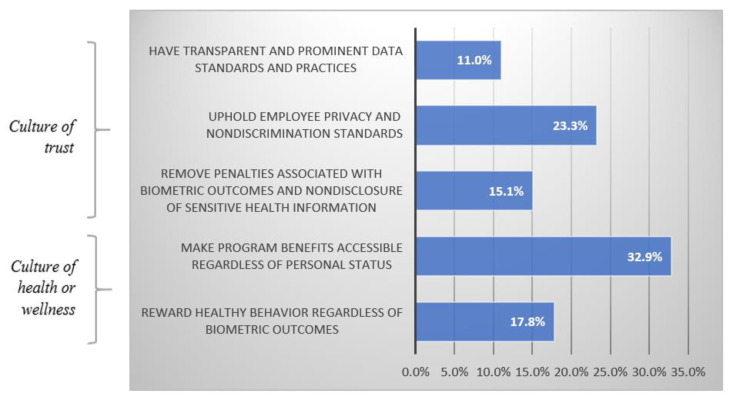
Employers in the United States (US) increasingly offer personalized wellness products as a workplace benefit. In doing so, those employers must be cognizant of not only US law but also European Union (EU) law to the extent that the EU law applies to European immigrants or guest workers in the US. To the extent that wellness programs are implemented in either public health or employment contexts within the US and/or EU, sponsors of these programs can partner with direct-to-consumer (DTC) genetic testing companies and other digital health companies to generate, collect, and process sensitive health information that are loosely or partially regulated from a privacy and nondiscrimination standpoint. Balancing claims about the benefits of wellness programs are concerns about employee health privacy and discrimination and the current unregulated nature of consumer health data. We qualitatively explored the concerns and opinions of public and legislative stakeholders in the US to determine key themes and develop privacy and nondiscrimination best practices. Key themes emerged as promoting a culture of trust and wellness. Best practices within these themes were: (1) have transparent and prominent data standards and practices, (2) uphold employee privacy and nondiscrimination standards, (3) remove penalties associated with biometric outcomes and nondisclosure of sensitive health information, (4) reward healthy behavior regardless of biometric outcomes, and (5) make program benefits accessible regardless of personal status. Employers, DTC genetic testing companies, policymakers, and stakeholders broadly should consider these themes and best practices in the current absence of broad regulations on nondiscriminatory workplace wellness programs.
美国的雇主越来越多地提供个性化的健康产品作为职场福利。在这样做的过程中,这些雇主不仅必须了解美国法律,还必须了解欧盟法律,只要欧盟法律适用于在美国的欧洲移民或外来务工人员。就健康计划在美国和/或欧盟的公共卫生或就业环境中实施的程度而言,这些计划的发起者可以与直接面向消费者(DTC)的基因检测公司和其他数字健康公司合作,以生成、收集和处理从隐私和非歧视角度受到宽松或部分监管的敏感健康信息。在权衡健康计划的益处的同时,人们也担心员工的健康隐私和歧视问题,以及消费者健康数据目前不受监管的性质。我们定性地探讨了美国公众和立法利益相关者的担忧和意见,以确定关键主题并制定隐私和非歧视的最佳实践。关键主题是促进信任和健康的文化。这些主题中的最佳实践包括:(1)拥有透明且突出的数据标准和实践,(2)维护员工隐私和非歧视标准,(3)消除与生物特征结果及不披露敏感健康信息相关的惩罚,(4)无论生物特征结果如何都奖励健康行为,(5)无论个人状况如何都能获得计划福利。在目前缺乏关于非歧视性职场健康计划的广泛法规的情况下,雇主、DTC基因检测公司、政策制定者和广大利益相关者应考虑这些主题和最佳实践。