Pitt Daniel, Sevane Natalia, Nicolazzi Ezequiel L, MacHugh David E, Park Stephen D E, Colli Licia, Martinez Rodrigo, Bruford Michael W, Orozco-terWengel Pablo
School of Biosciences Cardiff University Cardiff UK.
Parco Tecnologico Padano (PTP) Lodi Italy.
Evol Appl. 2018 Jul 23;12(1):123-136. doi: 10.1111/eva.12674. eCollection 2019 Jan.
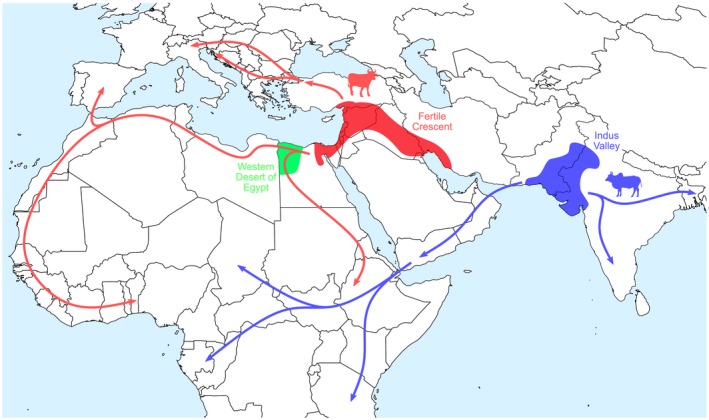
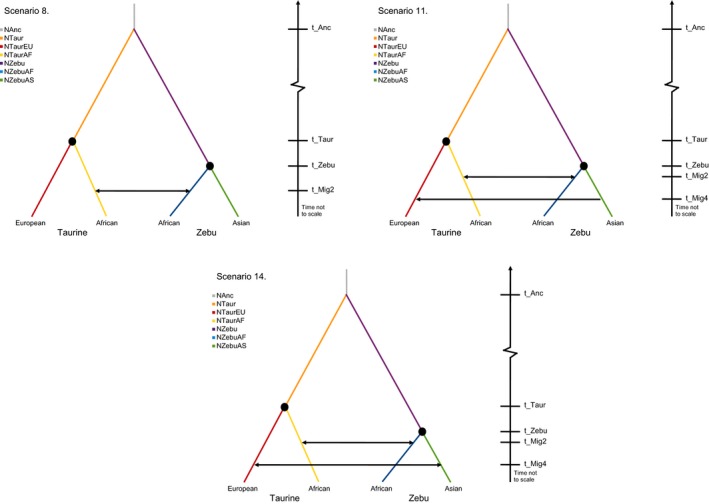
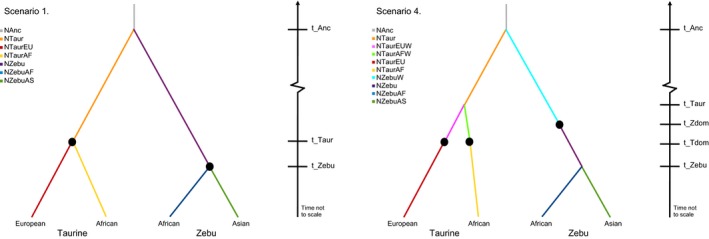
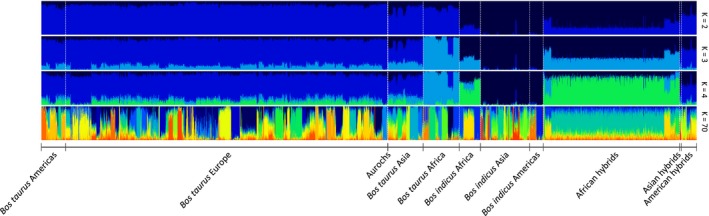
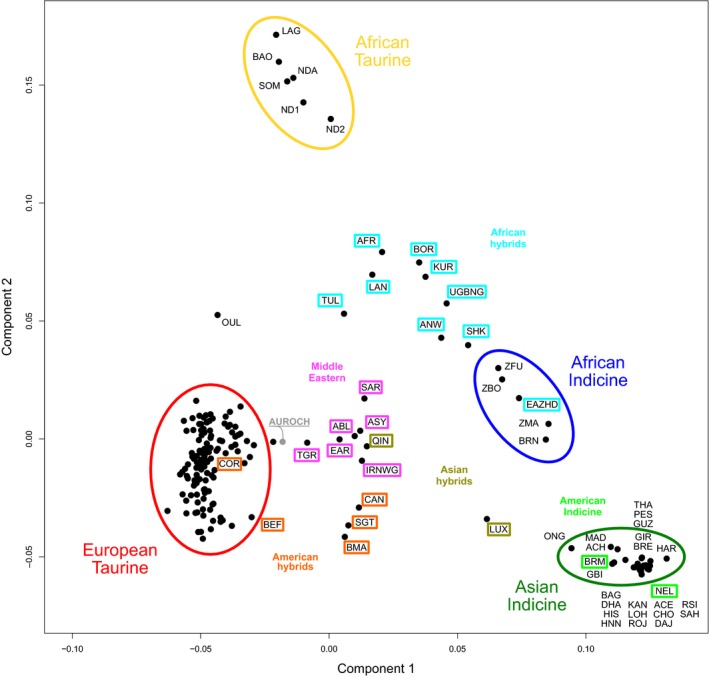
Cattle have been invaluable for the transition of human society from nomadic hunter-gatherers to sedentary farming communities throughout much of Europe, Asia and Africa since the earliest domestication of cattle more than 10,000 years ago. Although current understanding of relationships among ancestral populations remains limited, domestication of cattle is thought to have occurred on two or three occasions, giving rise to the taurine () and indicine () species that share the aurochs () as common ancestor 250,000 years ago. Indicine and taurine cattle were domesticated in the Indus Valley and Fertile Crescent, respectively; however, an additional domestication event for taurine in the Western Desert of Egypt has also been proposed. We analysed medium density Illumina Bovine SNP array (54,000 loci) data across 3,196 individuals, representing 180 taurine and indicine populations to investigate population structure within and between populations, and domestication and demographic dynamics using approximate Bayesian computation (ABC). Comparative analyses between scenarios modelling two and three domestication events consistently favour a model with only two episodes and suggest that the additional genetic variation component usually detected in African taurine cattle may be explained by hybridization with local aurochs in Africa after the domestication of taurine cattle in the Fertile Crescent. African indicine cattle exhibit high levels of shared genetic variation with Asian indicine cattle due to their recent divergence and with African taurine cattle through relatively recent gene flow. Scenarios with unidirectional or bidirectional migratory events between European taurine and Asian indicine cattle are also plausible, although further studies are needed to disentangle the complex human-mediated dispersion patterns of domestic cattle. This study therefore helps to clarify the effect of past demographic history on the genetic variation of modern cattle, providing a basis for further analyses exploring alternative migratory routes for early domestic populations.
自一万多年前最早驯化牛以来,在欧洲、亚洲和非洲的大部分地区,牛对于人类社会从游牧狩猎采集者向定居农耕社区的转变起到了极其重要的作用。尽管目前对祖先群体之间关系的了解仍然有限,但一般认为牛的驯化发生过两到三次,产生了约25万年前以原牛为共同祖先的普通牛()和瘤牛()。瘤牛和普通牛分别在印度河流域和新月沃地被驯化;不过,也有人提出普通牛在埃及西部沙漠还有一次额外的驯化事件。我们分析了3196个个体的中密度Illumina牛SNP芯片(约54000个位点)数据,这些个体代表180个普通牛和瘤牛群体,以研究群体内部和群体之间的群体结构,以及使用近似贝叶斯计算(ABC)来分析驯化和人口动态。对模拟两次和三次驯化事件的情景进行的比较分析一致支持只有两次驯化事件的模型,并表明通常在非洲普通牛中检测到的额外遗传变异成分可能是由于在新月沃地驯化普通牛之后与非洲当地原牛杂交所致。非洲瘤牛由于与亚洲瘤牛分歧时间较近,以及通过相对较新的基因流动与非洲普通牛存在联系,因此与亚洲瘤牛表现出高度的共享遗传变异。欧洲普通牛和亚洲瘤牛之间存在单向或双向迁徙事件的情景也有可能,不过需要进一步研究来理清家牛复杂的人类介导的扩散模式。因此,这项研究有助于阐明过去的人口历史对现代牛遗传变异的影响,为进一步分析探索早期家养群体的替代迁徙路线提供了基础。