Department of Zoology & Environment Sciences, Faculty of Science, University of Colombo, Colombo 3, Sri Lanka.
Department of Parasitology, Faculty of Medical Sciences, University of Sri Jayewardenepura, Nugegoda, Sri Lanka.
Malar J. 2020 Dec 7;19(1):452. doi: 10.1186/s12936-020-03527-8.
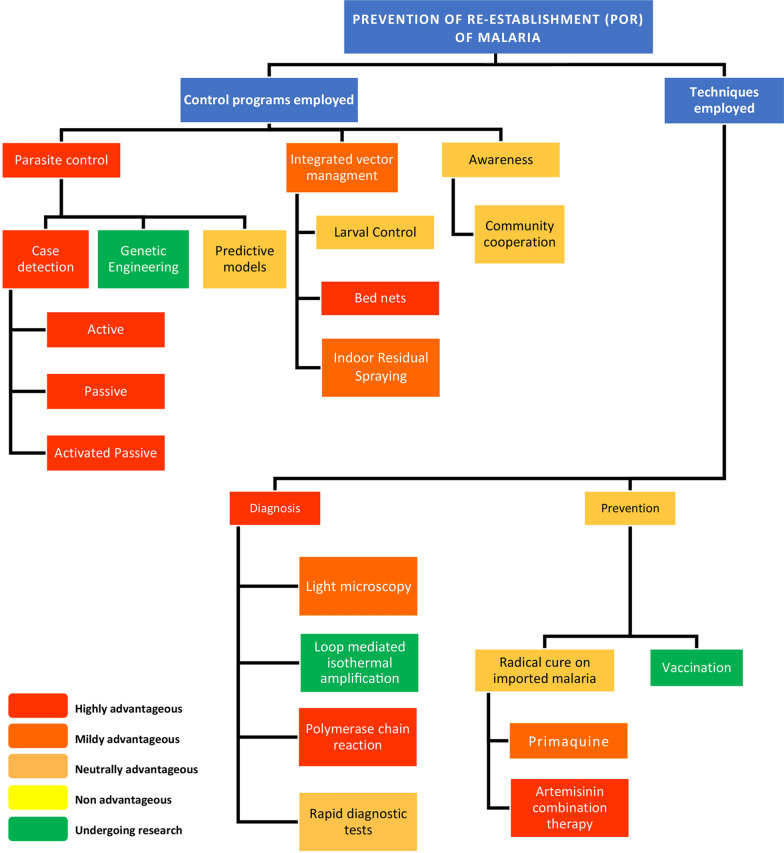
Prevention of re-establishment (POR) refers to the prevention of malaria outbreak/epidemic occurrence or preventing re-establishment of indigenous malaria in a malaria-free country. Understanding the effectiveness of the various strategies used for POR is, therefore, of vital importance to countries certified as "malaria-free" or to the countries to be thus certified in the near future. This review is based on extensive review of literature on both the POR strategies and elimination schemes of countries, (i) that have reached malaria-free status (e.g. Armenia, Mauritius, Sri Lanka), (ii) those that are reaching pre-elimination stage (e.g. South Korea), and (iii) countries at the control phase (e.g. India). History has clearly shown that poorly implemented POR programmes can result in deadly consequences (e.g. Sri Lanka); conversely, there are examples of robust POR programmes that have sustained malaria free status that can serve as examples to countries working toward elimination. Countries awaiting malaria elimination status should pre-plan their POR strategies. Malaria-free countries face the risk of resurgence mostly due to imported malaria cases; thus, a robust passenger screening programme and cross border collaborations are crucial in a POR setting. In addition, sustained vigilance, and continued funding for the national anti-malarial campaign programme and for related research is of vital importance for POR. With distinct intrinsic potential for malaria in each country, tailor-made POR programmes are built through continuous and robust epidemiological and entomological surveillance, particularly in countries such as Sri Lanka with increased receptivity and vulnerability for malaria transmission. In summary, across all five countries under scrutiny, common strengths of the POR programmes are (i) a multipronged approach, (ii) strong passive, active, and activated passive case detection, (iii) Indoor residual spraying (IRS), and (iv) health education/awareness programmes.
预防再传播(POR)是指预防疟疾暴发/流行,或防止无疟疾国家出现本地疟疾再传播。因此,了解 POR 所采用的各种策略的有效性对被认证为“无疟疾”的国家或即将在不久的将来获得认证的国家至关重要。本综述基于对 POR 策略和已达到无疟疾状态的国家(如亚美尼亚、毛里求斯、斯里兰卡)、即将进入消除阶段的国家(如韩国)以及处于控制阶段的国家(如印度)的消除计划的文献进行广泛回顾。历史清楚地表明,实施不力的 POR 计划可能会导致致命后果(例如,斯里兰卡);相反,也有一些强有力的 POR 计划维持了无疟疾状态,这些计划可以作为其他国家消除疟疾的榜样。等待获得消除疟疾地位的国家应预先规划其 POR 策略。无疟疾国家面临着因输入性疟疾病例而重新出现疟疾的风险;因此,在 POR 环境中,建立强大的旅客筛查计划和跨境合作至关重要。此外,持续的警惕、持续的资金投入,用于国家抗疟运动计划和相关研究,对于 POR 也至关重要。每个国家都有独特的疟疾内在潜力,通过持续和强有力的流行病学和昆虫学监测,特别是在像斯里兰卡这样疟疾传播的易感性和脆弱性增加的国家,制定定制化的 POR 计划。总之,在审查的五个国家中,POR 计划的共同优势包括:(i)多管齐下的方法;(ii)强大的被动、主动和激活的被动病例检测;(iii)室内滞留喷洒(IRS);以及(iv)健康教育/意识计划。