K.G. Jebsen Centre for Deep Sea Research, University of Bergen, 5007 Bergen, Norway;
School of Marine Science and Policy, University of Delaware, Lewes, DE 19958.
Proc Natl Acad Sci U S A. 2020 Dec 22;117(51):32617-32626. doi: 10.1073/pnas.2005917117. Epub 2020 Dec 7.
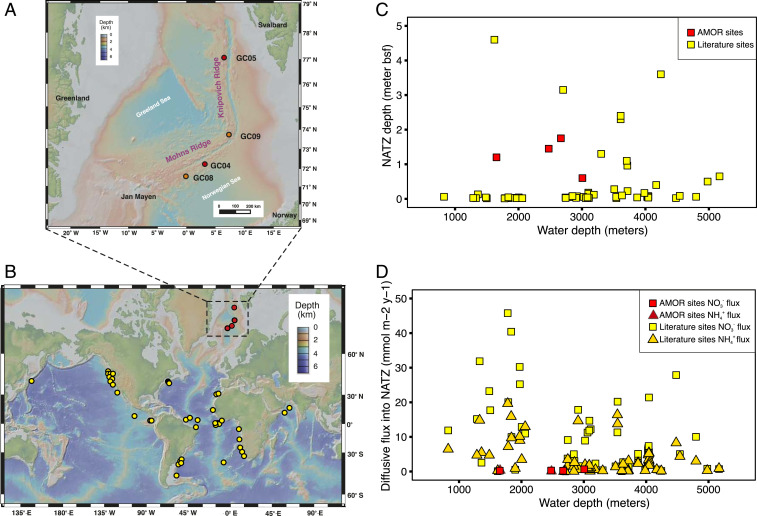
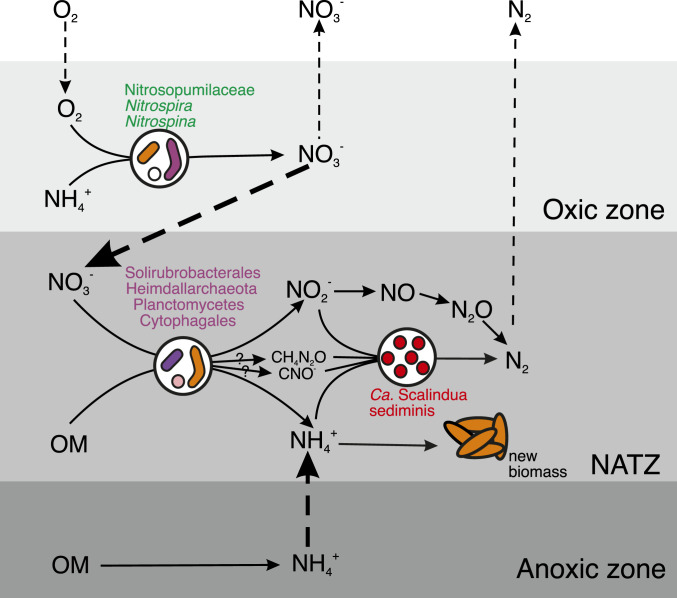
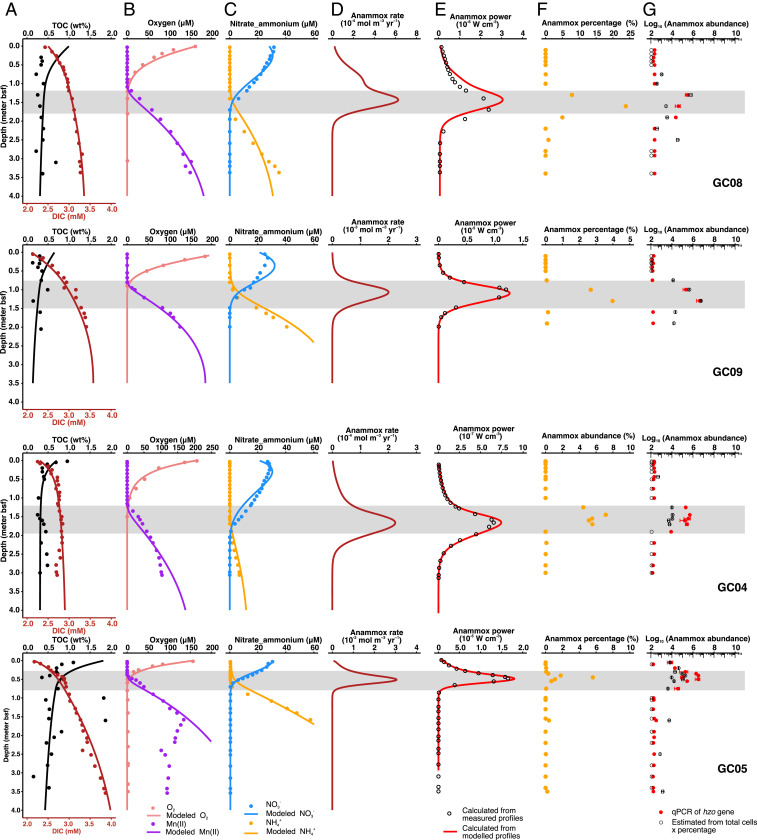
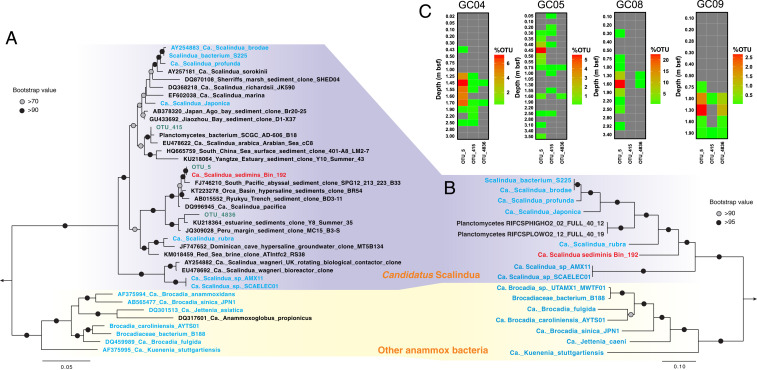
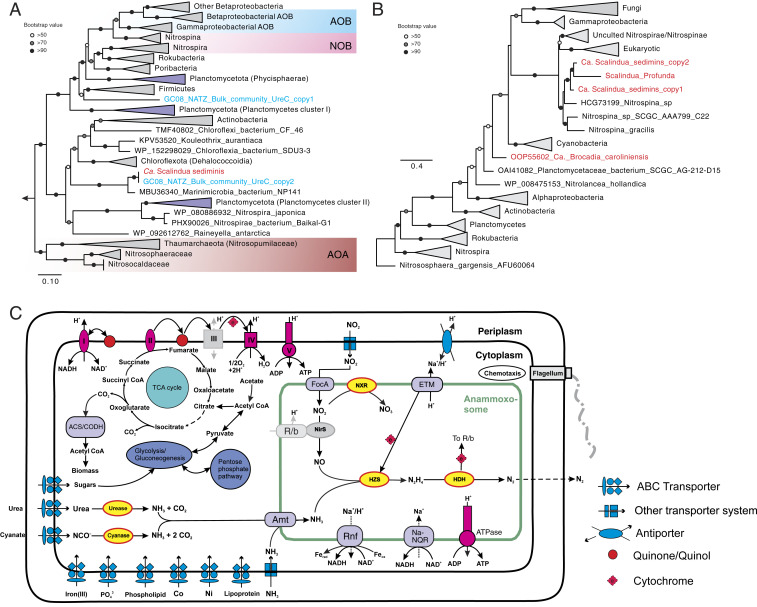
No other environment hosts as many microbial cells as the marine sedimentary biosphere. While the majority of these cells are expected to be alive, they are speculated to be persisting in a state of maintenance without net growth due to extreme starvation. Here, we report evidence for in situ growth of anaerobic ammonium-oxidizing (anammox) bacteria in ∼80,000-y-old subsurface sediments from the Arctic Mid-Ocean Ridge. The growth is confined to the nitrate-ammonium transition zone (NATZ), a widespread geochemical transition zone where most of the upward ammonium flux from deep anoxic sediments is being consumed. In this zone the anammox bacteria abundances, assessed by quantification of marker genes, consistently displayed a four order of magnitude increase relative to adjacent layers in four cores. This subsurface cell increase coincides with a markedly higher power supply driven mainly by intensified anammox reaction rates, thereby providing a quantitative link between microbial proliferation and energy availability. The reconstructed draft genome of the dominant anammox bacterium showed an index of replication (iRep) of 1.32, suggesting that 32% of this population was actively replicating. The genome belongs to a species which we name , so far exclusively found in marine sediments. It has the capacity to utilize urea and cyanate and a mixotrophic lifestyle. Our results demonstrate that specific microbial groups are not only able to survive unfavorable conditions over geological timescales, but can proliferate in situ when encountering ideal conditions with significant consequences for biogeochemical nitrogen cycling.
没有其他环境能像海洋沉积生物圈那样容纳如此多的微生物细胞。虽然大多数这些细胞预计是存活的,但由于极度饥饿,它们可能处于维持状态而没有净生长。在这里,我们报告了在北极中洋脊约 8 万年前的地下沉积物中,厌氧氨氧化(anammox)细菌原位生长的证据。这种生长仅限于硝酸盐-铵过渡区(NATZ),这是一个广泛存在的地球化学过渡区,大部分来自深层缺氧沉积物的向上铵通量都在此被消耗。在这个区域,通过定量标记基因来评估的 anammox 细菌丰度与四个核心中相邻层相比,一致显示出四个数量级的增加。这种地下细胞的增加与明显更高的电源供应相一致,主要是由强化的 anammox 反应速率驱动的,从而在微生物增殖和能源供应之间建立了定量联系。优势 anammox 细菌的重建草图基因组显示复制指数(iRep)为 1.32,表明该种群中有 32%的细菌正在积极复制。该基因组属于一种以前仅在海洋沉积物中发现的 种,我们将其命名为 。它具有利用尿素和氰酸盐的能力和混合营养的生活方式。我们的研究结果表明,特定的微生物群体不仅能够在地质时间尺度上存活不利条件,而且在遇到具有重要生物地球化学氮循环意义的理想条件时能够在原地增殖。