Kim Yoon Hee, Kim Young Suh, Park Younhee, Kim Soo Yeon, Kim Kyung Won, Kim Hyon Suk, Sohn Myung Hyun
Department of Pediatrics, Institute of Allergy, Institute of Immunology and Immunological Diseases, Brain Korea 21 PLUS Project for Medical Science, Yonsei University College of Medicine, Seoul 03722, Korea.
Gangnam Severance Hospital, Seoul 06273, Korea.
J Clin Med. 2020 Dec 5;9(12):3942. doi: 10.3390/jcm9123942.
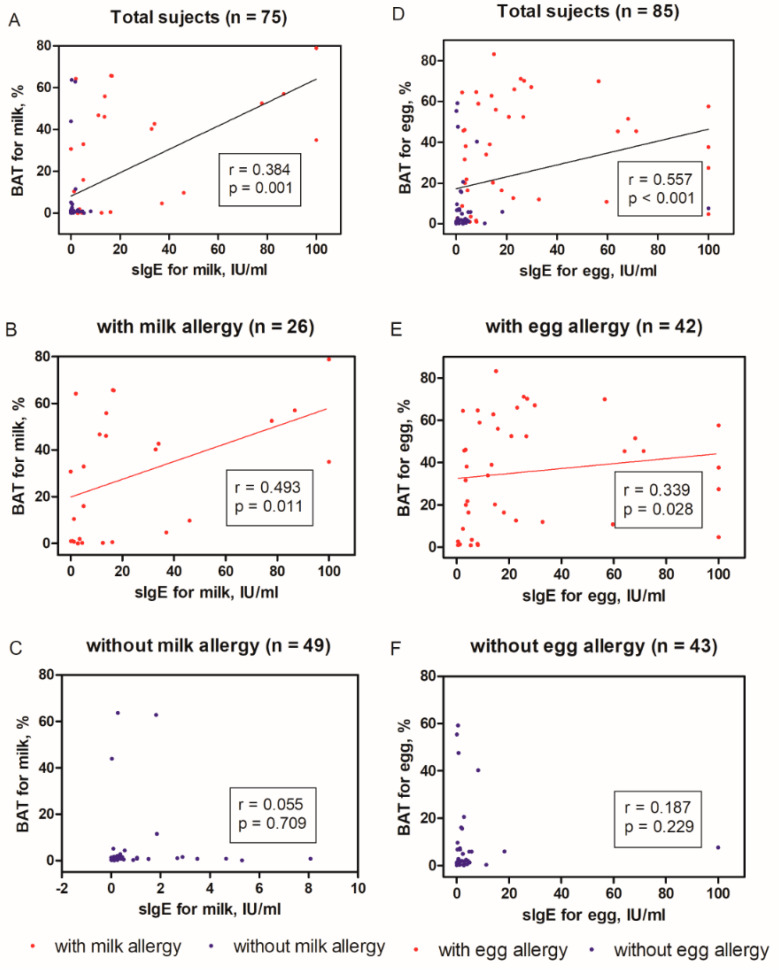
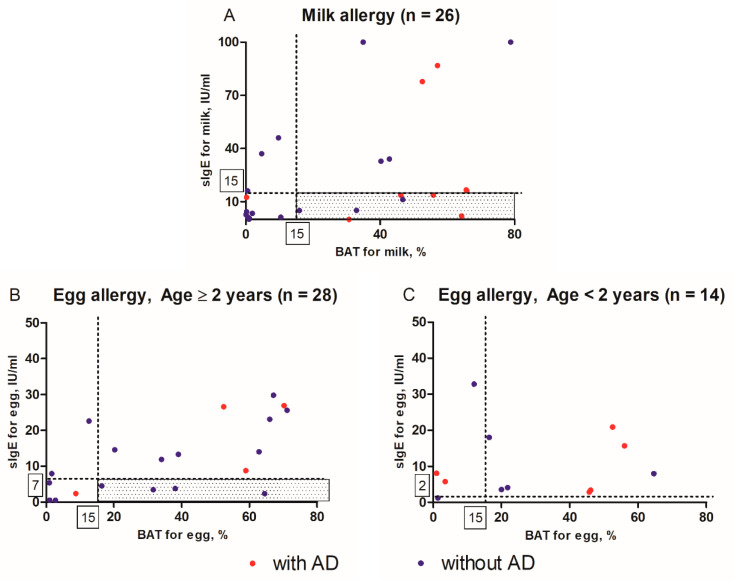
In children with concomitant food allergy and atopic dermatitis (AD), uncovering the causative food allergen is more arduous. We evaluated the basophil activation test (BAT) for its diagnostic value in children, including those with AD, for milk or egg allergy. We simultaneously measured serum-specific immunoglobulin E (sIgE) levels and performed BATs for cow's milk and egg white. We compared their overall diagnostic performance using the area under the receiver operating characteristic curve (AUC) with the Delong method and compared them in children with AD. Analyses were completed for 75 children for milk allergy and for 85 children for egg allergy. The sIgE and percentage of basophils with the expression of CD63 were correlated for both milk (r = 0.384, < 0.001) and egg (r = 0.557, < 0.001). The AUC of sIgE (0.701) for milk allergy was significantly increased when combined with the BAT (0.805; = 0.029). In children with AD, the AUC of the BAT (0.924) for milk allergy was significantly larger than that of sIgE (0.701; = 0.017). The BAT is a potentially useful diagnostic tool for milk allergy in children when combined with sIgE. Moreover, it may be a surrogate marker for milk allergy in children with AD.
在同时患有食物过敏和特应性皮炎(AD)的儿童中,找出引起过敏的食物过敏原更加困难。我们评估了嗜碱性粒细胞活化试验(BAT)对包括患有AD的儿童在内的牛奶或鸡蛋过敏儿童的诊断价值。我们同时测量了血清特异性免疫球蛋白E(sIgE)水平,并对牛奶和蛋清进行了BAT检测。我们使用德龙方法通过受试者操作特征曲线下面积(AUC)比较了它们的总体诊断性能,并在患有AD的儿童中进行了比较。对75名牛奶过敏儿童和85名鸡蛋过敏儿童完成了分析。牛奶(r = 0.384,<0.001)和鸡蛋(r = 0.557,<0.001)的sIgE与表达CD63的嗜碱性粒细胞百分比均相关。牛奶过敏的sIgE的AUC(0.701)与BAT联合使用时显著增加(0.805;P = 0.029)。在患有AD的儿童中,牛奶过敏的BAT的AUC(0.924)显著大于sIgE的AUC(0.701;P = 0.017)。BAT与sIgE联合使用时,可能是儿童牛奶过敏的一种有用诊断工具。此外,它可能是患有AD的儿童牛奶过敏的替代标志物。