Farhadian Maryam, Torkaman Sima, Mojarad Farzad
Department of Biostatistics, School of Public Health and Research Center for Health Sciences, Hamadan University of Medical Sciences, Hamadan, Iran.
Pediatric Dentistry Department, Dentistry School, Hamadan University of Medical Sciences, Hamadan, Iran.
BMC Sports Sci Med Rehabil. 2020 Nov 11;12(1):69. doi: 10.1186/s13102-020-00217-5.
Traumatic dental injuries are one of the most important problems with major physical, aesthetic, psychological, social, functional and therapeutic problems that adversely affect the quality of life of children and adolescents. Recently the development of methods based on machine learning algorithms has provided researchers with more powerful tools to more accurate prediction in different domains and evaluate the factors affecting different phenomena more reliably than traditional regression models. This study tries to investigate the performance of random forest (RF) in identifying factors associated with sports-related dental injuries. Also, the accuracy of the RF model for predicting sports-related dental injuries was compared with logistic regression model as traditional competitor.
This cross-sectional study was applied to 356 athlete children aged 6 to 13-year-old in Hamadan, Iran. Random forest and logistic regression constructed by using sports-related dental injuries as response variables and age, sex, parent's education, child's birth order, type of sports activity, duration of sports activity, awareness regarding the mouthguard, mouthguard use as input. A self-reported questionnaire was used to obtain information.
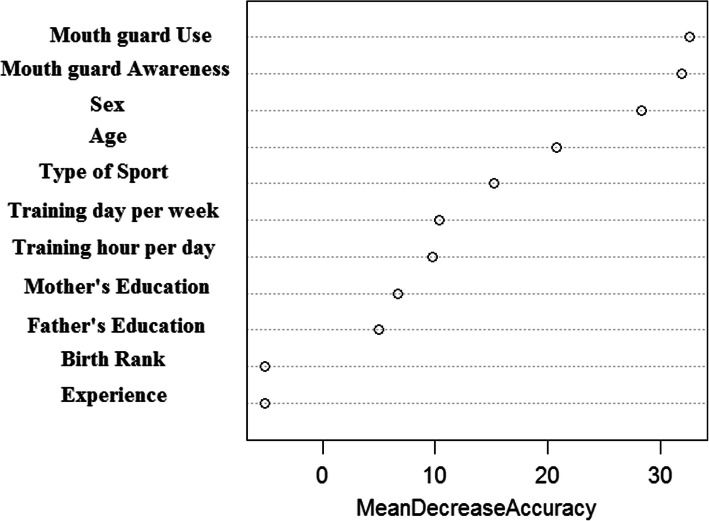
Fifty-five (15.4%) subjects had experienced a sports-related dental injury. The mean age of children with sports injuries was significantly higher than children without the experience of injury (p = 0.006). The prevalence of injury was significantly higher in boys (p = 0.008). Children with illiterate mothers are more likely to be injured than children with educated mothers (p = 0.045). Awareness of mouthguard and its use during exercise has a significant effect on reducing the prevalence of injury among users (p < 0.001). Random forest model has a higher prediction accuracy (89.3%) for predicting sports-related dental injuries compared to the logistic regression (84.2%). The results of the relative importance of variables, based on RF showed, mouthguard use, and mouthguard awareness has more contributed importance in dental sport-related injuries' prediction. Subsequently, the importance of sex and age is in the next position.
Using predictive models such as RF challenges existing inaccurate predictions due to high complexity and interactions between variables would be minimized. This helps to achieve more accurate identification of factors in sport-related dental injury among the general population of children.
创伤性牙损伤是最重要的问题之一,会带来严重的身体、美学、心理、社会、功能和治疗方面的问题,对儿童和青少年的生活质量产生不利影响。近年来,基于机器学习算法的方法发展为研究人员提供了更强大的工具,与传统回归模型相比,能在不同领域进行更准确的预测,并更可靠地评估影响不同现象的因素。本研究试图探讨随机森林(RF)在识别与运动相关牙损伤相关因素方面的性能。此外,还将RF模型预测运动相关牙损伤的准确性与作为传统竞争对手的逻辑回归模型进行了比较。
本横断面研究应用于伊朗哈马丹356名6至13岁的运动员儿童。以运动相关牙损伤作为响应变量,年龄、性别、父母教育程度、孩子出生顺序、体育活动类型、体育活动持续时间、对护齿器的认知、护齿器使用情况作为输入,构建随机森林和逻辑回归模型。使用自填式问卷获取信息。
55名(15.4%)受试者经历过运动相关牙损伤。运动损伤儿童的平均年龄显著高于未经历损伤的儿童(p = 0.006)。男孩的损伤患病率显著更高(p = 0.008)。母亲为文盲的儿童比母亲受过教育的儿童更容易受伤(p = 0.045)。对护齿器及其在运动中的使用的认知对降低使用者中的损伤患病率有显著影响(p < 0.001)。与逻辑回归(84.2%)相比,随机森林模型在预测运动相关牙损伤方面具有更高的预测准确性(89.3%)。基于RF的变量相对重要性结果显示,护齿器使用和护齿器认知在与牙运动相关损伤的预测中贡献的重要性更大。随后,性别和年龄的重要性排在其次。
使用如RF这样的预测模型,由于变量之间的高复杂性和相互作用,可挑战现有的不准确预测,并将其降至最低。这有助于在儿童总体人群中更准确地识别与运动相关牙损伤的因素。