Bilukha Oleg, Couture Alexia, McCain Kelly, Leidman Eva
Emergency Response and Recovery Branch, Division of Global Health Protection, Center for Global Health, Centers for Disease Control, 1600 Clifton Road, Atlanta, GA, 30329, USA.
Rollins School of Public Health, Emory University, Atlanta, USA.
BMC Nutr. 2020 Nov 13;6(1):60. doi: 10.1186/s40795-020-00385-0.
Ensuring the quality of anthropometry data is paramount for getting accurate estimates of malnutrition prevalence among children aged 6-59 months in humanitarian and refugee settings. Previous reports based on data from Demographic and Health Surveys suggested systematic differences in anthropometric data quality between the younger and older groups of preschool children.
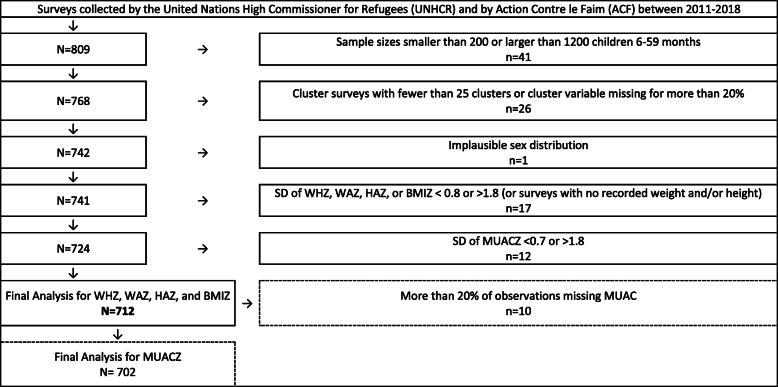
We analyzed 712 anthropometric population-representative field surveys from humanitarian and refugee settings conducted during 2011-2018. We examined and compared the quality of five anthropometric indicators in children aged 6-23 months and children aged 24-59 months: weight for height, weight for age, height for age, body mass index for age and mid-upper arm circumference (MUAC) for age. Using the z-score distribution of each indicator, we calculated the following parameters: standard deviation (SD), percentage of outliers, and measures of distribution normality. We also examined and compared the quality of height, weight, MUAC and age measurements using missing data and rounding criteria.
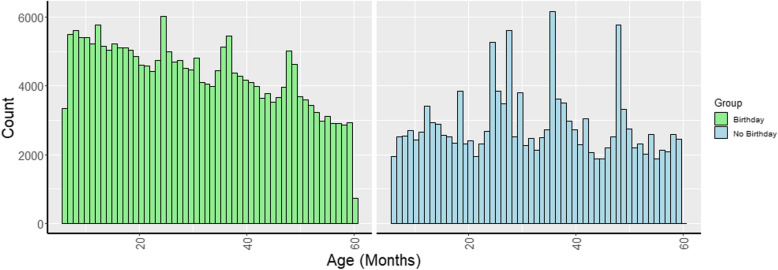
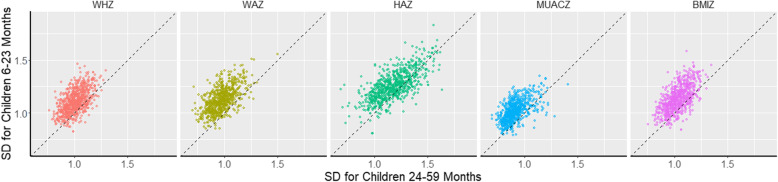
Both SD and percentage of flags were significantly smaller on average in older than in younger age group for all five anthropometric indicators. Differences in SD between age groups did not change meaningfully depending on overall survey quality or on the quality of age ascertainment. Over 50% of surveys overall did not deviate significantly from normality. The percentage of non-normal surveys was higher in older than in the younger age groups. Digit preference score for weight, height and MUAC was slightly higher in younger age group, and for age slightly higher in the older age group. Children with reported exact date of birth (DOB) had much lower digit preference for age than those without exact DOB. SD, percentage flags and digit preference scores were positively correlated between the two age groups at the survey level, such as those surveys showing higher anthropometry data quality in younger age group also tended to show higher quality in older age group.
There should be an emphasis on increased rigor of training survey measurers in taking anthropometric measurements in the youngest children. Standardization test, a mandatory component of the pre-survey measurer training and evaluation, of 10 children should include at least 4-5 children below 2 years of age.
在人道主义和难民环境中,确保人体测量数据的质量对于准确估计6至59个月儿童的营养不良患病率至关重要。先前基于人口与健康调查数据的报告表明,学龄前儿童中较年幼和较年长者在人体测量数据质量上存在系统性差异。
我们分析了2011年至2018年期间在人道主义和难民环境中进行的712项具有人口代表性的人体测量现场调查。我们检查并比较了6至23个月儿童和24至59个月儿童的五项人体测量指标的质量:身高别体重、年龄别体重、年龄别身高、年龄别体重指数和年龄别上臂中段周长(MUAC)。利用每个指标的z分数分布,我们计算了以下参数:标准差(SD)、异常值百分比和分布正态性度量。我们还使用缺失数据和舍入标准检查并比较了身高、体重、MUAC和年龄测量的质量。
对于所有五项人体测量指标,较年长者的标准差和标记百分比平均显著低于较年幼者。年龄组之间标准差的差异不会因总体调查质量或年龄确定质量而有显著变化。总体上超过50%的调查与正态性没有显著偏差。非正态调查的百分比在较年长者中高于较年幼者。较年幼者体重、身高和MUAC的数字偏好得分略高,而年龄的数字偏好得分在较年长者中略高。报告了确切出生日期(DOB)的儿童年龄的数字偏好远低于未报告确切DOB的儿童。在调查层面,两个年龄组的标准差、标记百分比和数字偏好得分呈正相关,例如那些在较年幼者中显示较高人体测量数据质量的调查在较年长者中也往往显示较高质量。
应强调提高调查测量人员对最年幼儿童进行人体测量时的培训严谨性。预调查测量人员培训和评估的强制性组成部分标准化测试,对于10名儿童,应至少包括4至5名2岁以下儿童。