Department of Medicine, Boston Children's Hospital, Boston, Massachusetts, USA.
Bristol Dental School, University of Bristol, Bristol, United Kingdom.
mBio. 2020 Dec 8;11(6):e01907-20. doi: 10.1128/mBio.01907-20.
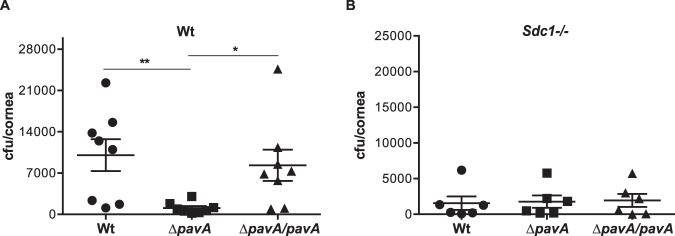
Subversion of heparan sulfate proteoglycans (HSPGs) is thought to be a common virulence mechanism shared by many microbial pathogens. The prevailing assumption is that pathogens co-opt HSPGs as cell surface attachment receptors or as inhibitors of innate host defense. However, there are few data that clearly support this idea We found that deletion of syndecan-1 (Sdc1), a major cell surface HSPG of epithelial cells, causes a gain of function in a mouse model of scarified corneal infection, where corneas were significantly less susceptible to infection. Administration of excess Sdc1 ectodomains significantly inhibited corneal infection, suggesting that Sdc1 promotes infection as a cell surface attachment receptor. However, did not interact with Sdc1 and Sdc1 was shed upon infection, indicating that Sdc1 does not directly support adhesion. Instead, Sdc1 promoted adhesion by driving the assembly of fibronectin (FN) fibrils in the corneal basement membrane to which attaches when infecting injured corneas. specifically bound to corneal FN via PavA, and PavA deletion significantly attenuated virulence in the cornea. Excess Sdc1 ectodomains inhibited corneal infection by binding to the Hep II domain and interfering with PavA binding to FN. These findings reveal a previously unknown virulence mechanism of where key extracellular matrix (ECM) interactions and structures that are essential for host cell homeostasis are exploited for bacterial pathogenesis. Bacterial pathogens have evolved several ingenious mechanisms to subvert host cell biology for their pathogenesis. Bacterial attachment to the host ECM establishes a niche to grow and is considered one of the critical steps of infection. This pathogenic mechanism entails coordinated assembly of the ECM by the host to form the ECM structure and organization that are specifically recognized by bacteria for their adhesion. We serendipitously discovered that epithelial Sdc1 facilitates the assembly of FN fibrils in the corneal basement membrane and that this normal biological function of Sdc1 has detrimental consequences for the host in corneal infection. Our studies suggest that bacterial subversion of the host ECM is more complex than previously appreciated.
硫酸乙酰肝素蛋白聚糖 (HSPG) 的颠覆被认为是许多微生物病原体共有的常见毒力机制。普遍的假设是病原体将 HSPG 作为细胞表面附着受体或作为先天宿主防御的抑制剂来利用。然而,很少有数据清楚地支持这一观点。我们发现,上皮细胞主要的细胞表面 HSPG 之一 syndecan-1 (Sdc1) 的缺失会导致划痕角膜感染的小鼠模型中功能获得,其中角膜对感染的敏感性显著降低。过量的 Sdc1 外显子显著抑制了感染,表明 Sdc1 作为细胞表面附着受体促进感染。然而,并没有与 Sdc1 相互作用,并且 Sdc1 在感染时被脱落,表明 Sdc1 不直接支持附着。相反,Sdc1 通过驱动角膜基底膜中纤维连接蛋白 (FN) 纤维的组装来促进 附着,当感染受伤的角膜时,附着在 FN 上。通过 PavA 特异性地结合角膜 FN,并且 PavA 缺失显著减弱了在角膜中的毒力。过量的 Sdc1 外显子通过结合 Hep II 结构域并干扰 PavA 与 FN 的结合来抑制 感染。这些发现揭示了一种以前未知的 毒力机制,其中关键的细胞外基质 (ECM) 相互作用和结构对于宿主细胞稳态被利用来进行细菌发病机制。细菌病原体已经进化出几种巧妙的机制来颠覆宿主细胞生物学以进行发病机制。细菌与宿主 ECM 的附着建立了一个生长的小生境,被认为是感染的关键步骤之一。这种致病机制需要宿主协调 ECM 的组装,以形成 ECM 结构和组织,这些结构和组织被细菌特异性识别以进行附着。我们偶然发现上皮细胞 Sdc1 促进了角膜基底膜中 FN 纤维的组装,而 Sdc1 的这种正常生物学功能在角膜感染中对宿主有不利影响。我们的研究表明,细菌对宿主 ECM 的颠覆比以前认为的要复杂。