Max-Planck-Institut für Molekulare Pflanzenphysiologie, Am Mühlenberg 1, D-14476, Potsdam-Golm, Germany.
University of California Los Angeles, Department of Chemistry and Biochemistry, and Institute for Genomics and Proteomics, 607 Charles E. Young Dr. East, Los Angeles, CA, 90095, USA.
Nat Commun. 2020 Dec 8;11(1):6269. doi: 10.1038/s41467-020-19983-4.
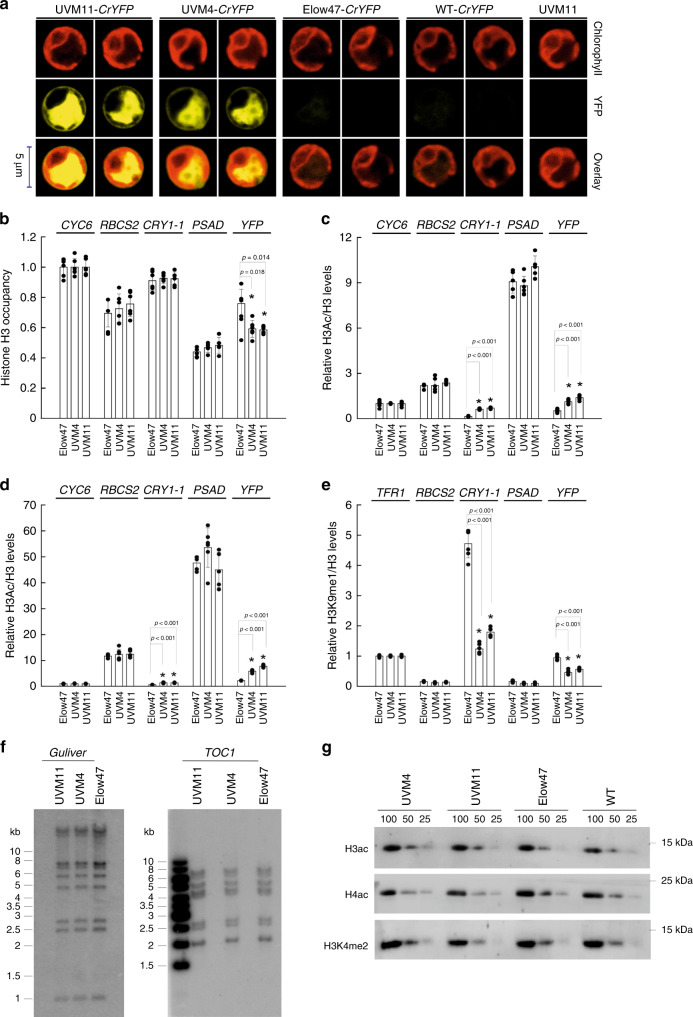
Silencing of exogenous DNA can make transgene expression very inefficient. Genetic screens in the model alga Chlamydomonas have demonstrated that transgene silencing can be overcome by mutations in unknown gene(s), thus producing algal strains that stably express foreign genes to high levels. Here, we show that the silencing mechanism specifically acts on transgenic DNA. Once a permissive chromatin structure has assembled, transgene expression can persist even in the absence of mutations disrupting the silencing pathway. We have identified the gene conferring the silencing and show it to encode a sirtuin-type histone deacetylase. Loss of gene function does not appreciably affect endogenous gene expression. Our data suggest that transgenic DNA is recognized and then quickly inactivated by the assembly of a repressive chromatin structure composed of deacetylated histones. We propose that this mechanism may have evolved to provide protection from potentially harmful types of environmental DNA.
外源 DNA 的沉默会使转基因表达非常低效。在模式藻类衣藻中的遗传筛选已经表明,通过未知基因(多个)的突变可以克服转基因沉默,从而产生能够稳定表达外源基因的藻类株系,达到高表达水平。在这里,我们表明沉默机制专门作用于转基因 DNA。一旦组装了允许的染色质结构,即使在没有破坏沉默途径的突变的情况下,转基因表达也可以持续存在。我们已经鉴定出赋予沉默的基因,并表明它编码一种组蛋白去乙酰化酶的 Sirtuin 型。该基因功能的丧失不会明显影响内源性基因表达。我们的数据表明,转基因 DNA 被识别,然后通过组装由去乙酰化组蛋白组成的抑制性染色质结构而迅速失活。我们提出,这种机制可能是为了提供对潜在有害类型的环境 DNA 的保护而进化而来的。