Collister David, Pohl Kayla, Herrington Gwen, Lee Shun Fu, Rabbat Christian, Tennankore Karthik, Zimmermann Deborah, Tangri Navdeep, Wald Ron, Manns Braden, Suri Rita S, Nadeau-Fredette Annie-Claire, Goupil Remi, Silver Samuel A, Walsh Michael
Population Health Research Institute, Hamilton, ON, Canada.
Department of Medicine, McMaster University, Hamilton, ON, Canada.
Can J Kidney Health Dis. 2020 Nov 26;7:2054358120968959. doi: 10.1177/2054358120968959. eCollection 2020.
Restless legs syndrome (RLS) affects approximately 30% of patients with end-stage kidney disease and is associated with impaired sleep and health-related quality of life. Medications used to treat RLS in patients receiving dialysis may have an increased risk of adverse events with dose titration, and residual RLS symptoms are common despite the use of effective treatments. Randomized controlled trials of monotherapy and combination pharmacologic therapy for RLS in hemodialysis are needed.
To perform a randomized, crossover, placebo-controlled blinded trial of pharmacologic therapy for RLS in hemodialysis.
DESIGN/SETTING: The DIalysis Symptom COntrol-Restless Legs Syndrome (DISCO-RLS) trial is a randomized, crossover, placebo-controlled blinded trial of fixed low-dose pharmacologic therapy in patients receiving hemodialysis in 10 centers across Canada. It uses patient partners in its design, conduct, and reporting.
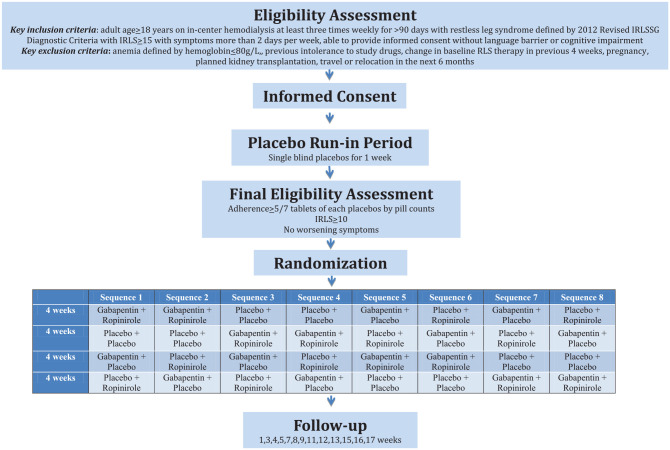
Adults receiving thrice-weekly hemodialysis for at least 3 months with RLS of at least mild symptoms defined International Restless Legs Syndrome Study Group Rating Scale (IRLS) of 10 or more will enter a double placebo run-in period to exclude nonadherent participants and those unable to tolerate double placebo. Seventy-two participants who completed the run-in period will be randomized to 1 of 8 treatment sequences based on modeling with 4 treatment periods.
Each treatment period lasts 4 weeks and consists of ropinirole 0.5 mg daily and gabapentin 100 mg daily, both together or neither with a double dummy placebo control for each treatment. The primary outcome is the difference in change scores of the IRLS between study treatments. Secondary outcomes are the differences in change scores of the Restless Legs Syndrome-6 Scale, patient global impression, 5-level EQ-5D version, and safety outcomes.
This randomized, crossover, placebo-controlled blinded trial will evaluate the efficacy and safety of fixed low-dose combination of ropinirole and gabapentin in patients receiving hemodialysis with RLS.
Patients with chronic kidney disease not on dialysis, kidney transplant recipients and those receiving peritoneal dialysis or home hemodialysis are not included. The intervention's long term safety and efficacy including the risk of augmentation is not captured.
This randomized crossover placebo controlled blinded trial will evaluate the efficacy and safety of fixed low-dose combination ropinirole and gabapentin in patients receiving hemodialysis with RLS.
ClinicalTrials.gov (NCT03806530).
不安腿综合征(RLS)影响约30%的终末期肾病患者,与睡眠障碍及健康相关生活质量受损有关。接受透析的患者用于治疗RLS的药物在剂量滴定过程中不良事件风险可能增加,且尽管使用了有效治疗方法,RLS残留症状仍很常见。需要针对血液透析患者RLS的单药治疗和联合药物治疗进行随机对照试验。
进行一项针对血液透析患者RLS的药物治疗的随机、交叉、安慰剂对照双盲试验。
设计/地点:透析症状控制-不安腿综合征(DISCO-RLS)试验是一项在加拿大10个中心对接受血液透析的患者进行的固定低剂量药物治疗的随机、交叉、安慰剂对照双盲试验。它在设计、实施和报告过程中采用了患者合作伙伴。
每周接受三次血液透析至少3个月且RLS症状至少为轻度(根据国际不安腿综合征研究组评分量表(IRLS)评分为10分或更高)的成年人将进入双安慰剂导入期,以排除不依从的参与者和无法耐受双安慰剂的参与者。完成导入期的72名参与者将根据4个治疗期的模型随机分配到8种治疗序列中的1种。
每个治疗期持续4周,包括每日服用0.5毫克罗匹尼罗和每日服用100毫克加巴喷丁,两者一起服用或均不服用,每种治疗均采用双模拟安慰剂对照。主要结局是研究治疗之间IRLS变化分数的差异。次要结局是不安腿综合征-6量表、患者整体印象、5级EQ-5D版本的变化分数差异以及安全性结局。
这项随机、交叉、安慰剂对照双盲试验将评估固定低剂量罗匹尼罗和加巴喷丁联合用药对接受血液透析的RLS患者的疗效和安全性。
未纳入未接受透析的慢性肾病患者、肾移植受者以及接受腹膜透析或家庭血液透析的患者。未评估干预措施的长期安全性和疗效,包括增敏风险。
这项随机交叉安慰剂对照双盲试验将评估固定低剂量罗匹尼罗和加巴喷丁联合用药对接受血液透析的RLS患者的疗效和安全性。
ClinicalTrials.gov(NCT03806530)。