Department of Animal Science, Iowa State University, Ames, IA, USA.
USDA-ARS-National Laboratory for Agriculture and the Environment, Ames, IA, USA.
J Nutr. 2021 Jan 4;151(1):223-234. doi: 10.1093/jn/nxaa356.
Restaurant oil in poultry diets increases energy content, reduces production costs, and promotes sustainability within the food supply chain. However, variable oil composition and heating temperatures among restaurant oil sources can impact broiler chicken health due to heat-induced lipid modifications.
A 21-d experiment was conducted to evaluate ileal morphology, liver cytokine gene expression, and ileal immune cell populations in broilers fed control or peroxidized lipids with varying chain and saturation characteristics.
Day-old broilers were housed in battery cages (5 birds per cage) and fed diets containing 5% control or peroxidized oils. Eight diets were randomly assigned in a 4 × 2 factorial arrangement consisting of oil source (palm, soybean, flaxseed, or fish) and peroxidation status (control or peroxidized). At day 21, samples were collected for ileal histomorphology [villus height (VH), crypt depth (CrD), and the VH:CrD ratio], and liver cytokine expression (qPCR). Ileum cytokine expression and T-cell markers were analyzed by RNAscope in situ hybridization (ISH). Data were analyzed as a mixed model (SAS 9.4) with fixed effects of lipid source, peroxidation, and lipid × peroxidation interaction.
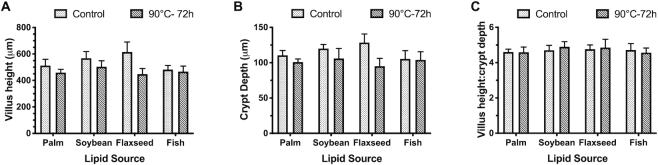
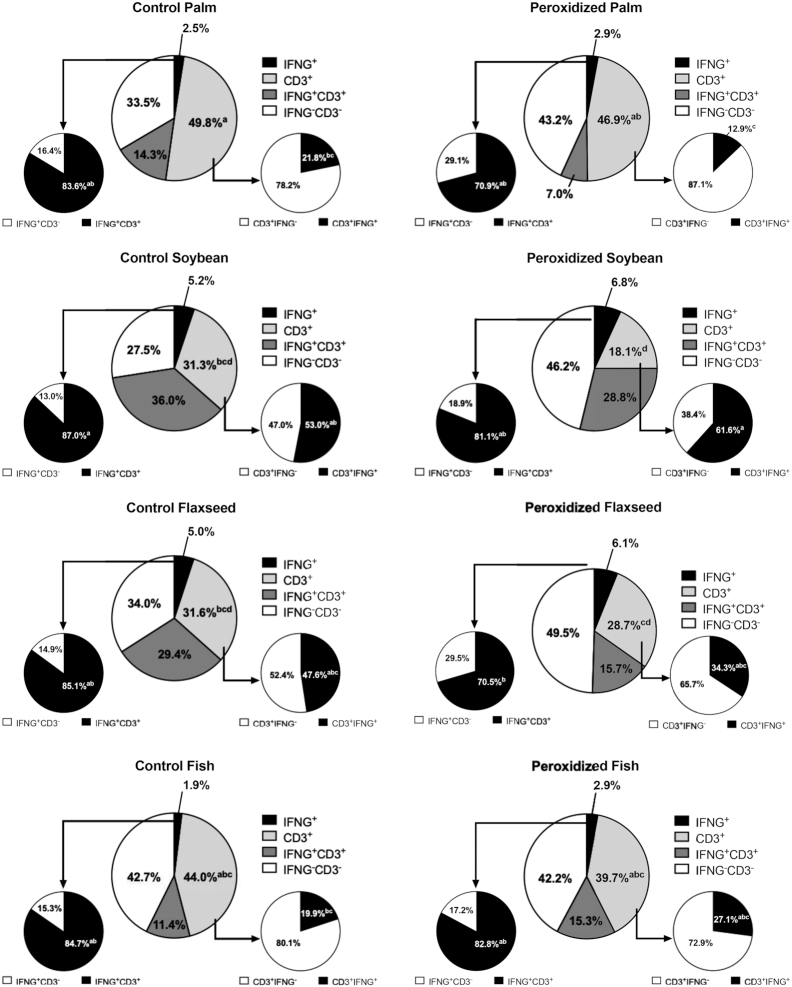
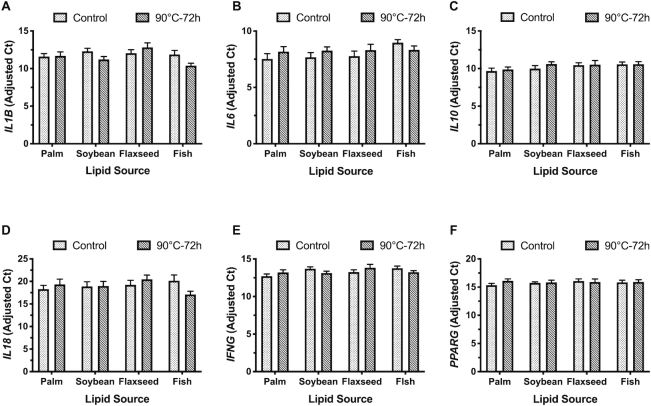
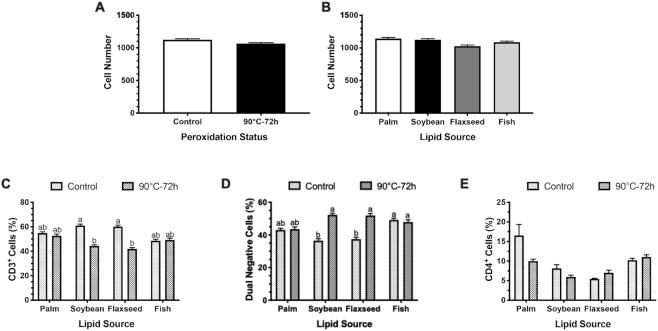
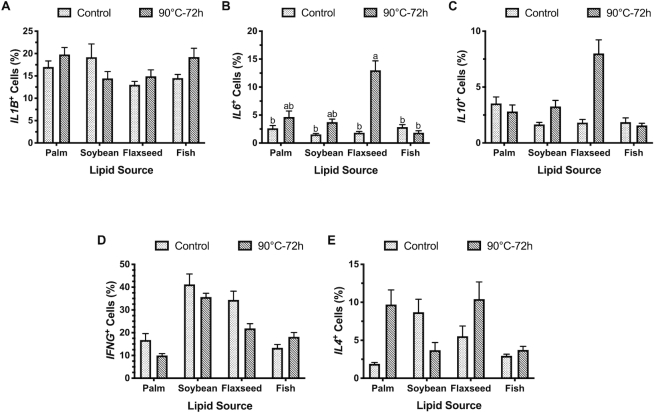
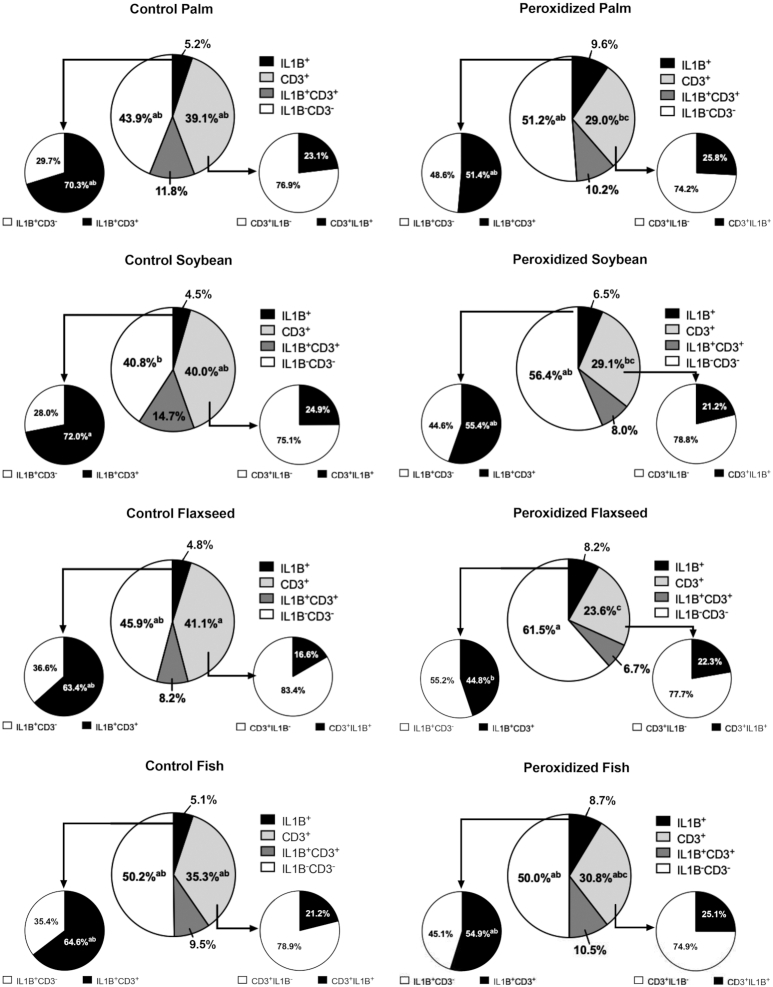
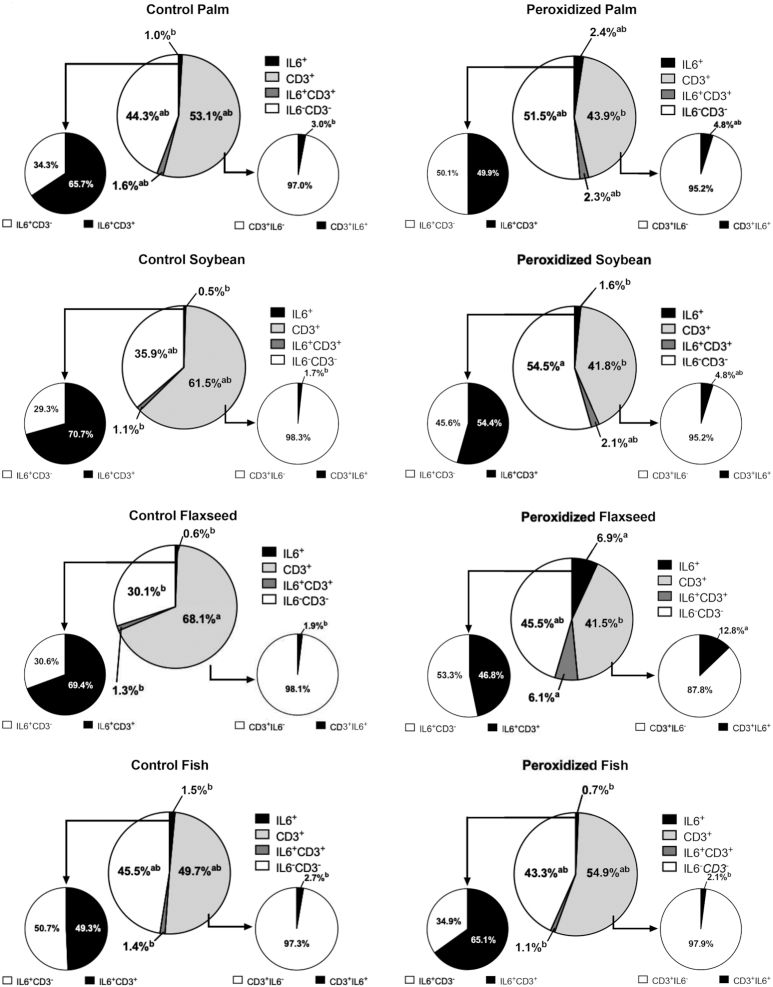
CD3+ T-cells in the ileum decreased 16.2% due to peroxidation (P = 0.001) with 30.3% reductions observed in birds fed peroxidized flaxseed oil (P = 0.01). Peroxidation increased IL6+ and IL1B+ cells by 62.0% and 40.3%, respectively (P = 0.01). Soybean oil increased IFNG+ cells by 55.1% compared with palm oil, regardless of peroxidation status (P = 0.007). Lipid source and peroxidation did not alter ileal histomorphology or liver cytokine expression.
Lipid peroxidation increased ileal IL1B and IL6 in broiler chickens, whereas soybean oil diets increased IFNG. Generally, peroxidation decreased overall CD3+ T-cell populations, suggesting impaired T-cell presence or recruitment. These results identify potential immunomodulatory lipid profiles in restaurant oil while supporting RNAscope-ISH as a method to describe avian tissue-level immune responses.
在禽类日粮中使用餐馆用油可以提高能量含量、降低生产成本,并促进食品供应链的可持续性。然而,由于热诱导的脂质变化,餐馆用油来源中的油成分和加热温度的变化会影响肉鸡的健康。
本试验进行了 21 天试验,以评估饲粮中添加具有不同链长和饱和度特征的过氧化脂质对肉鸡回肠形态、肝脏细胞因子基因表达和回肠免疫细胞群体的影响。
将 1 日龄肉鸡饲养在笼养(每笼 5 只鸡)中,并饲喂含 5%对照或过氧化油的日粮。8 种日粮按 4×2 析因设计安排,包括油源(棕榈油、大豆油、亚麻籽油或鱼油)和过氧化状态(对照或过氧化)。在第 21 天,收集回肠组织进行形态学分析[绒毛高度(VH)、隐窝深度(CrD)和 VH:CrD 比值],并通过 qPCR 检测肝脏细胞因子表达。采用 RNAscope 原位杂交(ISH)分析回肠中细胞因子表达和 T 细胞标记物。数据采用混合模型(SAS 9.4)进行分析,固定效应包括脂质源、过氧化作用和脂质×过氧化作用的相互作用。
过氧化作用使回肠中 CD3+T 细胞减少了 16.2%(P=0.001),而饲喂过氧化亚麻籽油的肉鸡减少了 30.3%(P=0.01)。过氧化作用使 IL6+和 IL1B+细胞分别增加了 62.0%和 40.3%(P=0.01)。与棕榈油相比,大豆油无论是否过氧化,均使 IFNG+细胞增加了 55.1%(P=0.007)。脂质源和过氧化作用均未改变回肠形态或肝脏细胞因子表达。
脂质过氧化作用增加了肉鸡回肠中的 IL1B 和 IL6,而大豆油饲粮增加了 IFNG。一般来说,过氧化作用降低了总 CD3+T 细胞群体,表明 T 细胞存在或募集受损。这些结果确定了餐馆用油中的潜在免疫调节脂质特征,同时支持 RNAscope-ISH 作为描述禽类组织水平免疫反应的方法。