Rae J W B, Gray W R, Wills R C J, Eisenman I, Fitzhugh B, Fotheringham M, Littley E F M, Rafter P A, Rees-Owen R, Ridgwell A, Taylor B, Burke A
School of Earth and Environmental Sciences, University of St Andrews, St Andrews, UK.
Laboratoire des Sciences du Climat et de l'Environnement (LSCE/IPSL), Université Paris-Saclay, Gif-sur-Yvette, France.
Sci Adv. 2020 Dec 9;6(50). doi: 10.1126/sciadv.abd1654. Print 2020 Dec.
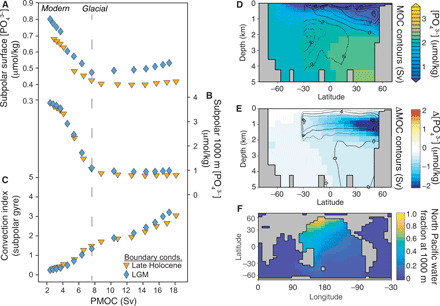
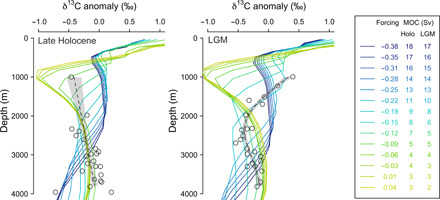
Although the Pacific Ocean is a major reservoir of heat and CO, and thus an important component of the global climate system, its circulation under different climatic conditions is poorly understood. Here, we present evidence that during the Last Glacial Maximum (LGM), the North Pacific was better ventilated at intermediate depths and had surface waters with lower nutrients, higher salinity, and warmer temperatures compared to today. Modeling shows that this pattern is well explained by enhanced Pacific meridional overturning circulation (PMOC), which brings warm, salty, and nutrient-poor subtropical waters to high latitudes. Enhanced PMOC at the LGM would have lowered atmospheric CO-in part through synergy with the Southern Ocean-and supported an equable regional climate, which may have aided human habitability in Beringia, and migration from Asia to North America.
尽管太平洋是热量和二氧化碳的主要储存库,因此是全球气候系统的重要组成部分,但人们对其在不同气候条件下的环流了解甚少。在此,我们提供证据表明,在末次盛冰期(LGM)期间,北太平洋在中等深度的水体通气性更好,与现今相比,其表层水营养物质含量更低、盐度更高、温度更高。模型显示,这种模式可以通过增强的太平洋经向翻转环流(PMOC)得到很好的解释,该环流将温暖、高盐且营养物质匮乏的亚热带水体带到高纬度地区。末次盛冰期增强的PMOC部分通过与南大洋协同作用降低了大气中的二氧化碳含量,并维持了较为稳定的区域气候,这可能有助于白令陆桥适合人类居住,并促进了从亚洲到北美的迁徙。