El Ouarradi Amal, Abdeladim Salma, Oualim Sara, Filali Rita Aniq, Bensahi Ilham, Elharass Mahassine, Hafid Sara, Tazi Hamza, Naitlhou Abdelhamid, Bouaiti El Arbi, Moustaghfir Abdelhamid, Sabry Mohamed
Department of Cardiology, Mohammed VI University of Health Sciences, Cheikh Khalifa Hospital, Casablanca, Morocco.
Department of Internal Medicine, Mohammed VI University of Health Sciences, Cheikh Khalifa Hospital, Casablanca, Morocco.
J Saudi Heart Assoc. 2020 Aug 19;32(3):350-357. doi: 10.37616/2212-5043.1088. eCollection 2020.
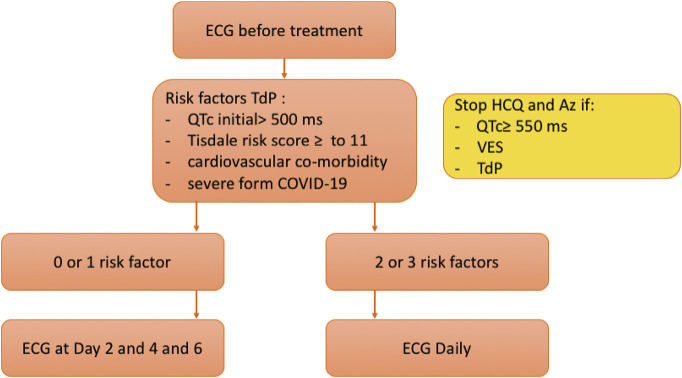
During the COVID-19 pandemic, the effectiveness of the combination of hydroxychloroquine and azithromycin is widely discussed. This treatment can cause many severe cardiac side effects that makes us discuss its utility. The aim of this study is to describe the cardiovascular effect of hydroxychloroquine and azithromycin by analyzing surface ECG in patients with COVID-19. This observational cohort study included Moroccan patients with COVID-19 diagnosis and were hospitalized in Cheikh Khalifa International University Hospital, Casablanca, Morocco between March 26 and April 20, 2020. Patients were treated with a combination of hydroxychloroquine and azithromycin over a period of at least ten days. We were interested in the effects of this combination on the electrocardiogram. A total of 118 eligible patients were enrolled in the study. QT interval prolongation was observed in 19% of patients under the treatment. Only 5 patients required discontinuation of treatment. The factors associated with QT prolongation are male gender (P value 0,043), age over 68 years (P value 0,09), cardiovascular comorbidity (P value 0,013), tisdale score ≥11 (P value < 0,001), and a severe form of COVID-19 (P value < 0,001). First degree atrioventricular block was observed in 2 patients. No serious rhythm or conduction disorders were observed in this study. QT prolongation is a real risk with the combination of hydroxychloroquine and azithromycin. In the current context, it is necessary to select patients at high risk of severe rhythm disturbances that require closer ECG monitoring. Treatment should be discontinued if there are alarming signs such as QTc prolongation beyond 550 ms and the development of ventricular extrasystole or torsade de pointe.
在新冠疫情期间,羟氯喹和阿奇霉素联合使用的有效性受到广泛讨论。这种治疗会引发许多严重的心脏副作用,这促使我们探讨其效用。本研究的目的是通过分析新冠患者的体表心电图来描述羟氯喹和阿奇霉素的心血管效应。这项观察性队列研究纳入了确诊为新冠的摩洛哥患者,他们于2020年3月26日至4月20日期间在摩洛哥卡萨布兰卡的谢赫·哈利法国际大学医院住院。患者接受了至少十天的羟氯喹和阿奇霉素联合治疗。我们关注这种联合用药对心电图的影响。共有118名符合条件的患者参与了研究。治疗期间,19%的患者出现QT间期延长。只有5名患者需要停药。与QT延长相关的因素包括男性(P值0.043)、年龄超过68岁(P值0.09)、心血管合并症(P值0.013)、蒂斯代尔评分≥11(P值<0.001)以及新冠重症(P值<0.001)。2名患者出现一度房室传导阻滞。本研究未观察到严重的节律或传导障碍。羟氯喹和阿奇霉素联合使用确实存在QT延长的风险。在当前情况下,有必要挑选出有严重节律紊乱高风险的患者,对其进行更密切的心电图监测。如果出现如QTc延长超过550毫秒以及室性早搏或尖端扭转型室速等警示信号,应停止治疗。