Srisuphanunt Mayuna, Wilairatana Polrat, Kooltheat Nateelak, Damrongwatanapokin Thanis, Karanis Panagiotis
Department of Medical Technology, School of Allied Health Sciences, Walailak University, Nakhon Si Thammarat 80160, Thailand.
Centre for One Health, Walailak University, Nakhon Si Thammarat 80161, Thailand.
Food Waterborne Parasitol. 2023 Jul 27;32:e00205. doi: 10.1016/j.fawpar.2023.e00205. eCollection 2023 Sep.
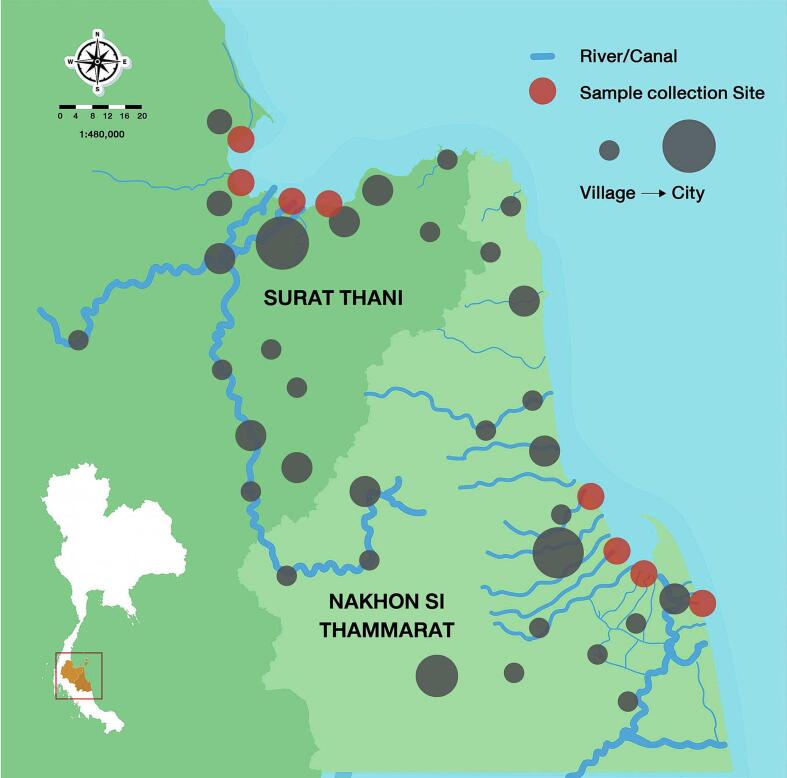
The enteric parasite is spread through the fecal-oral pathway, most commonly by the consumption of contaminated water but also through food. Because eating raw or barely cooked shellfish might put consumers at risk for cryptosporidiosis, identifying the parasite in oysters is important for public health. A total of 240 oysters, collected from two shellfish aquaculture sites in Thailand's Gulf coast, Nakhon Si Thammarat and Surat Thani, were tested for the presence of . , enterococci, and thermotolerant coliform total levels were measured to assess seawater quality in the shellfish production regions. Oocysts of spp. were detected in 13.8% of the samples processed by immunofluorescence analyses. The detection of spp. oocysts in oysters obtained from Surat Thani (17.5%) was higher than in those obtained from Nakhon Si Thammarat (9.2%). The difference in detection of positive samples obtained from Nakhon Si Thammarat and those obtained from Surat Thani may be attributed to the effects of physical, ecological, and anthropogenic conditions, resulting in an increased level of marine water contamination by spp. oocysts. These findings demonstrate that native commercial oysters obtained from Thailand's southern Gulf coast contained spp. oocysts which might serve as a source of human infection. Consequently, these findings pose a serious public health concern and suggest that more quality control measures need to be implemented by the oyster aquaculture business to ensure the safety of seafood.
这种肠道寄生虫通过粪口途径传播,最常见的是通过饮用受污染的水,但也可通过食物传播。由于食用生的或几乎未煮熟的贝类可能使消费者面临隐孢子虫病的风险,因此鉴定牡蛎中的寄生虫对公共卫生很重要。从泰国湾沿岸的洛坤和素叻他尼的两个贝类养殖场所采集了总共240只牡蛎,检测是否存在……同时测量肠球菌和耐热大肠菌群的总水平,以评估贝类生产区域的海水质量。通过免疫荧光分析,在13.8%的处理样本中检测到了隐孢子虫属的卵囊。从素叻他尼采集的牡蛎中隐孢子虫属卵囊的检出率(17.5%)高于从洛坤采集的牡蛎(9.2%)。从洛坤采集的阳性样本与从素叻他尼采集的阳性样本检出率的差异可能归因于物理、生态和人为条件的影响,导致海水被隐孢子虫属卵囊污染的程度增加。这些发现表明,从泰国湾南部海岸获取的本地商业牡蛎含有隐孢子虫属卵囊,这可能是人类感染的一个来源。因此,这些发现引起了严重的公共卫生问题,并表明牡蛎养殖企业需要实施更多质量控制措施,以确保海鲜安全。