
尿生物标志物组合和 PancRISK 评分用于早期检测胰腺癌:一项病例对照研究。
A combination of urinary biomarker panel and PancRISK score for earlier detection of pancreatic cancer: A case-control study.
机构信息
Centre for Cancer Biomarkers and Biotherapeutics, Barts Cancer Institute, Queen Mary University of London, London, United Kingdom.
Centro Nacional de Investigaciones Oncológicas, Madrid, Spain.
出版信息
PLoS Med. 2020 Dec 10;17(12):e1003489. doi: 10.1371/journal.pmed.1003489. eCollection 2020 Dec.
BACKGROUND
Pancreatic ductal adenocarcinoma (PDAC) is one of the deadliest cancers, with around 9% of patients surviving >5 years. Asymptomatic in its initial stages, PDAC is mostly diagnosed late, when already a locally advanced or metastatic disease, as there are no useful biomarkers for detection in its early stages, when surgery can be curative. We have previously described a promising biomarker panel (LYVE1, REG1A, and TFF1) for earlier detection of PDAC in urine. Here, we aimed to establish the accuracy of an improved panel, including REG1B instead of REG1A, and an algorithm for data interpretation, the PancRISK score, in additional retrospectively collected urine specimens. We also assessed the complementarity of this panel with CA19-9 and explored the daily variation and stability of the biomarkers and their performance in common urinary tract cancers.
METHODS AND FINDINGS
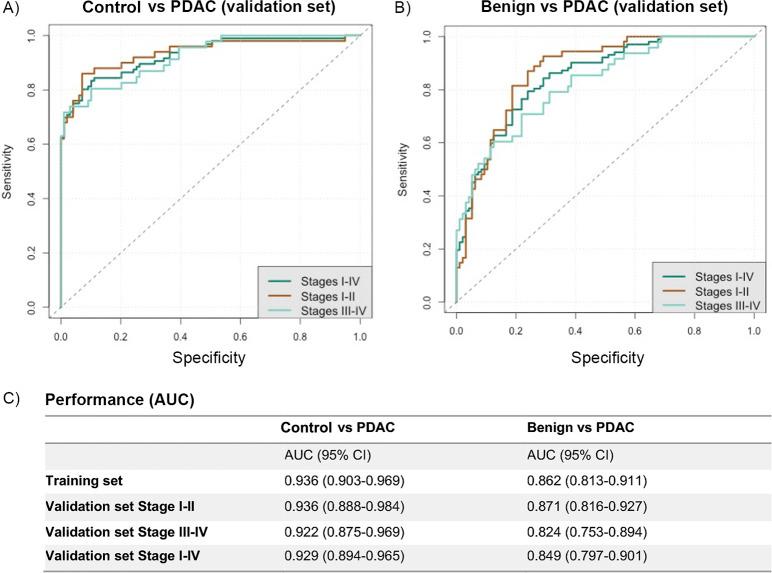
Clinical specimens were obtained from multiple centres: Barts Pancreas Tissue Bank, University College London, University of Liverpool, Spanish National Cancer Research Center, Cambridge University Hospital, and University of Belgrade. The biomarker panel was assayed on 590 urine specimens: 183 control samples, 208 benign hepatobiliary disease samples (of which 119 were chronic pancreatitis), and 199 PDAC samples (102 stage I-II and 97 stage III-IV); 50.7% were from female individuals. PDAC samples were collected from patients before treatment. The samples were assayed using commercially available ELISAs. Statistical analyses were performed using non-parametric Kruskal-Wallis tests adjusted for multiple comparisons, and multiple logistic regression. Training and validation datasets for controls and PDAC samples were obtained after random division of the whole available dataset in a 1:1 ratio. The substitution of REG1A with REG1B enhanced the performance of the panel to detect resectable PDAC. In a comparison of controls and PDAC stage I-II samples, the areas under the receiver operating characteristic curve (AUCs) increased from 0.900 (95% CI 0.843-0.957) and 0.926 (95% CI 0.843-1.000) in the training (50% of the dataset) and validation sets, respectively, to 0.936 in both the training (95% CI 0.903-0.969) and the validation (95% CI 0.888-0.984) datasets for the new panel including REG1B. This improved panel showed both sensitivity (SN) and specificity (SP) to be >85%. Plasma CA19-9 enhanced the performance of this panel in discriminating PDAC I-II patients from controls, with AUC = 0.992 (95% CI 0.983-1.000), SN = 0.963 (95% CI 0.913-1.000), and SP = 0.967 (95% CI 0.924-1.000). We demonstrate that the biomarkers do not show significant daily variation, and that they are stable for up to 5 days at room temperature. The main limitation of our study is the low number of stage I-IIA PDAC samples (n = 27) and lack of samples from individuals with hereditary predisposition to PDAC, for which specimens collected from control individuals were used as a proxy.
CONCLUSIONS
We have successfully validated our urinary biomarker panel, which was improved by substituting REG1A with REG1B. At a pre-selected cutoff of >80% SN and SP for the affiliated PancRISK score, we demonstrate a clinically applicable risk stratification tool with a binary output for risk of developing PDAC ('elevated' or 'normal'). PancRISK provides a step towards precision surveillance for PDAC patients, which we will test in a prospective clinical study, UroPanc.
背景
胰腺导管腺癌(PDAC)是最致命的癌症之一,只有约 9%的患者能存活超过 5 年。由于在初始阶段无症状,PDAC 通常在局部晚期或转移性疾病时才被诊断出来,因为在早期阶段没有有用的生物标志物可以检测到,而此时手术可以治愈。我们之前描述了一种有前途的生物标志物组合(LYVE1、REG1A 和 TFF1),可用于更早地检测尿液中的 PDAC。在此,我们旨在建立一个改进的生物标志物组合(包括 REG1B 而不是 REG1A)的准确性,以及一个用于数据解释的算法,即 PancRISK 评分,该评分在额外的回顾性收集的尿液标本中进行。我们还评估了该组合与 CA19-9 的互补性,并探索了生物标志物的日常变化和稳定性,以及它们在常见的泌尿道癌症中的性能。
方法和发现
临床标本来自多个中心:伦敦大学学院巴茨胰腺组织库、利物浦大学、西班牙国家癌症研究中心、剑桥大学医院和贝尔格莱德大学。对 590 份尿液标本进行了生物标志物组合检测:183 份对照样本、208 份良性肝胆疾病样本(其中 119 份为慢性胰腺炎)和 199 份 PDAC 样本(102 份为 I-II 期和 97 份为 III-IV 期);其中 50.7%来自女性个体。PDAC 样本来自未经治疗的患者。使用商业上可用的 ELISA 进行检测。使用非参数 Kruskal-Wallis 检验进行统计分析,并进行了多次逻辑回归分析。对整个可用数据集进行 1:1 随机分组后,获得对照和 PDAC 样本的训练和验证数据集。用 REG1B 替代 REG1A 提高了检测可切除 PDAC 的面板性能。在对照和 PDAC I-II 期样本的比较中,训练集(数据集的 50%)和验证集(分别为 0.926[95%CI 0.843-1.000]和 0.900[95%CI 0.843-0.957])的 AUC 分别增加到 0.936,均包含新的 REG1B 面板。该改进的面板在区分 PDAC I-II 期患者和对照组时,具有较高的灵敏度(SN)和特异性(SP),均大于 85%。血浆 CA19-9 增强了该面板在区分 PDAC I-II 期患者和对照组的性能,AUC = 0.992(95%CI 0.983-1.000),SN = 0.963(95%CI 0.913-1.000),SP = 0.967(95%CI 0.924-1.000)。我们证明生物标志物没有显著的日变化,在室温下稳定长达 5 天。本研究的主要局限性是 I-IIA 期 PDAC 样本数量较少(n = 27),以及缺乏遗传性 PDAC 易感性个体的样本,为此我们使用对照组个体的标本作为替代。
结论
我们成功验证了我们的尿液生物标志物组合,通过用 REG1A 替代 REG1B 进行了改进。在选定的>80% SN 和 SP 的临界值下,我们展示了一种具有临床应用价值的风险分层工具,其输出为 PDAC 发病风险的二进制结果(“升高”或“正常”)。PancRISK 为 PDAC 患者的精准监测提供了一个方法,我们将在一项前瞻性临床研究 UroPanc 中进行测试。




 Zotero 插件