Department of Gastroenterology & Hepatology, University Medical Center Utrecht, Utrecht, The Netherlands.
J Viral Hepat. 2021 Mar;28(3):454-463. doi: 10.1111/jvh.13456. Epub 2020 Dec 20.
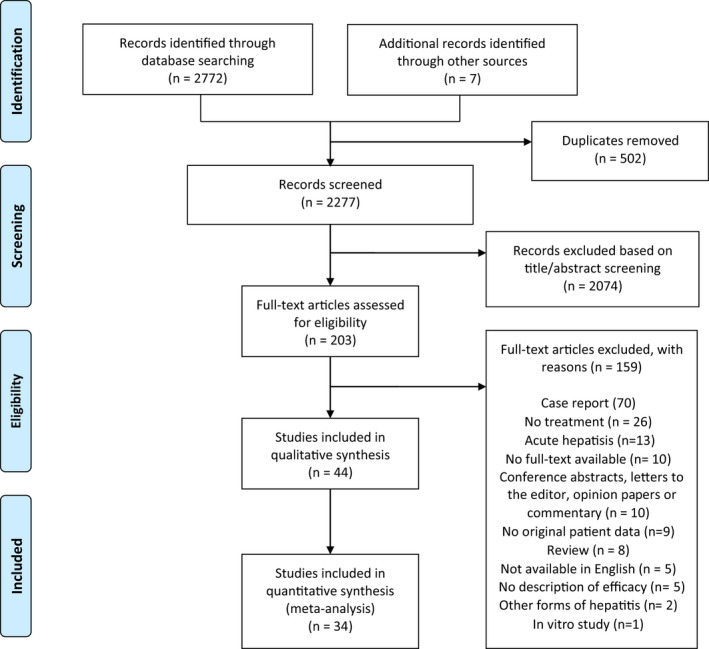
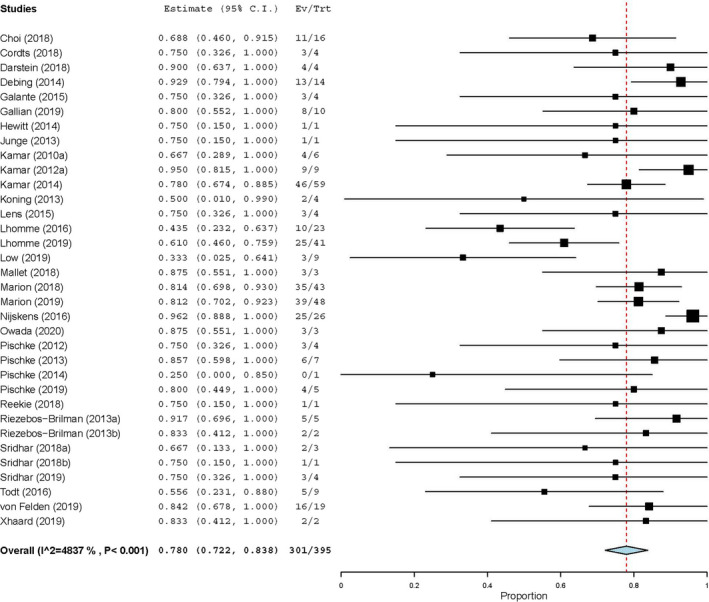
Hepatitis E virus infection can cause chronic hepatitis in immunocompromised patients with significant chance of progressive fibrosis and possibly cirrhosis. The aim of this systematic review was to summarize the efficacy and safety of the various treatment options for chronic hepatitis E. We performed a systematic literature search. The primary outcome measure was a sustained virological response (SVR). Secondary end points were rapid virological response (RVR), relapse rates, side effects and adverse events. Forty-four articles were included with a total of 582 patients. Reduction of immunosuppressive medication induced viral clearance in 55/174 (32%) of the patients. Meta-analysis of 395 patients showed a pooled SVR rate of 78% (95-CI 72%-84%) after ribavirin treatment. Twenty-five per cent of the patients obtained a RVR, whereas a relapse occurred in 18% of the patients. Anaemia during treatment led to dose reduction, use of erythropoietin and/or blood transfusion in 37% of the patients. A second treatment attempt with ribavirin led to a SVR in 39/51 (76%) of the patients. Pegylated interferon-alpha was administered to 13 patients and SVR was obtained in 85%. Two patients (15%) suffered from acute transplant rejection during treatment with interferon. In conclusion, reduction of immunosuppressive medication and treatment with ribavirin is safe, generally well tolerated and induced viral clearance in 32% and 78% of patients, respectively. Therefore, ribavirin should be considered as first treatment step for chronic hepatitis E. Treatment with pegylated interferon-alpha increases the risk of transplant rejection and should therefore be administered with great caution.
戊型肝炎病毒感染可导致免疫功能低下的患者发生慢性肝炎,这些患者有显著进展为纤维化和可能发生肝硬化的风险。本系统评价的目的是总结慢性戊型肝炎各种治疗选择的疗效和安全性。我们进行了系统的文献检索。主要结局指标是持续病毒学应答(SVR)。次要终点是快速病毒学应答(RVR)、复发率、副作用和不良事件。共纳入 44 篇文章,总计 582 例患者。减少免疫抑制药物可使 174 例患者中的 55 例(32%)清除病毒。对 395 例患者的荟萃分析显示,利巴韦林治疗后的 SVR 率为 78%(95%CI 72%-84%)。25%的患者获得了 RVR,而 18%的患者发生了复发。治疗期间发生贫血导致 37%的患者减少剂量、使用促红细胞生成素和/或输血。对 51 例患者进行第二次利巴韦林治疗,其中 39 例(76%)获得 SVR。13 例患者接受了聚乙二醇干扰素-α治疗,其中 85%获得 SVR。2 例患者(15%)在干扰素治疗期间发生急性移植排斥反应。总之,减少免疫抑制药物和使用利巴韦林治疗是安全的,通常耐受良好,分别使 32%和 78%的患者清除了病毒。因此,利巴韦林应作为慢性戊型肝炎的首选治疗方法。聚乙二醇干扰素-α的治疗增加了移植排斥反应的风险,因此应谨慎使用。