Department of Allergy and Clinical Immunology, Ajou University School of Medicine, 206 Worldcup-ro, Yeongtong-gu, Suwon, 16499, Korea.
Ajou Regional Pharmacovigilance Center, Ajou University Hospital, Suwon, Korea.
BMC Pharmacol Toxicol. 2020 Dec 10;21(1):87. doi: 10.1186/s40360-020-00464-9.
Aging populations are often accompanied by comorbidity and polypharmacy, leading to increases in adverse drug reactions (ADRs). We sought to evaluate the causes and characteristics of ADRs in older Korean adults (≥65 years) in comparison to younger individuals (< 65 years).
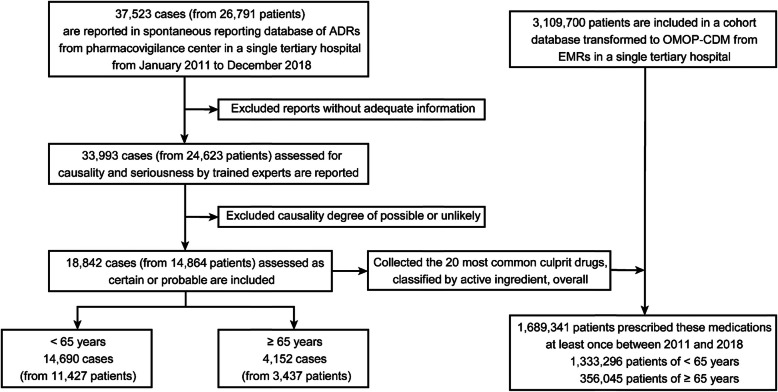
Of 37,523 cases reported at a Korean pharmacovigilance center from 2011 to 2018, we reviewed 18,842 ADRs of certain or probable causality on the basis of WHO-UMC criteria. We estimated the number of ADRs per 1000 patients exposed to the major culprit drugs, and incidence rate ratios were obtained to assess high- and low-risk medications in older adults.
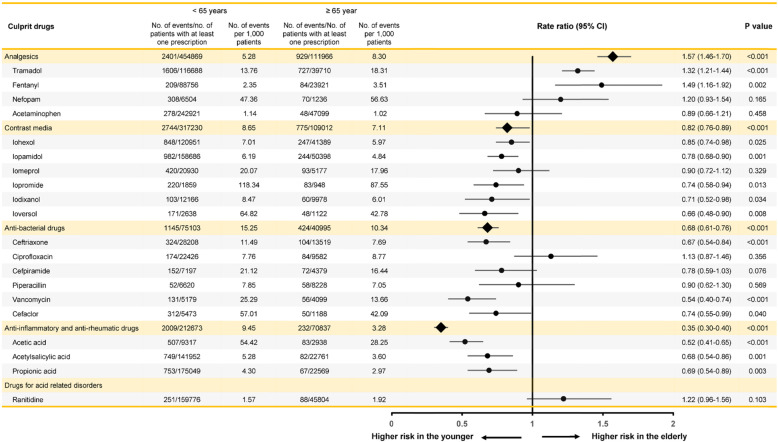
In total, 4152 (22.0%) ADRs were reported for 3437 older adults (mean age, 74.6 years and 57.3% female). Tramadol (rate ratio, 1.32; 95% confidence interval [CI], 1.21-1.44; P < 0.001) and fentanyl (1.49, 1.16-1.92, P = 0.002) posed higher risks of ADRs in the older adults, whereas nonsteroidal anti-inflammatory drugs (NSAIDs) (0.35, 0.30-0.40, P < 0.001) and iodinated contrast media (ICM) (0.82, 0.76-0.89, P < 0.001) posed lower risks. Ratios of serious ADRs to NSAIDs (odds ratio, 2.16; 95% CI, 1.48-3.15; P < 0.001) and ICM (2.09, 1.36-3.21, P = 0.001) were higher in the older adults than in the younger patients. Analgesics primarily elicited cutaneous ADRs in the younger patients and gastrointestinal reactions in the older adults. ICM more commonly led to anaphylaxis in the older adults than the younger patients (3.0% vs. 1.6%, P = 0.019).
For early detection of ADRs in older adults, better understanding of differences in the causes and characteristics thereof in comparison to the general population is needed.
老龄化人口常伴有合并症和多种药物治疗,导致药物不良反应(ADR)增加。我们旨在评估与年轻个体(<65 岁)相比,老年韩国成年人(≥65 岁)ADR 的原因和特征。
在 2011 年至 2018 年期间,我们从一家韩国药物警戒中心报告的 37523 例病例中,根据世界卫生组织-医学科学组织(WHO-UMC)标准,回顾了 18842 例具有确定或可能因果关系的 ADR 病例。我们估计了每 1000 例暴露于主要罪魁祸首药物的患者的 ADR 数量,并获得了发病率比值,以评估老年人中的高风险和低风险药物。
共有 4152 例(22.0%)ADR 报告给 3437 例老年患者(平均年龄为 74.6 岁,女性占 57.3%)。曲马多(比值比,1.32;95%置信区间[CI],1.21-1.44;P<0.001)和芬太尼(1.49,1.16-1.92,P=0.002)在老年人中具有更高的 ADR 风险,而非甾体抗炎药(NSAIDs)(0.35,0.30-0.40,P<0.001)和碘造影剂(ICM)(0.82,0.76-0.89,P<0.001)则具有较低的风险。老年人中 NSAIDs(比值比,2.16;95%CI,1.48-3.15;P<0.001)和 ICM(2.09,1.36-3.21,P=0.001)所致严重 ADR 的比值高于年轻患者。与年轻患者相比,老年人中主要引起皮肤 ADR 的是镇痛药,引起胃肠道反应的是 ICM。老年人中 ICM 引起过敏反应的比例高于年轻患者(3.0%比 1.6%,P=0.019)。
为了早期发现老年人的 ADR,需要更好地了解与一般人群相比,老年人中 ADR 原因和特征的差异。