Hijikata Nanako, Kawakami Michiyuki, Ishii Ryota, Tsuzuki Keita, Nakamura Takuya, Okuyama Kohei, Liu Meigen
Department of Rehabilitation Medicine, Keio University School of Medicine, Tokyo, Japan.
Biostatistics Unit, Clinical and Translational Research Center, Keio University Hospital, Tokyo, Japan.
Front Neurol. 2020 Nov 16;11:577855. doi: 10.3389/fneur.2020.577855. eCollection 2020.
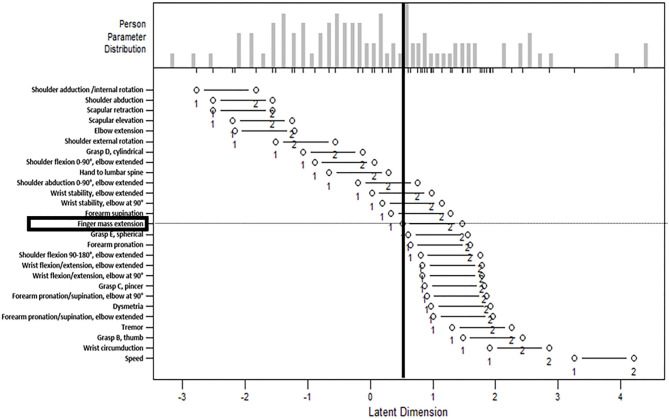
Limited research has been conducted with the aim of understanding which upper extremity movements are difficult for persons with severe chronic stroke. The purpose of this study was to test the structure of the Fugl-Meyer Assessment for Upper Extremity (FMA-UE) using Rasch analysis in persons with chronic stroke with moderate to severe deficits and to determine the item difficulty hierarchy. This was a secondary analysis of data from previous randomized, controlled trials, or clinical trials. The participants were 101 persons with chronic stroke with moderate to severe hemiparesis (time after onset of stroke, 1375.3 ± 1157.9 days; the 33-item FMA-UE, 31.1 ± 12.8). Principal component analysis and infit statistics were used to evaluate dimensionality. Rasch analysis using a rating scale model was performed, and item difficulty was determined. Six misfit items were removed. The results showed that the 27-item FMA-UE was unidimensional. Rasch analysis showed that the movements performed within synergies were among the easiest items. Shoulder and elbow movements were among the easiest items, whereas forearm and wrist movements were among the moderately to most difficult items. Hand items spanned various difficulty levels. The FMA-UE is a valid assessment tool of upper extremity motor function in persons with chronic stroke with moderate to severe deficits. The results showed that item difficulty was consistent with the stepwise recovery course proposed by Fugl-Meyer. The movements that are difficult for patients with moderate to severe chronic paresis were determined, which would enable comparison of each movement using a measure of motion difficulty in future studies.
针对理解重度慢性中风患者哪些上肢动作存在困难这一目的,所开展的研究有限。本研究旨在运用拉施分析,对中重度功能缺损的慢性中风患者上肢 Fugl-Meyer 评估量表(FMA-UE)的结构进行测试,并确定项目难度等级。这是对既往随机对照试验或临床试验数据的二次分析。研究对象为 101 例中重度偏瘫的慢性中风患者(中风发病后时间为 1375.3±1157.9 天;33 项 FMA-UE 评分为 31.1±12.8)。采用主成分分析和拟合统计量评估维度。运用评分量表模型进行拉施分析,并确定项目难度。去除了 6 个不拟合项目。结果显示,27 项 FMA-UE 具有单维度性。拉施分析表明,协同运动中的动作属于最容易的项目。肩部和肘部动作属于最容易的项目,而前臂和腕部动作属于中等难度至最难的项目。手部项目涵盖了不同难度级别。FMA-UE 是评估中重度功能缺损慢性中风患者上肢运动功能的有效工具。结果表明,项目难度与 Fugl-Meyer 提出的逐步恢复过程一致。确定了中重度慢性麻痹患者存在困难的动作,这将有助于在未来研究中使用动作难度测量方法对每个动作进行比较。