Ishahak Matthew, Hill Jordan, Amin Quratulain, Wubker Laura, Hernandez Adiel, Mitrofanova Alla, Sloan Alexis, Fornoni Alessia, Agarwal Ashutosh
Department of Biomedical Engineering, University of Miami, Coral Gables, FL, United States.
Katz Family Division of Nephrology and Hypertension, Department of Medicine, Peggy and Harold Katz Family Drug Discovery Center, University of Miami Miller School of Medicine, Miami, FL, United States.
Front Bioeng Biotechnol. 2020 Nov 12;8:581163. doi: 10.3389/fbioe.2020.581163. eCollection 2020.
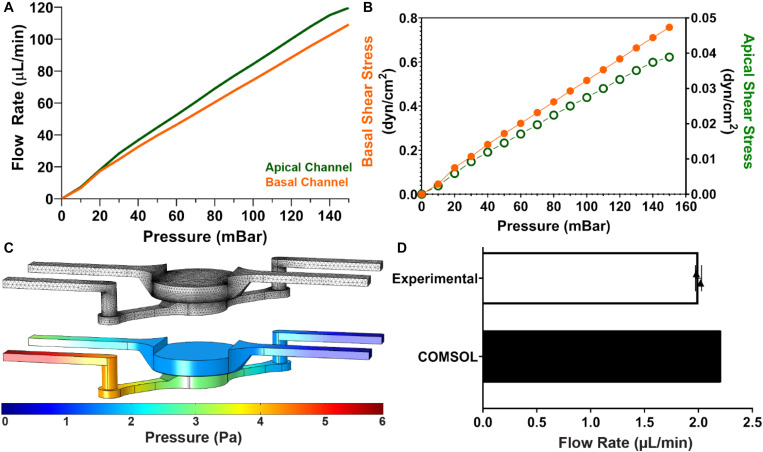
Microphysiological systems, also known as organs-on-chips, are microfluidic devices designed to model human physiology . Polydimethylsiloxane (PDMS) is the most widely used material for organs-on-chips due to established microfabrication methods, and properties that make it suitable for biological applications such as low cytotoxicity, optical transparency, gas permeability. However, absorption of small molecules and leaching of uncrosslinked oligomers might hinder the adoption of PDMS-based organs-on-chips for drug discovery assays. Here, we have engineered a modular, PDMS-free microphysiological system that is capable of recapitulating biologic barrier functions commonly demonstrated in PDMS-based devices. Our microphysiological system is comprised of a microfluidic chip to house cell cultures and pneumatic microfluidic pumps to drive flow with programmable pressure and shear stress. The modular architecture and programmable pumps enabled us to model multiple microenvironments. First, we demonstrate the ability to generate cyclic strain on the culture membrane and establish a model of the alveolar air-liquid interface. Next, we utilized three-dimensional finite element analysis modeling to characterize the fluid dynamics within the device and develop a model of the pressure-driven filtration that occurs at the glomerular filtration barrier. Finally, we demonstrate that our model can be used to recapitulate sphingolipid induced kidney injury. Together, our results demonstrate that a multifunctional and modular microphysiological system can be deployed without the use of PDMS. Further, the bio-inert plastic used in our microfluidic device is amenable to various established, high-throughput manufacturing techniques, such as injection molding. As a result, the development plastic organs-on-chips provides an avenue to meet the increasing demand for organ-on-chip technology.
微生理系统,也被称为芯片器官,是用于模拟人体生理学的微流控装置。聚二甲基硅氧烷(PDMS)由于其成熟的微加工方法以及诸如低细胞毒性、光学透明性、气体渗透性等使其适用于生物应用的特性,成为芯片器官中使用最广泛的材料。然而,小分子的吸收和未交联低聚物的浸出可能会阻碍基于PDMS的芯片器官在药物发现分析中的应用。在此,我们设计了一种模块化的、不含PDMS的微生理系统,该系统能够重现基于PDMS的装置中常见的生物屏障功能。我们的微生理系统由一个用于容纳细胞培养物的微流控芯片和用于以可编程压力和剪切应力驱动流体流动的气动微流控泵组成。模块化架构和可编程泵使我们能够模拟多种微环境。首先,我们展示了在培养膜上产生循环应变的能力,并建立了肺泡气液界面模型。接下来,我们利用三维有限元分析建模来表征装置内的流体动力学,并开发了肾小球滤过屏障处压力驱动过滤的模型。最后,我们证明我们的模型可用于重现鞘脂诱导的肾损伤。总之,我们的结果表明,无需使用PDMS即可部署多功能模块化微生理系统。此外,我们微流控装置中使用的生物惰性塑料适用于各种既定的高通量制造技术,如注塑成型。因此,开发塑料芯片器官为满足对芯片器官技术日益增长的需求提供了一条途径。