Srivastava Shobhit, Muhammad T
International Institute for Population Sciences, Mumbai, Maharashtra, 400088, India.
SSM Popul Health. 2020 Nov 25;12:100702. doi: 10.1016/j.ssmph.2020.100702. eCollection 2020 Dec.
Since older population in India continue to rely on family and social networks for care and support, understanding the health outcomes associated with violence within and outside family may direct the development of policies and measures to aid the victims of violence. The present paper examines the health consequences of violence against older adults and its gender differentials in India.
Using data from Building Knowledge Base on Population Ageing in India (BKPAI), we employed bivariate and logistic regressions on a sample of 9181 older adults to fulfil the aims and objective of the paper.
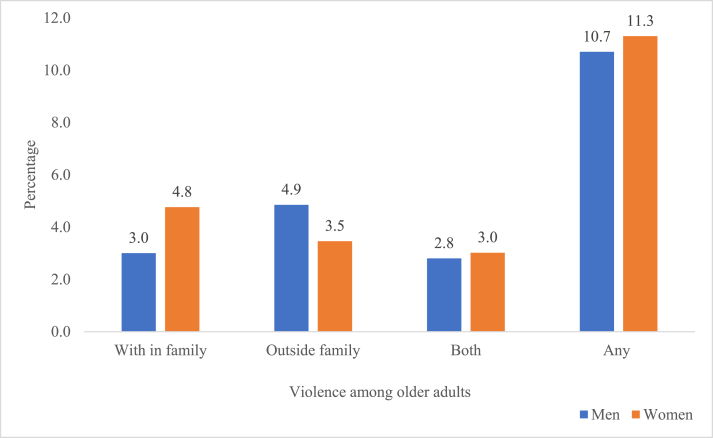
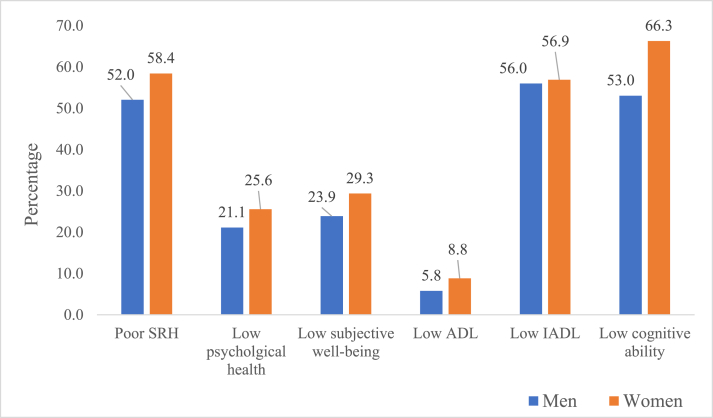
About 10.7% and 11.3% of men and women faced violence after turning 60 years respectively. Older adults who ever faced violence after turning age 60 years had 60%, 41% and 33% higher likelihood to have poor-SRH, low ADL and low IADL respectively in comparison to their counterparts. Further, it was found that older adults who ever faced violence after turning age 60 years had 97% and 62% higher likelihood to have lower psychological health and low subjective well-being. Additionally, it was found that women who faced violence had higher odds of having low psychological health [OR: 1.18, CI: 1.06, 1.63], low subjective well-being [OR: 1.70, CI: 1.24, 2.33] and low cognitive ability [OR: 1.32, CI: 1.04, 1.79] in comparison to men who faced violence.
Violence against older adults must be recognized as a key public health issue for older adults in India. Study findings indicate the immediate need for assessing victim health outcomes following any type of violence in later years to determine related policies and programs to protect the victims. Reducing violence will have a positive impact on physical and mental health outcomes late in life as well as the functional abilities of older adults, especially older women.
由于印度的老年人口仍然依赖家庭和社会网络来获得照顾和支持,了解与家庭内外暴力相关的健康结果可能会指导制定援助暴力受害者的政策和措施。本文研究了印度针对老年人暴力行为的健康后果及其性别差异。
利用印度人口老龄化知识库(BKPAI)的数据,我们对9181名老年人的样本进行了双变量和逻辑回归分析,以实现本文的目标。
分别有10.7%的男性和11.3%的女性在60岁以后遭受过暴力。与未遭受暴力的同龄人相比,60岁以后曾遭受暴力的老年人出现不良自评健康状况、低日常生活活动能力和低工具性日常生活活动能力的可能性分别高出60%、41%和33%。此外,研究发现,60岁以后曾遭受暴力的老年人出现心理健康水平较低和主观幸福感较低的可能性分别高出97%和62%。此外,研究发现,与遭受暴力的男性相比,遭受暴力的女性出现心理健康水平较低[比值比:1.18,置信区间:1.06,1.63]、主观幸福感较低[比值比:1.70,置信区间:1.24,2.33]和认知能力较低[比值比:1.32,置信区间:1.04,1.79]的几率更高。
针对老年人的暴力行为必须被视为印度老年人面临的一个关键公共卫生问题。研究结果表明,迫切需要评估晚年遭受任何类型暴力后的受害者健康结果,以确定保护受害者的相关政策和项目。减少暴力将对老年人晚年的身心健康结果以及功能能力产生积极影响,尤其是老年女性。