Umezawa Rei, Kadoya Noriyuki, Ota Hideki, Nakajima Yujiro, Saito Masahide, Takagi Hidenobu, Takanami Kentaro, Takahashi Noriyoshi, Ishikawa Yojiro, Yamamoto Takaya, Matsushita Haruo, Takeda Ken, Takase Kei, Jingu Keiichi
Department of Radiation Oncology, Tohoku University Graduate School of Medicine, Sendai, Japan.
Department of Diagnostic Radiology, Tohoku University Graduate School of Medicine, Sendai, Japan.
Adv Radiat Oncol. 2020 Aug 5;5(6):1170-1178. doi: 10.1016/j.adro.2020.07.012. eCollection 2020 Nov-Dec.
The purpose of this prospective study was to evaluate radiation-induced myocardial damage after mediastinal radiation therapy (RT) using late gadolinium-enhancement (LGE) magnetic resonance imaging (MRI).
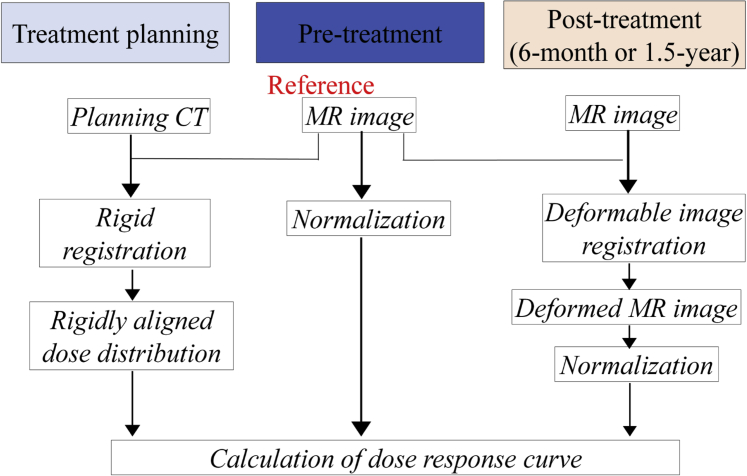
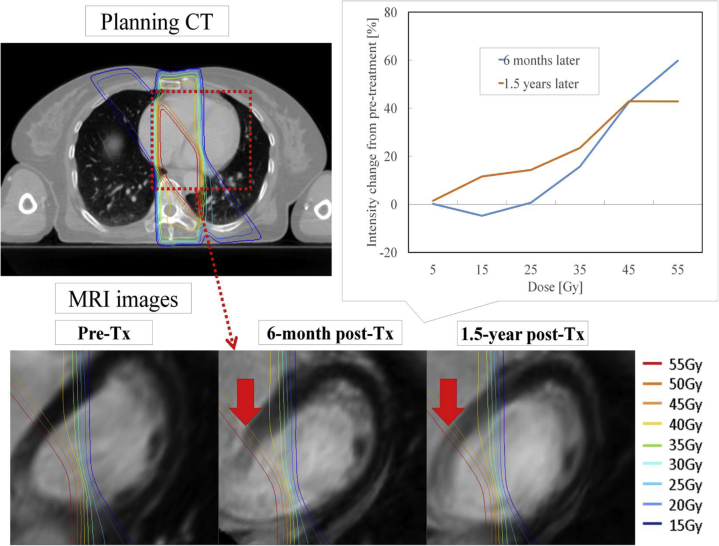
We enrolled 19 patients with esophageal cancer who were expected to have long-term survival by definitive treatment. They underwent delayed contrast-enhanced MRI (19 patients before treatment, 19 patients 6 months after treatment, and 12 patients 1.5 years after treatment). Dose distribution of the left ventricle was made using computed tomography, and the dose volume histogram of the left ventricle was calculated. Myocardial signal intensities in individual MRIs were normalized by the mean values in regions receiving low doses (<5 Gy). Changes in the normalized signal intensities after mediastinal radiation therapy were compared among regions where irradiation doses were 0 to 10 Gy, 10 to 20 Gy, 20 to 30 Gy, 30 to 40 Gy, 40 to 50 Gy, and 50 to 60 Gy, and we investigated whether intensity change was detected in a dose-dependent manner.
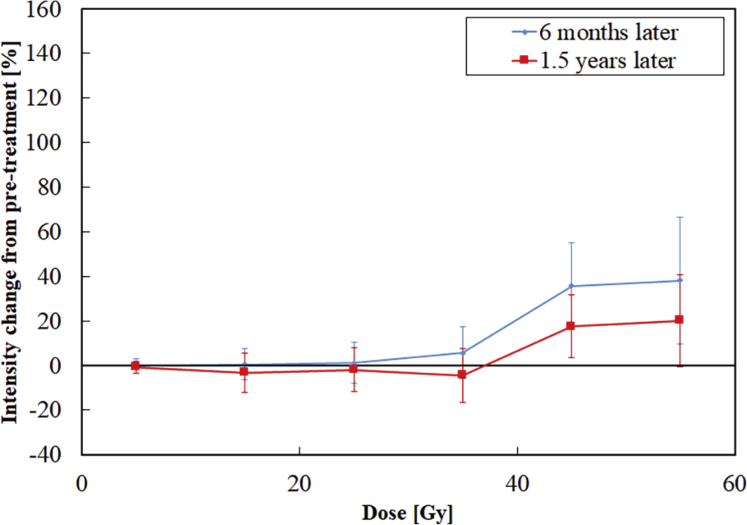
The registered patients were treated with concurrent chemoradiotherapy with a median total dose of 60 Gy (50.4-66 Gy). Chemotherapy consisting of cisplatin and 5-fluorouracil was administered. In the population-based dose-response curve, dose-dependent intensity changes progressively increased in regions receiving more than 30 Gy. The averages of relative intensity change at 6 months and 1.5 years after treatment were 1.1% and -1.9% at 20 to 30 Gy and 37.5% and 17.5% at 40 to 50 Gy, respectively. LGE in regions receiving more than 30 Gy was detected in 68% (13/19) of the patients.
A dose-dependent relationship for myocardial signal intensity change was found by using LGE MRI. It may be necessary to reduce the volume of the myocardium receiving more than 30 Gy.
本前瞻性研究的目的是使用延迟钆增强(LGE)磁共振成像(MRI)评估纵隔放射治疗(RT)后辐射诱发的心肌损伤。
我们纳入了19例经确定性治疗有望长期存活的食管癌患者。他们接受了延迟对比增强MRI检查(19例患者在治疗前、19例患者在治疗后6个月、12例患者在治疗后1.5年)。使用计算机断层扫描绘制左心室的剂量分布,并计算左心室的剂量体积直方图。通过低剂量(<5 Gy)区域的平均值对各个MRI中的心肌信号强度进行归一化。比较纵隔放射治疗后归一化信号强度在照射剂量为0至10 Gy、10至20 Gy、20至30 Gy、30至40 Gy、40至50 Gy和50至60 Gy的区域中的变化,并且我们调查强度变化是否以剂量依赖性方式被检测到。
登记的患者接受了同步放化疗,中位总剂量为60 Gy(50.4 - 66 Gy)。给予由顺铂和5-氟尿嘧啶组成的化疗。在基于人群的剂量反应曲线中,接受超过30 Gy的区域中剂量依赖性强度变化逐渐增加。治疗后6个月和1.5年时,20至30 Gy区域的相对强度变化平均值分别为1.1%和 -1.9%,40至50 Gy区域分别为37.5%和17.5%。68%(13/19)的患者在接受超过30 Gy的区域中检测到LGE。
通过使用LGE MRI发现了心肌信号强度变化的剂量依赖性关系。可能有必要减少接受超过30 Gy的心肌体积。