Hall Ruth E, Tusevljak Natasa, Wu C Fangyun, Ibrahim Quazi, Schulze Karleen, Khan Anam M, Desai Dipika, Awadalla Philip, Broet Philippe, Dummer Trevor J B, Hicks Jason, Tardif Jean-Claude, Teo Koon K, Vena Jennifer, Lee Douglas, Friedrich Matthias, Anand Sonia S, Tu Jack V
ICES, Toronto, Ontario, Canada.
Institute for Health Policy Management and Evaluation, Dalla Lana School of Public Health, University of Toronto, Toronto, Ontario, Canada.
CJC Open. 2020 Jul 22;2(6):599-609. doi: 10.1016/j.cjco.2020.07.013. eCollection 2020 Nov.
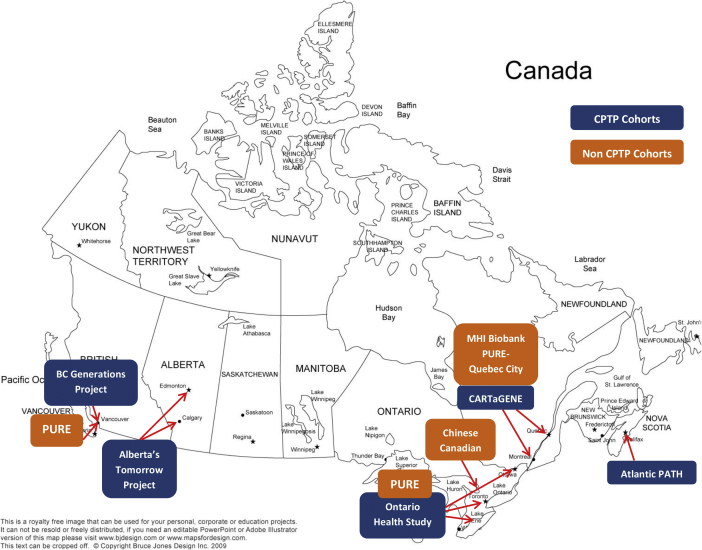
The intent of the Canadian Alliance for Healthy Hearts and Minds (CAHHM) cohort is to understand the early determinants of subclinical cardiac and vascular disease and progression in adults selected from existing cohorts-the Canadian Partnership for Tomorrow's Health, the Prospective Urban and Rural Evaluation (PURE) cohort, and the Montreal Heart Institute Biobank. We evaluated how well the CAHHM-Health Services Research (CAHHM-HSR) subcohort reflects the Canadian population.
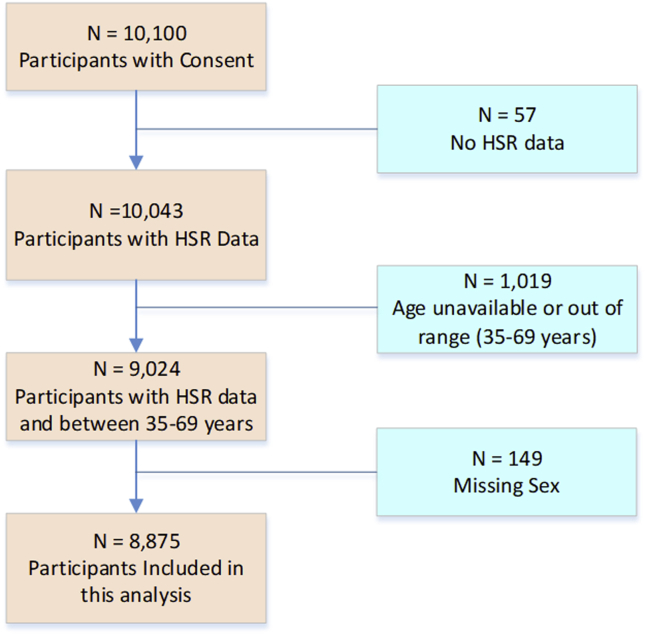
A cross-sectional design was used among a prospective cohort of community-dwelling adults aged 35-69 years who met the CAHHM inclusion criteria, and a cohort of adults aged 35-69 years who responded to the 2015 Canadian Community Health Survey-Rapid Response module. The INTERHEART risk score was calculated at the individual level with means and proportions reported at the overall and provincial level.
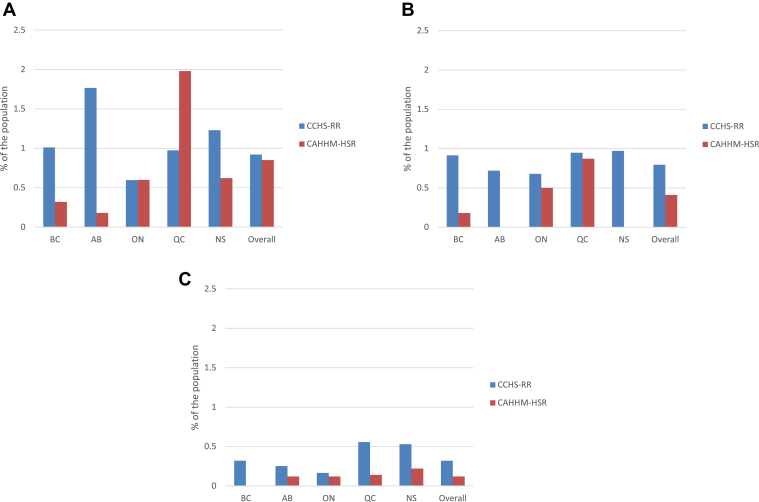
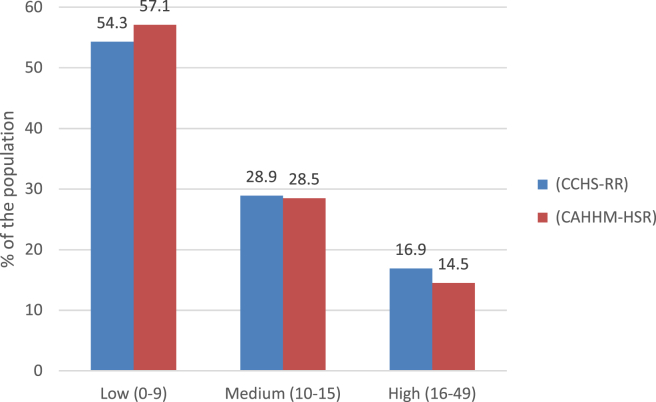
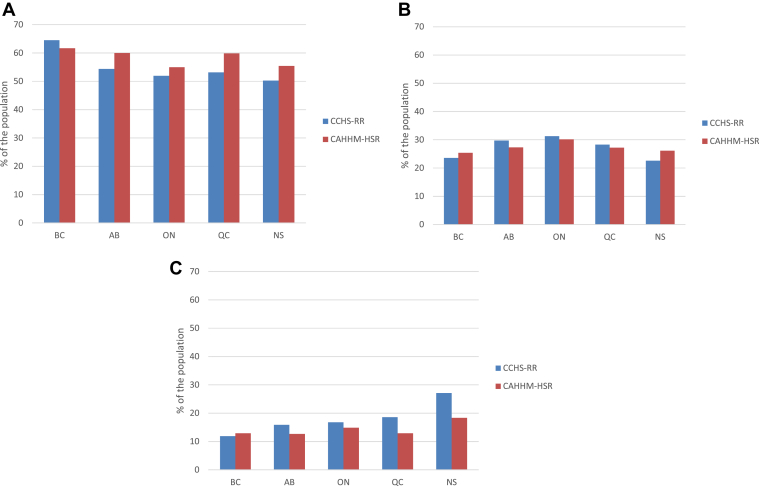
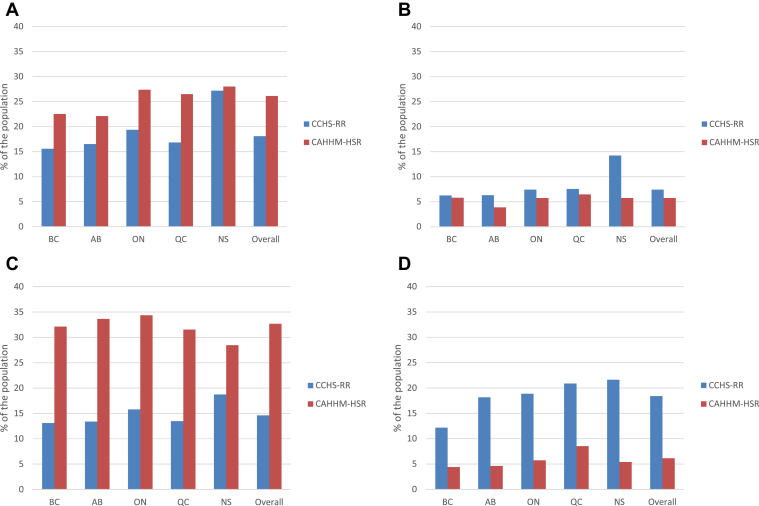
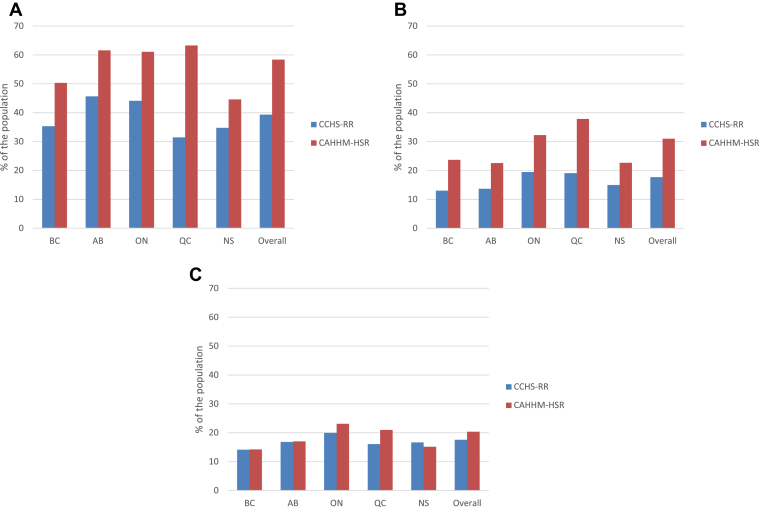
There are modest differences between CAHHM-HSR study participants and the 2015 Canadian Community Health Survey-Rapid Response respondents in age (56.3 vs 51.7 mean years), proportion of men (44.9% vs 49.3%), and mean INTERHEART risk score (9.7 vs 10.1). Larger differences were observed in postsecondary education (86.8% vs 70.2%), Chinese ethnicity (11.0% vs 3.3%), obesity (23.2% vs 29.3%), current smoker status (6.1% vs 18.4%), and having no cardiac testing (30.4% vs 55.9%).
CAHHM-HSR participants are older, of higher socioeconomic status, and have a similar mean INTERHEART risk score, compared with participants in the Canadian Community Health Survey. Differing sampling strategies and missing data may explain some differences between the CAHHM-HSR cohort and Canadian community-dwelling adults and should be considered when using the CAHHM-HSR for scientific research.
加拿大心脏与心理健康联盟(CAHHM)队列研究的目的是了解从现有队列(加拿大明日健康伙伴关系、城乡前瞻性评估(PURE)队列和蒙特利尔心脏研究所生物样本库)中选取的成年人中亚临床心脏和血管疾病的早期决定因素及其进展情况。我们评估了CAHHM卫生服务研究(CAHHM-HSR)子队列在多大程度上反映了加拿大人口情况。
采用横断面设计,对符合CAHHM纳入标准的35 - 69岁社区居住成年人前瞻性队列,以及对2015年加拿大社区健康调查快速反应模块做出回应的35 - 69岁成年人队列进行研究。在个体层面计算INTERHEART风险评分,并在总体和省级层面报告均值和比例。
CAHHM-HSR研究参与者与2015年加拿大社区健康调查快速反应模块受访者在年龄(平均56.3岁对51.7岁)、男性比例(44.9%对49.3%)和平均INTERHEART风险评分(9.7对10.1)方面存在适度差异。在高等教育程度(86.8%对70.2%)、华裔(11.0%对3.3%)、肥胖(23.2%对29.3%)、当前吸烟者状态(6.1%对18.4%)以及未进行心脏检查(30.4%对55.9%)方面观察到较大差异。
与加拿大社区健康调查的参与者相比,CAHHM-HSR参与者年龄更大,社会经济地位更高,且平均INTERHEART风险评分相似。不同的抽样策略和缺失数据可能解释了CAHHM-HSR队列与加拿大社区居住成年人之间的一些差异,在将CAHHM-HSR用于科学研究时应予以考虑。