• 文献检索
  • 文档翻译
  • 深度研究
  • 学术资讯
  • Suppr Zotero 插件Zotero 插件
  • 邀请有礼
  • 套餐&价格
  • 历史记录
应用&插件
Suppr Zotero 插件Zotero 插件浏览器插件Mac 客户端Windows 客户端微信小程序
定价
高级版会员购买积分包购买API积分包
服务
文献检索文档翻译深度研究API 文档MCP 服务
关于我们
关于 Suppr公司介绍联系我们用户协议隐私条款
关注我们

Suppr 超能文献

核心技术专利:CN118964589B侵权必究
粤ICP备2023148730 号-1Suppr @ 2026

文献检索

告别复杂PubMed语法,用中文像聊天一样搜索,搜遍4000万医学文献。AI智能推荐,让科研检索更轻松。

立即免费搜索

文件翻译

保留排版,准确专业,支持PDF/Word/PPT等文件格式,支持 12+语言互译。

免费翻译文档

深度研究

AI帮你快速写综述,25分钟生成高质量综述,智能提取关键信息,辅助科研写作。

立即免费体验

“关于我们的一切”:原住民数据分析研讨会——加拿大健康心灵联盟原住民队列能力建设

"All About Us": Indigenous Data Analysis Workshop-Capacity Building in the Canadian Alliance for Healthy Hearts and Minds First Nations Cohort.

出版信息

CJC Open. 2019 Oct 5;1(6):282-288. doi: 10.1016/j.cjco.2019.09.002. eCollection 2019 Nov.

DOI:10.1016/j.cjco.2019.09.002
PMID:32159122
原文链接:https://pmc.ncbi.nlm.nih.gov/articles/PMC7063631/
Abstract

BACKGROUND

Research collaborations between non-Indigenous and Indigenous researchers primarily have been led by non-Indigenous researchers with privileged locations in university settings. Recognition of the importance of data sovereignty and control to enable Indigenous self-determination requires building data management and analysis capacities among Indigenous research partners. The Canadian Alliance for Healthy Hearts and Minds First Nations (CAHHM-FN) cohort study, a collaboration of 8 First Nations and researchers at 8 universities, convened a 3-day data management and analysis workshop.

METHODS

Before the workshop, participating communities were asked to develop research questions of interest regarding data collected as part of CAHHM-FN and forward them to the coordinating team. An agenda was created, circulated, and modified on the basis of community feedback to plan the workshop. The CAHHM coordinating team, an Indigenous researcher, and a non-Indigenous biostatistician planned the workshop to strike balance among Indigenous protocols for engagement, theory concerning Indigenous approaches to statistical analysis, and applied data analysis training.

RESULTS

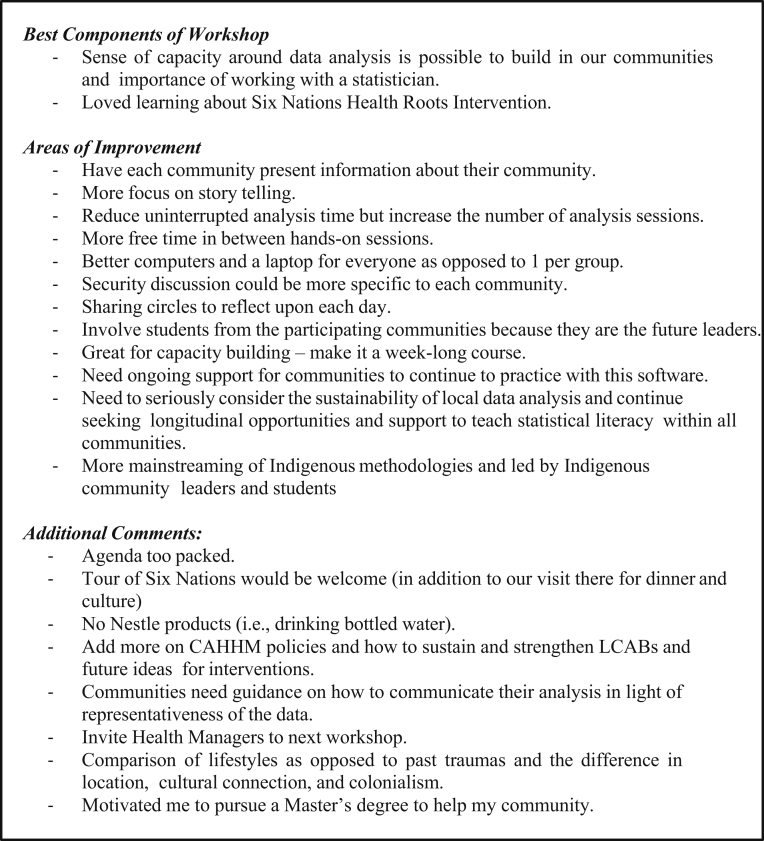
Fifty participants and coordinating team members convened for the 3-day workshop (22 Indigenous and 28 non-Indigenous people from communities, professors, trainees, and staff). Topics included statistical literacy, hands-on data analysis, data security, and topics in Indigenous health research. Workshop evaluations indicated a high level of satisfaction and enthusiasm to hold similar future workshops.

CONCLUSIONS

The Indigenous data workshop was designed to increase capacity for data management and analysis by Indigenous community partners and develop new capacity for non-Indigenous partners and trainees. It achieved this, with enthusiasm from Indigenous community members to conduct future workshops.

摘要

背景

非原住民研究人员与原住民研究人员之间的合作主要由在大学环境中占据优势地位的非原住民研究人员主导。认识到数据主权和控制权对于实现原住民自决的重要性,需要培养原住民研究伙伴的数据管理和分析能力。加拿大健康心灵第一民族联盟(CAHHM-FN)队列研究是8个第一民族与8所大学的研究人员之间的合作项目,为此召开了一次为期3天的数据管理和分析研讨会。

方法

在研讨会召开之前,要求参与的社区针对作为CAHHM-FN项目一部分收集的数据,提出感兴趣的研究问题,并将其提交给协调团队。根据社区反馈制定了一份议程,进行了分发并加以修改,以规划此次研讨会。CAHHM协调团队、一名原住民研究人员和一名非原住民生物统计学家共同规划了此次研讨会,以在原住民参与协议、原住民统计分析方法理论和应用数据分析培训之间取得平衡。

结果

50名参与者和协调团队成员参加了为期3天的研讨会(22名原住民和28名来自社区、教授、学员及工作人员的非原住民)。主题包括统计素养、实际数据分析、数据安全以及原住民健康研究中的主题。研讨会评估表明,大家对此次研讨会高度满意,并热衷于举办类似的未来研讨会。

结论

此次原住民数据研讨会旨在提高原住民社区伙伴的数据管理和分析能力,并为非原住民伙伴和学员培养新的能力。它做到了这一点,原住民社区成员也热衷于举办未来的研讨会。
https://cdn.ncbi.nlm.nih.gov/pmc/blobs/cd50/7063631/6a7becbedf40/gr1.jpg

相似文献

1
"All About Us": Indigenous Data Analysis Workshop-Capacity Building in the Canadian Alliance for Healthy Hearts and Minds First Nations Cohort.“关于我们的一切”:原住民数据分析研讨会——加拿大健康心灵联盟原住民队列能力建设
CJC Open. 2019 Oct 5;1(6):282-288. doi: 10.1016/j.cjco.2019.09.002. eCollection 2019 Nov.
2
Re-Envisioning the Canadian Nephrology Trials Network: A Can-SOLVE-CKD Stakeholder Meeting of Patient Partners and Researchers.重新构想加拿大肾脏病试验网络:患者合作伙伴与研究人员的加拿大慢性肾脏病解决方案(Can-SOLVE-CKD)利益相关者会议
Can J Kidney Health Dis. 2021 Jul 14;8:20543581211030396. doi: 10.1177/20543581211030396. eCollection 2021.
3
Canadian Alliance for Healthy Hearts and Minds: First Nations Cohort Study Rationale and Design.加拿大健康心脏与心灵联盟:原住民队列研究的基本原理与设计。
Prog Community Health Partnersh. 2018;12(1):55-64. doi: 10.1353/cpr.2018.0006.
4
Developing palliative care programs in Indigenous communities using participatory action research: a Canadian application of the public health approach to palliative care.运用参与式行动研究在原住民社区开展姑息治疗项目:加拿大公共卫生姑息治疗方法的应用
Ann Palliat Med. 2018 Apr;7(Suppl 2):S52-S72. doi: 10.21037/apm.2018.03.06.
5
The Canadian Alliance for Healthy Hearts and Minds: How Well Does It Reflect the Canadian Population?加拿大健康心脏与心灵联盟:它在多大程度上反映了加拿大人口的情况?
CJC Open. 2020 Jul 22;2(6):599-609. doi: 10.1016/j.cjco.2020.07.013. eCollection 2020 Nov.
6
Conversations on telemental health: listening to remote and rural First Nations communities.关于远程心理健康的对话:倾听偏远和农村地区的原住民社区的声音。
Rural Remote Health. 2011;11(2):1656. Epub 2011 Apr 19.
7
Rationale, design, and methods for Canadian alliance for healthy hearts and minds cohort study (CAHHM) - a Pan Canadian cohort study.加拿大健康心脏与心灵联盟队列研究(CAHHM)的基本原理、设计与方法——一项全加拿大队列研究。
BMC Public Health. 2016 Jul 27;16:650. doi: 10.1186/s12889-016-3310-8.
8
Enacting research ethics in partnerships with indigenous communities in Canada: "Do it in a good way".在与加拿大原住民社区的合作中践行研究伦理:“以良好的方式去做”。
J Empir Res Hum Res Ethics. 2008 Jun;3(2):33-51. doi: 10.1525/jer.2008.3.2.33.
9
"Nothing About Us, without Us." How Community-Based Participatory Research Methods Were Adapted in an Indigenous End-of-Life Study Using Previously Collected Data.“没有我们的参与,就没有关于我们的事。” 基于社区的参与性研究方法如何在一项使用先前收集数据的原住民临终研究中得到应用。
Can J Aging. 2020 Jun;39(2):145-155. doi: 10.1017/S0714980819000291.
10
Learning circles: an adaptive strategy to support food sovereignty among First Nations communities in Canada.学习圈:一种支持加拿大原住民社区粮食主权的适应性策略。
Appl Physiol Nutr Metab. 2022 Aug 1;47(8):813-825. doi: 10.1139/apnm-2021-0776. Epub 2022 Apr 20.

引用本文的文献

1
Competing interests: digital health and indigenous data sovereignty.利益冲突:数字健康与原住民数据主权
NPJ Digit Med. 2024 Jul 4;7(1):178. doi: 10.1038/s41746-024-01171-z.
2
Effectiveness of RADAR: An Innovative Model to Organize Diabetes Care in First Nations Communities.RADAR的有效性:一种在原住民社区组织糖尿病护理的创新模式。
Clin Diabetes. 2023 Summer;41(3):351-358. doi: 10.2337/cd22-0090. Epub 2023 Jan 27.
3
Partnering with Aboriginal and Torres Strait Islander Peoples: An Evaluation Study Protocol to Strengthen a Comprehensive Multi-Scale Evaluation Framework for Participatory Systems Modelling through Indigenous Paradigms and Methodologies.

本文引用的文献

1
Improving health research among Indigenous Peoples in Canada.改善加拿大原住民的健康研究。
CMAJ. 2018 May 22;190(20):E616-E621. doi: 10.1503/cmaj.171538.
2
Canadian Alliance for Healthy Hearts and Minds: First Nations Cohort Study Rationale and Design.加拿大健康心脏与心灵联盟:原住民队列研究的基本原理与设计。
Prog Community Health Partnersh. 2018;12(1):55-64. doi: 10.1353/cpr.2018.0006.
3
Beyond health equity: achieving wellness within American Indian and Alaska Native communities.超越健康公平:在美国印第安人和阿拉斯加原住民社区实现健康
与原住民和托雷斯海峡岛民合作:通过原住民范式和方法加强参与式系统建模综合多尺度评估框架的评估研究方案。
Int J Environ Res Public Health. 2022 Dec 21;20(1):53. doi: 10.3390/ijerph20010053.
4
Indigenous and Tribal Peoples Data Governance in Health Research: A Systematic Review.原住民和部落民族在健康研究中的数据治理:系统评价。
Int J Environ Res Public Health. 2021 Sep 30;18(19):10318. doi: 10.3390/ijerph181910318.
5
Are we walking the talk of participatory Indigenous health research? A scoping review of the literature in Atlantic Canada.我们是否在践行参与式原住民健康研究的承诺?加拿大大西洋地区文献的范围综述。
PLoS One. 2021 Jul 27;16(7):e0255265. doi: 10.1371/journal.pone.0255265. eCollection 2021.
Am J Public Health. 2015 Jul;105 Suppl 3(Suppl 3):S376-9. doi: 10.2105/AJPH.2014.302447. Epub 2015 Apr 23.
4
The 'warrior gene' and the Mãori people: the responsibility of the geneticists.“战士基因”与毛利人:遗传学家的责任。
Bioethics. 2013 Sep;27(7):382-7. doi: 10.1111/j.1467-8519.2012.01970.x. Epub 2012 Apr 12.
5
CME and the pharmaceutical industry: two worlds, three views, four steps.继续医学教育与制药行业:两个世界,三种观点,四个步骤。
CMAJ. 2004 Jul 20;171(2):149-50. doi: 10.1503/cmaj.1040361.