Aligos Therapeutics, Inc., South San Francisco, California, United States of America.
Aligos Belgium BV, Leuven, Belgium.
PLoS One. 2020 Dec 11;15(12):e0240338. doi: 10.1371/journal.pone.0240338. eCollection 2020.
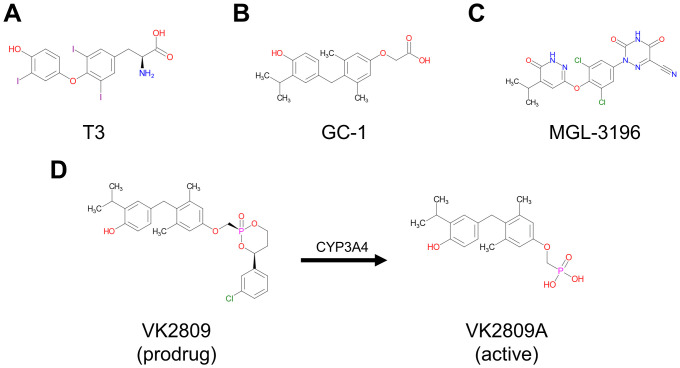
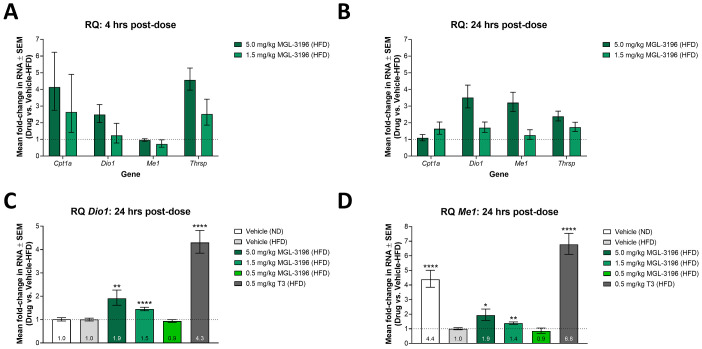
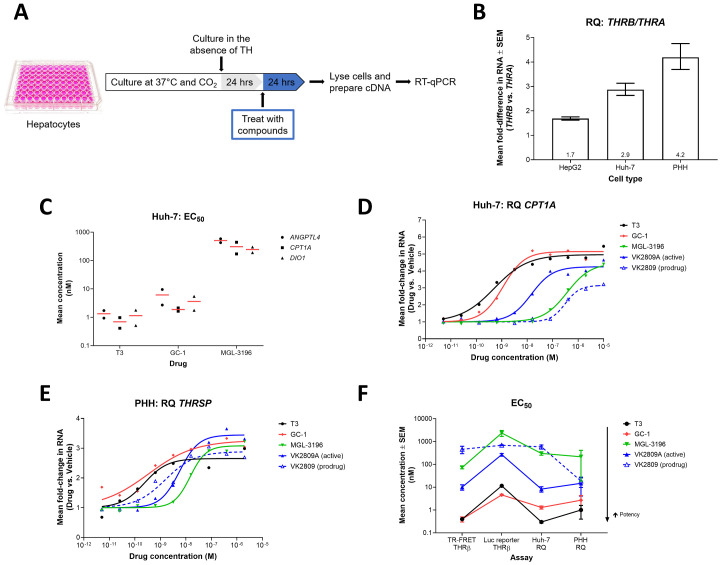
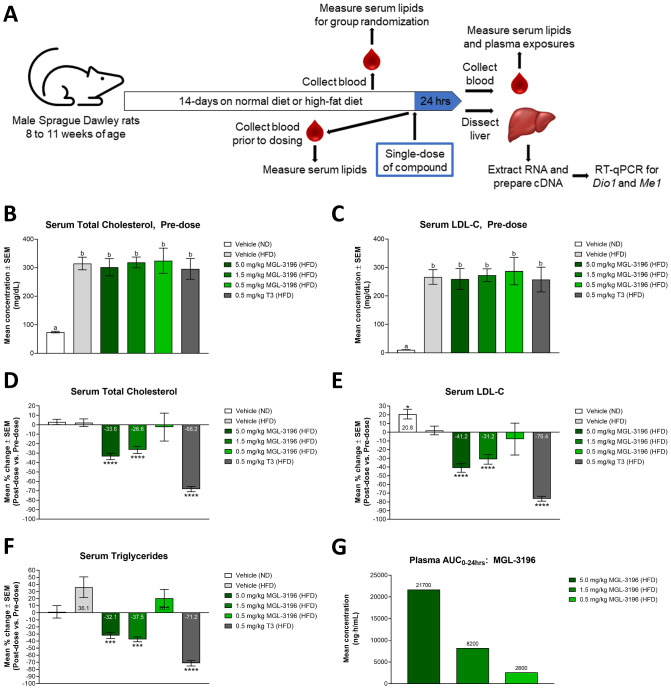
Thyroid hormones are important modulators of metabolic activity in mammals and alter cholesterol and fatty acid levels through activation of the nuclear thyroid hormone receptor (THR). Currently, there are several THRβ agonists in clinical trials for the treatment of non-alcoholic steatohepatitis (NASH) that have demonstrated the potential to reduce liver fat and restore liver function. In this study, we tested three THRβ-agonism-based NASH treatment candidates, GC-1 (sobetirome), MGL-3196 (resmetirom), and VK2809, and compared their selectivity for THRβ and their ability to modulate the expression of genes specific to cholesterol and fatty acid biosynthesis and metabolism in vitro using human hepatic cells and in vivo using a rat model. Treatment with GC-1 upregulated the transcription of CPT1A in the human hepatocyte-derived Huh-7 cell line with a dose-response comparable to that of the native THR ligand, triiodothyronine (T3). VK2809A (active parent of VK2809), MGL-3196, and VK2809 were approximately 30-fold, 1,000-fold, and 2,000-fold less potent than T3, respectively. Additionally, these relative potencies were confirmed by quantification of other direct gene targets of THR, namely, ANGPTL4 and DIO1. In primary human hepatocytes, potencies were conserved for every compound except for VK2809, which showed significantly increased potency that was comparable to that of its active counterpart, VK2809A. In high-fat diet fed rats, a single dose of T3 significantly reduced total cholesterol levels and concurrently increased liver Dio1 and Me1 RNA expression. MGL-3196 treatment resulted in concentration-dependent decreases in total and low-density lipoprotein cholesterol with corresponding increases in liver gene expression, but the compound was significantly less potent than T3. In conclusion, we have implemented a strategy to rank the efficacy of THRβ agonists by quantifying changes in the transcription of genes that lead to metabolic alterations, an effect that is directly downstream of THR binding and activation.
甲状腺激素是哺乳动物代谢活动的重要调节剂,通过激活核甲状腺激素受体(THR)来改变胆固醇和脂肪酸水平。目前,有几种 THRβ 激动剂正在进行临床试验,用于治疗非酒精性脂肪性肝炎(NASH),这些药物已被证明有潜力降低肝脂肪并恢复肝功能。在这项研究中,我们测试了三种基于 THRβ 激动剂的 NASH 治疗候选药物,GC-1(索贝替罗)、MGL-3196(雷美替罗)和 VK2809,并比较了它们对 THRβ 的选择性及其在体外使用人肝细胞和体内使用大鼠模型调节胆固醇和脂肪酸生物合成和代谢特异性基因表达的能力。GC-1 处理可上调人源性 Huh-7 肝细胞系中 CPT1A 的转录,其剂量反应与天然 THR 配体三碘甲状腺原氨酸(T3)相当。VK2809A(VK2809 的活性母体)、MGL-3196 和 VK2809 的效力分别比 T3 低约 30 倍、1000 倍和 2000 倍。此外,通过定量分析 THR 的其他直接基因靶点,即 ANGPTL4 和 DIO1,证实了这些相对效力。在原代人肝细胞中,除 VK2809 外,每种化合物的效力均保持一致,而 VK2809 则显示出显著增加的效力,与 VK2809A 相当。在高脂肪饮食喂养的大鼠中,单次给予 T3 可显著降低总胆固醇水平,同时增加肝脏 Dio1 和 Me1 RNA 表达。MGL-3196 处理导致总胆固醇和低密度脂蛋白胆固醇浓度依赖性降低,同时肝基因表达增加,但该化合物的效力明显低于 T3。总之,我们通过定量分析导致代谢改变的基因转录变化来制定 THRβ 激动剂的疗效排名策略,这是 THR 结合和激活的直接下游效应。